Key takeaways
- Length: 6 ft per cable, two cables per pack
- Connector type: 3-pin XLR male to 3-pin XLR female
- Wiring: balanced, two signal conductors plus shield
- Conductors: oxygen-free copper
- Typical use: microphones, audio interfaces, mixers, short patch runs
Best overall: the Cable Matters 2-Pack Premium XLR to XLR Cable in 6 ft. It is the cable most people should buy first, because 6 ft is the length that actually fits a mic on a desk stand or boom arm feeding an audio interface, it is built as a proper balanced two-conductor shielded cable rather than a lookalike with a single conductor and a floating shield, and it arrives as a pair so you already own a spare. If budget is the deciding factor, the VANDESAIL 3 ft 2-Pack covers short patch runs for very little money. If you are kitting out a whole room and want cables that survive years of plugging and unplugging, the Gearlux 25 ft 6-Pack is the premium pick, and the AA AUDIO ACCESSORY 10 ft cable with Neutrik REAN connectors is the smart mid-range choice when connector quality matters more than length. The twelve cables below cover everything from a 3 ft rack patch to a 50 ft run to a vocal booth, and the buying advice that follows is organised around the things that actually fail or degrade: connector quality, shield construction, conductor gauge, length and flexibility.
Top 3 Picks
Best overall: Cable Matters 2-Pack Premium XLR to XLR Cable, 6 ft. This is the default recommendation for a single-mic home setup, a two-person podcast or a small desk rig, because 6 ft is the length that fits most desktop and boom-arm positions without leaving a coil of slack, and the two-pack gives you an instant spare. It is a balanced male-to-female XLR cable with oxygen-free copper conductors and moulded strain relief, which is exactly what the job needs and nothing it does not.
Best budget: VANDESAIL XLR Cables 3 ft 2-Pack. Short cables are where budget pricing hurts least, because the electrical demands of a 3 ft run are trivial and the failure points are all in the connector. This pair covers patchbay links, rack-to-interface runs and pedalboard-adjacent gear for the price of a couple of coffees, and the oxygen-free copper construction with a noise-reducing shield is the right spec class for the money.
Best premium: Gearlux XLR Microphone Cable, Fully Balanced, 25 ft, 6-Pack. If you are supplying cables for a rehearsal room, a small venue or a four-piece band’s worth of mics, buying six long cables at once is cheaper per cable and far more useful than accumulating mismatched singles. Fully balanced construction, 25 ft of reach and a six-pack quantity make this the pick when the requirement is “cover the whole room and stop thinking about it”.
Quick Comparison
| Product | Best for | Key specs | Price tier |
|---|---|---|---|
| Cable Matters 2-Pack Premium XLR to XLR Cable | Desk and boom-arm runs, everyday spare | 6 ft; 2-pack; male-to-female 3-pin XLR; balanced; OFC conductors | Mid-range |
| GEARit 22AWG OFC XLR Cables 3FT 10-Pack | Wiring a rack, patchbay or outboard chain | 3 ft; 10-pack; 22 AWG oxygen-free copper; male-to-female | Premium |
| VANDESAIL XLR Cables 3 ft 2-Pack | Short patch runs on a tight budget | 3 ft; 2-pack; OFC conductors; noise-reduction shield | Budget |
| Amazon Basics XLR Male to Female Microphone Cable | First cable and backup duty | All-copper conductors; male-to-female; recording, studio, PA use | Budget |
| Amazon Basics XLR Microphone Cable (Low Noise) | PA and speaker-system use on a budget | All-copper conductors; low-noise construction; speaker/PA and studio use | Budget |
| AuxLink XLR Cable 25 ft 2-Pack | Stage runs and longer mic positions | 25 ft; 2-pack; male-to-female balanced | Mid-range |
| Gearlux XLR Microphone Cable 25 ft 6-Pack | Kitting out a band or rehearsal room | 25 ft; 6-pack; fully balanced; male-to-female | Premium |
| Monoprice Premier Series XLR Cable 10 ft | Heavy-gauge runs on a budget | 10 ft; 16 AWG conductors; gold-plated contacts; male-to-female | Budget |
| AA AUDIO ACCESSORY XLR Cables 10 ft | Connector quality at a mid-range price | 10 ft; Neutrik REAN connectors; dual shielded | Mid-range |
| VANDESAIL Long XLR Cables 30 ft 2-Pack | Long runs to a booth or back-line amp | 30 ft; 2-pack; OFC conductors; shielded | Mid-range |
| MIKIZ XLR Cables 50 ft 2-Pack | Very long runs and fixed installs | 50 ft; 2-pack; male-to-female balanced | Premium |
| AuxLink XLR Cables 25 ft 4-Pack | Multi-mic setups and live use | 25 ft; 4-pack; gold-plated 3-pin connectors; balanced | Premium |
How We Chose
These twelve cables were selected by comparing published specifications and stated construction rather than by ranking anything on popularity. The first filter was wiring: a cable only qualifies as a serious microphone cable if it is a balanced three-conductor arrangement — two signal conductors plus a shield tied to pin 1 — because that is what makes the differential input on a mixer or interface reject the hum and radio-frequency noise that a long run will pick up. A cable with a single conductor and a shield used as the return path is not equivalent, and several cheap lookalikes are built that way.
The second filter was the specification details a listing actually states: conductor material and gauge, shield type or coverage, contact plating, length, and pack quantity. Where a listing states 22 AWG oxygen-free copper, 16 AWG conductors or Neutrik REAN connectors, that is a verifiable claim about the product; where a listing is vague, we describe the cable by spec class instead of inventing numbers. The third filter was category fit and upgrade path — whether a given cable solves a real problem (a 3 ft rack patch, a 25 ft stage run, a 50 ft install) rather than duplicating another entry. Finally, we weighed pack economics: buying six or ten cables at once usually lowers the cost per connection substantially, and a spare cable is the cheapest insurance in audio. Nothing here is based on physical testing or ownership; it is a specification-led shortlist.
1. Cable Matters 2-Pack Premium XLR to XLR Cable – Best for desk-to-interface runs and everyday spares
As an Amazon Associate we earn from qualifying purchases at no extra cost to you.

The Cable Matters two-pack is what to buy when you want one product that solves a single-mic setup and never needs a second thought. Six feet is the sweet spot for a desktop boom arm or a mic stand beside a laptop: long enough to reach across a desk with the interface on the far side, short enough that you are not coiling slack on the floor. Buying it as a pair means the second cable lives in a drawer as a spare, which is the single most useful accessory a podcaster or home recordist can own, because the moment a cable fails mid-session you have a five-second fix instead of a lost evening.
- Length: 6 ft per cable, two cables per pack
- Connector type: 3-pin XLR male to 3-pin XLR female
- Wiring: balanced, two signal conductors plus shield
- Conductors: oxygen-free copper
- Typical use: microphones, audio interfaces, mixers, short patch runs
The strengths here are the ones that matter at this length. Balanced wiring means the cable is not the weak link when you plug a dynamic or condenser mic into an interface, and it will pass 48 V phantom power without complaint. The connectors are the standard three-pin XLR with a proper latch, so the cable stays seated when someone walks past the desk and catches it with a sleeve — a failure mode that costs more studio time than any electrical problem. Moulded strain relief at both ends spreads bending force away from the solder joints, which is where cheap cables die first. Six feet also keeps capacitance low, so there is no realistic high-frequency loss even with a condenser microphone’s lower output impedance.
Pros
- Two cables for the price of roughly one premium single, so a spare is built into the purchase
- 6 ft is the most useful length for desktop, boom-arm and small-desk setups
- Balanced wiring handles phantom power and rejects interference properly
- Oxygen-free copper conductors and moulded strain relief at both ends
- Short run means negligible capacitance and no measurable high-frequency roll-off
Cons
- 6 ft is too short for a floor stand across a room, a vocal booth or any stage use
- Moulded connectors cannot be repaired or re-terminated; a failed cable becomes waste
- No stated shield coverage figure, so it sits in the standard class rather than the premium one
Compared with the nearest alternatives in this list, the choice comes down to length and connector ambition. The VANDESAIL 3 ft 2-Pack does the same job for less money but only if your gear is stacked within arm’s reach — on a desk with a separate interface and a monitor controller, 3 ft runs out fast. The AA AUDIO ACCESSORY 10 ft cable is the upgrade path: it costs more, gives you four extra feet and uses Neutrik REAN connectors, which are a recognised brand part rather than a generic moulded plug. If you want one cable to cover a desktop mic and you value having a spare immediately, the Cable Matters pair is the sensible default. If you plan to add a second mic position or a booth later, buy the AA AUDIO ACCESSORY cable instead and treat the extra length as headroom.
2. GEARit 22AWG OFC XLR Cables 3 ft 10-Pack – Best for wiring a whole studio rack at once

Ten short cables is a strange thing to buy until you own a rack. The moment you have an interface, a preamp, a compressor, an EQ and a patchbay, you need a matched set of short interconnects and you need them all at once, because a rack half-wired with mismatched lengths looks and behaves like a mess. The GEARit 10-pack solves that in one purchase: 3 ft is the right length for unit-to-unit runs inside a rack, 22 AWG oxygen-free copper is a sensible conductor spec for the job, and buying ten at once is far cheaper per cable than buying singles.
- Length: 3 ft per cable, ten cables per pack
- Conductor: 22 AWG oxygen-free copper
- Connector type: 3-pin XLR male to 3-pin XLR female
- Wiring: balanced, suitable for line-level and microphone signals
- Typical use: patchbays, outboard gear, rack interconnects, studio recording
22 AWG is the standard conductor gauge for microphone and line cable, and it is the right choice here for a specific reason: it is thin enough to stay flexible and to fit a normal XLR barrel, while still being mechanically robust enough to survive being pulled out of a patchbay hundreds of times. Heavier gauges look impressive on a spec sheet, but inside a rack you want cables that bend without fighting back, because a stiff cable puts constant leverage on the connector and the socket behind it. Oxygen-free copper is a genuine material claim, not marketing decoration: it is drawn from higher-purity stock, which reduces the chance of oxidation-related degradation over years of service, and it solders predictably, which matters if you ever re-terminate a broken end.
Pros
- Ten cables in one purchase at a far lower cost per cable than buying individually
- 3 ft is the ideal length for rack unit to rack unit and patchbay to interface runs
- 22 AWG oxygen-free copper is the correct conductor spec for the application
- Having spares on hand means a dead cable never stops a session
- Matched lengths make a rack easier to route, label and troubleshoot
Cons
- 3 ft is useless for anything except short rack and desk runs
- Premium tier pricing means a higher upfront outlay than buying two cables at a time
- Ten cables is more than a simple two-piece home setup will ever use
The nearest alternative is the VANDESAIL 3 ft 2-Pack, and the comparison is purely about quantity. If you own two pieces of gear, the VANDESAIL pair is the sensible buy and the GEARit pack is overkill. If you own a rack, the maths flips hard: buying ten singles costs several times what the pack does, and you will still end up short when one fails. The other relevant comparison is the Monoprice 16 AWG 10 ft cable, which is heavier gauge but four times the length and far stiffer. Inside a rack, heavy gauge and extra length are both liabilities. Buy the GEARit pack if you are wiring a fixed installation; buy the Cable Matters 6 ft pair if your gear lives on a desk.
3. VANDESAIL XLR Cables 3 ft 2-Pack – Best for short patch runs on a tight budget

The VANDESAIL 3 ft two-pack is the cheapest sensible way to connect two pieces of gear that sit within arm’s reach of each other. That covers more situations than people expect: a desktop interface feeding a small mixer, a rack unit linked to the one below it, a headphone amp fed from a monitor controller, or a spare pair to keep in a gig bag. Short runs are the least electrically demanding application in audio, which is exactly why budget cables work well here — you are not asking the cable to carry a low-level signal fifty feet through a room full of lighting dimmers.
- Length: 3 ft per cable, two cables per pack
- Conductor: oxygen-free copper
- Shielding: noise-reduction shield over the signal conductors
- Connector type: 3-pin XLR male to 3-pin XLR female
- Typical use: short microphone and line-level patch runs
The strengths are straightforward. Oxygen-free copper conductors and a shielded, balanced construction put this cable in the correct spec class rather than the “single conductor plus return” class that some very cheap cables occupy. At 3 ft, the total conductor resistance is a fraction of an ohm and cable capacitance is measured in the low hundreds of picofarads, so there is no realistic signal degradation to worry about. The short length also means the cable is less likely to be walked on, kinked or coiled tightly, and those three things are what actually kill cables. Two cables in the pack means you can wire a stereo or dual-mono pair and still have a matched set.
Pros
- Very low cost for a pair, making it the cheapest way to fill short-run gaps
- Balanced, shielded construction with oxygen-free copper conductors
- 3 ft keeps resistance and capacitance negligible
- Short cables take far less physical abuse than long ones
- Useful as a permanent spare pair in a gig bag or drawer
Cons
- 3 ft is genuinely limiting; it will not reach a floor stand or a booth
- Moulded connectors mean no repair path if an end fails
- No published shield coverage or connector mating-cycle figures
Against the Cable Matters 6 ft pair, the trade is simple: you save money and lose three feet and some strain-relief quality. If your gear is stacked, that trade is free money. If your microphone sits on a stand while your interface sits on a shelf, 3 ft will leave you pulling gear off the shelf to make it reach, which is worse than paying more for the longer cable. Against the GEARit 10-pack, the VANDESAIL pair is the right answer for someone with two or three pieces of gear rather than a full rack. The honest summary is that this is a filler cable, not a foundation cable: buy it to connect things that are already close together, and buy something longer for the microphone itself.
4. Amazon Basics XLR Male to Female Microphone Cable – Best for a first cable and backup duty

The Amazon Basics male-to-female XLR cable is the cable you buy when you have just unboxed your first interface and you need something that works tonight without research. It is aimed at recording studios, PA systems and speaker setups, uses all-copper conductors, and is priced low enough that buying a second one as a backup is not a decision worth agonising over. It is a general-purpose cable rather than a specialist one, and for most beginners that is exactly the right trade.
- Connector type: 3-pin XLR male to 3-pin XLR female
- Conductors: all-copper construction
- Wiring: balanced microphone cable
- Intended use: recording studio, PA system, speaker system
- Typical role: first cable, backup cable, spare for a gig bag
Its main strength is availability and price predictability. This is a cable that exists in multiple lengths, so you can standardise on one product line and buy the length you need for each position rather than mixing brands and hoping the connectors match. All-copper conductors are the baseline requirement for a real microphone cable, and the balanced three-pin configuration means it will pass phantom power to a condenser microphone and reject common-mode noise the way a balanced input expects. The connectors are the standard latch type, so the cable stays put under normal handling.
Pros
- Low price makes it easy to buy two and keep one as a spare
- Balanced male-to-female XLR wiring suitable for microphones and line signals
- All-copper conductors meet the baseline requirement for a real mic cable
- Widely available in several lengths, so you can standardise on one line
- Simple, no-frills build with nothing to configure or get wrong
Cons
- No published conductor gauge or shield coverage figure
- Moulded ends cannot be re-terminated if a connector fails
- Construction sits at the entry level, so it is not the pick for heavy touring use
This cable and the Amazon Basics low-noise variant are siblings, and the difference between them is mostly which listing you land on rather than any dramatic engineering gap; both are all-copper balanced cables aimed at the same broad set of uses. Against the VANDESAIL 3 ft pair, this one wins on length flexibility and loses on price per cable. Against the Cable Matters 6 ft pair, it is the cheaper option with less stated construction detail. The sensible way to use it is as the cable that gets you running and as the spare that lives in the bag, while your main microphone cable is a longer, better-documented one.
5. Amazon Basics XLR Microphone Cable for Speaker or PA System – Best for PA and speaker-system use on a budget
This Amazon Basics cable is the PA-oriented sibling in the same family, described for speaker or PA systems, recording studios and low-noise operation with all-copper conductors. It is the cable to reach for when the job is a small PA, a powered speaker, a mixer-to-amp link or a house-of-worship setup where cables get plugged in and unplugged by different people every week and need to be cheap enough to replace without a committee meeting.
- Connector type: 3-pin XLR male to 3-pin XLR female
- Conductors: all-copper construction
- Design emphasis: low-noise signal transfer
- Intended use: PA systems, speaker systems, recording studio
- Typical role: general-purpose line and microphone connection
The practical strength is that low-noise construction and all-copper conductors are the two things that matter most in a noisy venue. PA systems share space with lighting rigs, power amps, laptop chargers and long mains runs, and a cable that is properly shielded and balanced will keep that hash out of the signal. The three-pin XLR latch means the connector will not work loose when a speaker stack vibrates or when a cable is draped across a stage edge. It is also a genuinely cheap way to standardise: if you are equipping a small venue or a rehearsal room with a dozen cables, buying a consistent model means every cable behaves the same way and swapping them around is painless.
Pros
- Low price makes it practical to buy several and keep spares on site
- All-copper conductors and balanced XLR wiring
- Described for PA and speaker-system duty, where noise rejection matters
- Latching connectors resist vibration-induced disconnection
- Consistent model makes a venue’s cable stock easy to manage
Cons
- No published gauge, shield type or coverage figure
- Moulded connectors cannot be repaired
- Not positioned as a premium or install-grade cable, so it is not the pick for permanent runs
The nearest alternative is the other Amazon Basics cable in this list, and the honest answer is that they are close enough that you should choose on length and price rather than on the listing copy. If you need to compare against something meaningfully different, look at the AuxLink 25 ft pair: it costs more but gives you the reach that a PA setup usually needs, since a 3 ft or 6 ft cable rarely spans from a mixer to a powered speaker across a stage. Buy the Amazon Basics cable when the run is short, the budget is tight and the cable will be handled by lots of people. Buy the AuxLink pair when the run is long.
6. AuxLink XLR Cable 25 ft 2-Pack – Best for stage runs and longer mic positions
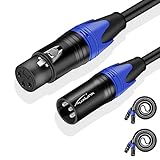
Twenty-five feet is the length at which cable choice starts to matter. It is the typical distance from a stage mic position to a mixer at the side of the room, from a vocal booth to a control room desk, or from a drum kit to an interface on the far side of a home studio. The AuxLink 25 ft two-pack covers that class of job at a mid-range price, and buying two at once means you can run a stereo pair or keep a spare without a second order.
- Length: 25 ft per cable, two cables per pack
- Connector type: 3-pin XLR male to 3-pin XLR female
- Wiring: balanced microphone cable
- Typical use: stage runs, booth-to-desk runs, floor stands, drum positions
- Pack role: matched pair for stereo or dual-mono use
At 25 ft the balanced construction earns its keep. A run of this length crosses more electromagnetic real estate than a desk cable, so the shield and the differential pair are doing real work keeping lighting noise, laptop chargers and mains hum out of the signal. Cable capacitance at 25 ft is still comfortably low, so there is no meaningful high-frequency roll-off even with a condenser microphone’s lower output impedance. The two-pack format is the practical strength: matching lengths make it easy to run a stereo pair cleanly along the same path, and having two identical cables means troubleshooting is a matter of swapping rather than hunting for a substitute of unknown quality.
Pros
- 25 ft reaches most stage, booth and floor-stand positions
- Balanced wiring keeps interference out of a longer run
- Two matched cables support stereo pairs or a main-plus-spare setup
- Mid-range pricing sits between cheap short cables and premium install stock
- Capacitance at this length remains too low to affect audible high frequencies
Cons
- No published gauge, shield coverage or contact plating details
- 25 ft is awkward to manage on a small desk; you will be coiling slack
- Not a heavy-duty install cable, so permanent conduit runs deserve something more rugged
The closest competitor is the Gearlux 25 ft 6-Pack, which offers the same length at a higher tier with six cables instead of two. If you need one or two runs, the AuxLink pair is the better value; if you need to cover a whole band, the Gearlux pack wins on per-cable cost. Against the VANDESAIL 30 ft pair, the trade is five feet of extra reach for a modest price step, and if your booth or back-line amp sits at the far end of a room, those five feet are worth having. Buy the AuxLink pair when 25 ft is genuinely enough and you want a spare in the bag.
7. Gearlux XLR Microphone Cable, 25 ft 6-Pack – Best for kitting out a full band or rehearsal room

The Gearlux six-pack is a supply decision rather than a cable decision. If you run a rehearsal room, a small venue, a school music department or a four-piece band’s PA, you do not need one good cable — you need six that all behave the same way, are long enough to reach any position in the room, and can be replaced without a search. Twenty-five feet covers mic stands, back-line amps and floor monitors, and fully balanced construction means the cables are electrically appropriate for every one of those jobs.
- Length: 25 ft per cable, six cables per pack
- Connector type: 3-pin XLR male to 3-pin XLR female
- Wiring: fully balanced
- Typical use: multi-mic stage setups, rehearsal rooms, small venues, houses of worship
- Pack role: standardised cable stock for a shared space
The strength is standardisation. When every cable in a room is the same model and length, fault-finding becomes trivial: swap the cable, and if the problem moves, you have your answer. Mixed cable stock of unknown provenance is the single biggest time sink in a shared rehearsal space, because nobody knows which of the tangled cables is the one that crackles. Fully balanced construction means the cables are suitable for both microphone-level and line-level signals, so the same box of cables covers vocal mics, DI boxes, keyboards and mixer-to-amp links. Twenty-five feet is also long enough to route around the edge of a room rather than straight across the middle, which reduces both trip hazards and physical wear.
Pros
- Six matched 25 ft cables standardise a whole room’s cable stock
- Fully balanced construction suits microphone and line-level use alike
- Long enough to route around a room rather than across it
- Premium tier pricing is justified by per-cable cost when bought in a pack
- Replacing a failed cable is a matter of pulling an identical spare from the box
Cons
- High upfront cost compared with buying two cables at a time
- 25 ft is excessive for desk and rack use, leaving awkward slack
- No published gauge or shield coverage figures in the listing
Against the AuxLink 25 ft two-pack, this is the same length at a higher price tier with three times the quantity — the per-cable cost favours Gearlux, but only if you genuinely need six. Against the AuxLink 25 ft four-pack, the gap narrows: four cables covers a typical four-mic drum or vocal setup, and two spare is a reasonable stock level. Choose the six-pack if you are responsible for a shared space where cables vanish; choose the four-pack if you are equipping one band that keeps its own gear together. Either way, resist the temptation to mix lengths in the same room, because matched stock is what makes troubleshooting fast.
8. Monoprice Premier Series XLR Cable, 16 AWG, 10 ft – Best for heavy-gauge runs on a budget

The Monoprice Premier Series cable stands out in this list for one stated number: 16 AWG conductors. That is substantially heavier copper than the 22 AWG that most microphone cables use, and it comes with gold-plated contacts at a budget price tier. It is aimed at people who read spec sheets and want the heaviest conductor they can get without paying premium prices, and it is a genuinely interesting choice for fixed runs where the cable will not be moved.
- Length: 10 ft
- Conductor: 16 AWG
- Contacts: gold-plated
- Connector type: 3-pin XLR male to 3-pin XLR female
- Typical use: studio and stage runs where durability and low resistance are priorities
Heavier gauge does three real things. It lowers conductor resistance, which matters mainly on long runs and with low-impedance dynamic microphones; it makes the cable physically tougher, so it survives being dragged across a floor; and it holds a connector crimp or solder joint more securely because there is more copper to work with. Gold-plated contacts are the second genuine feature: gold does not tarnish the way bare nickel or brass does, so the contact resistance stays stable over years of use, which is worth having in humid rooms or on gear that is plugged in and left alone.
Pros
- 16 AWG conductors are considerably heavier than the category norm
- Gold-plated contacts resist oxidation and keep contact resistance stable
- Budget pricing for a spec that usually costs more
- 10 ft is a flexible middle length for desk and short stage runs
- Physically robust cable that tolerates being moved and dragged
Cons
- Heavier gauge means a stiffer cable with a larger minimum bend radius
- Stiffness puts more leverage on connectors and sockets in tight spaces
- Only one cable per purchase, so covering a multi-mic setup gets expensive
The comparison that matters is against the GEARit 22 AWG pack. GEARit gives you thin, flexible, rack-friendly cables in quantity; Monoprice gives you one heavy, stiff cable with gold contacts. For a rack, the GEARit pack is clearly better, because a stiff 16 AWG cable fighting for space behind a patchbay is a liability. For a fixed run between a wall panel and a desk, or for a cable that lives on a stage floor and gets walked near, the Monoprice cable’s extra copper is a real advantage. It is also the pick if you specifically want gold-plated contacts without moving up to a premium tier. Buy it as a durable single, not as your whole cable inventory.
9. AA AUDIO ACCESSORY XLR Cables 10 ft, Neutrik REAN Connectors – Best for connector quality on a mid-range budget

Connectors are where cables fail, and this is the cable in this list that addresses that directly. It uses Neutrik REAN connectors — Neutrik is the best-known name in audio connectors, and REAN is its value line — combined with dual shielding, in a 10 ft length at a mid-range price. If you have ever had a cable die because the moulded plug cracked or the latch stopped holding, this is the specification class that solves that problem.
- Length: 10 ft
- Connectors: Neutrik REAN, 3-pin XLR male to female
- Shielding: dual shielded
- Wiring: balanced
- Typical use: microphone and line-level connections where connector reliability matters
Dual shielding is the second meaningful feature. A dual-shielded cable typically combines a foil layer for full coverage with a braided or spiral layer for mechanical strength and flexibility, which gives you both high coverage against radio-frequency interference and a shield that survives being flexed repeatedly. That matters in rooms with dimmers, fluorescent fixtures, wireless routers and long mains runs. Neutrik REAN connectors bring a recognised design with a proper chuck-style strain relief that grips the cable jacket rather than relying on the solder joints to hold everything together. In practice that means the failure point moves from the connector to nowhere, because the jacket takes the load.
Pros
- Neutrik REAN connectors from a recognised connector manufacturer
- Dual shielding combines high coverage with a durable, flexible shield
- Strain relief grips the jacket, protecting the solder joints
- 10 ft is a versatile length for desks, booths and short stage runs
- Mid-range pricing for a connector specification that usually costs more
Cons
- More expensive than generic moulded cables of the same length
- Only one cable per purchase, so multi-mic setups add up quickly
- 10 ft is still too short for a full stage or a distant booth
Against the Cable Matters 6 ft pair, this is the upgrade: you pay more per cable, but you get four extra feet and connectors from a brand that publishes specifications. Against the Gearlux 25 ft six-pack, the comparison is quality versus quantity — Gearlux covers a room, while this cable gives you one connection you can trust. The best use of this cable is at the point in your signal chain where reliability matters most: the microphone itself, or the interface input, or any position where a cable failure ruins a take. Buy it for those positions and use cheaper cables for the short, static runs where nothing is being plugged and unplugged.
10. VANDESAIL Long XLR Cables 30 ft 2-Pack – Best for long runs to a booth or back-line amp

Thirty feet is the length that solves the awkward middle distance: a vocal booth at the end of a room, a guitar amp in a separate space, a drum kit in a corner while the interface sits on a desk. The VANDESAIL 30 ft two-pack covers that distance with oxygen-free copper conductors and a shielded, balanced construction at a mid-range price, and the pair format means you can run two mics into a booth or keep one as a spare.
- Length: 30 ft per cable, two cables per pack
- Conductor: oxygen-free copper
- Shielding: shielded, balanced construction
- Connector type: 3-pin XLR male to 3-pin XLR female
- Typical use: booth-to-desk runs, back-line amps, drum rooms, separated tracking spaces
The strength is the length itself, combined with the fact that the cable is still built to the correct electrical spec. At 30 ft, capacitance is roughly 750 to 1,200 picofarads depending on the cable’s per-foot figure, which is far too small to affect the audible band when driven by a microphone’s low source impedance. The shield and balanced pair keep longer runs quiet in rooms with mixed mains wiring, which is the whole point of using balanced cable for a separated tracking space. The two-pack also means you can run a stereo pair along the same route, which is useful for overheads, room mics or a stereo DI setup.
Pros