
Key takeaways
- Motor: 1/3 HP, induction type, roughly 1,725 RPM class
- Feed type: continuous feed
- Grinding chamber: galvanized steel class
- Grind stages: single-stage
- Mount: InSinkErator’s proprietary sink flange and mount assembly
- Power: corded, plugs into a switched outlet under the sink
- Warranty: the shortest tier in this list — verify current terms before purchase
- Typical body weight: approximately 8–10 lb class, among the lightest here
The best under-sink garbage disposal for heavy bones is the Moen Chef Series 1 HP continuous-feed model. A full 1 HP motor, stainless-steel grinding components, and a sound-reduced housing put it in the class that actually takes chicken, fish, and small pork bones without stalling — and it suits households that roast whole birds, simmer stock, and cook with bones several times a week. If you want the most RPM per dollar, the VEVOR 1 HP 3700 RPM unit is the aggressive alternative, and if money is tight and bones are occasional, the Waste King L-111 is the budget entry point. One honest caveat before anything else: no residential disposer is engineered to eat large beef, pork, or knuckle bones, and any listing that implies otherwise is overselling. The real buying question is which combination of horsepower, motor torque, grinding chamber material, and jam resistance keeps working after a few hundred bone sessions — that is what this guide compares, product by product, with the numbers attached.
Top 3 Picks
Best overall: Moen Chef Series 1 HP Continuous Feed
The Chef Series is the pick for anyone whose sink regularly sees bones, because 1 HP of motor and stainless-steel grinding components give it the torque headroom that 1/3 HP and 1/2 HP units simply do not have. The sound-reduction housing and lighted design matter more than they sound like they do — a powerful disposer that rattles the cabinet gets used less, and a unit that gets used less clogs more. It also carries the longest warranty tier in this list.
Best budget: Waste King L-111
At the budget tier, the L-111 is the sensible bone-duty compromise: a compact 1/3 HP continuous-feed body with stainless-steel swivel impellers that resist corrosion better than plain steel ones, and a small footprint that fits shallow cabinets. It handles chicken and fish bones in small batches; it is not a machine for a Sunday roast carcass, and buying it expecting that is how people end up replacing disposers every two years.
Best for maximum throughput: VEVOR 1 HP 3700 RPM
The VEVOR is the spec-sheet standout — 1 HP and 3,700 RPM from a DC motor, which is a notably higher spindle speed than the roughly 1,725–2,800 RPM class most AC disposers run at. Higher RPM means more cutting events per second, which helps with both bone grit and fibrous waste, at the cost of more noise and more electronics inside the housing.
Quick Comparison
Every product covered below, sorted by what it is actually for. Prices are given as tiers rather than figures because they move constantly; check current listings before you commit.
| Product | Best for | Key specs | Price tier |
|---|---|---|---|
| Moen Chef Series 1 HP | Heavy bone loads in busy kitchens | 1 HP, continuous feed, stainless-steel grinding components, sound-reduction housing, LED light, corded, 3-bolt style mount | Premium |
| VEVOR 1 HP 3700 RPM | Maximum RPM, bones plus fibrous waste | 1 HP DC motor, 3,700 RPM, continuous feed, 3-bolt mount | Mid-range |
| Frigidaire FF05DISPC1 | 1/2 HP value for small households | 1/2 HP, continuous feed, corded, compact body, 3-bolt style mount | Mid-range |
| Moen Prep Series GXP50C | Occasional bones in a mid-size kitchen | 1/2 HP, continuous feed, corded, compact body, high-RPM class | Mid-range |
| Waste King L-111 | Tight budgets, light bone duty | 1/3 HP, continuous feed, corded, compact body, stainless-steel swivel impellers | Budget |
| InSinkErator Badger 1 | Brand-name parts availability, small kitchens | 1/3 HP, continuous feed, corded, galvanized-steel grind chamber class, induction motor | Premium |
| Antrader Garbage Disposal Support | Holding a heavy disposer during install | Adjustable 18–27 cm (7.09″–10.63″) jack, 1 piece, metal | Budget |
| CLEESINK Splash Guard Collar | Replacing a worn or torn sink baffle | 3-1/8 inch opening, multi-function rubber baffle, drop-in replacement | Budget |
How We Chose
This roundup is built from published manufacturer specifications, brand documentation, and the recurring failure patterns owners describe in long-term use, not from any physical evaluation of the units. We ranked candidates on four things. First, raw capability for the stated job: horsepower, motor type, spindle speed, grind chamber material, and the number of grinding stages, because bone is a density problem and density is solved with torque and hardened cutting surfaces. Second, category fit — a disposer, an installation jack, and a splash guard are not competing products, so each was judged against others of its own type rather than against each other. Third, use-case match: a 1/3 HP compact unit is a genuinely good answer for a two-person apartment and a genuinely bad one for a family that roasts weekly, and the guide says so instead of flattening everything into a single ranking. Fourth, upgrade path: whether the unit can be swapped later without changing the sink flange, whether parts are available, and whether the motor class supports the heavier loads a household tends to take on after the first year. Where a manufacturer does not publish a figure consistently, we describe the specification by class rather than inventing a precise number.
1. InSinkErator Badger 1 – Best for Brand Reliability in Small Kitchens
As an Amazon Associate we earn from qualifying purchases at no extra cost to you.

The Badger 1 is the entry point into the InSinkErator ecosystem: a Standard Series, 1/3 HP, continuous-feed disposer that ships with a power cord and is aimed at light-to-moderate kitchen duty. It suits renters, small households, and anyone replacing a failed builder-grade unit who wants a recognizable name and easy access to mounting hardware and service parts. If your bone exposure is limited to the occasional chicken thigh bone, it will do the job. If you are buying specifically because you want to grind bones regularly, this is the wrong horsepower class, and no amount of brand reputation changes the physics.
Key specs
- Motor: 1/3 HP, induction type, roughly 1,725 RPM class
- Feed type: continuous feed
- Grinding chamber: galvanized steel class
- Grind stages: single-stage
- Mount: InSinkErator’s proprietary sink flange and mount assembly
- Power: corded, plugs into a switched outlet under the sink
- Warranty: the shortest tier in this list — verify current terms before purchase
- Typical body weight: approximately 8–10 lb class, among the lightest here
What the Badger 1 does well is simplicity. The induction motor is a genuinely durable design — no brushes, fewer electronics, and a stall characteristic that tends to trip the overload protector rather than destroy the windings. The continuous-feed design means you can add waste while it runs, which is convenient for scraping plates. And because InSinkErator is the largest name in the category, replacement splash guards, flanges, and mounting gaskets are everywhere, which matters more than most buyers expect: the mount assembly and the rubber baffle are the parts that fail first on any disposer, not the motor.
For bone work, the limitation is torque at the spindle. A 1/3 HP motor grinding a chicken bone produces a sharp torque spike; the unit either powers through it or trips the thermal overload and shuts down for several minutes. Do that repeatedly with denser bones — pork chop ends, lamb, larger poultry joints — and you are asking an entry-level motor to do a 1 HP job. The galvanized steel grind chamber is the second constraint. Galvanized surfaces are coated rather than solid corrosion-resistant alloy, and bone produces mildly acidic, gritty slurry; over years, that combination is what turns a chamber rough and noisy rather than smooth and quiet.
Pros
- Simple, brushless induction motor with a long-established reliability record
- Widely available mounting hardware, baffles, and service parts
- Light body weight makes installation and removal straightforward
- Continuous feed lets you add waste while running
- Compact enough for shallow cabinets and small sinks
Cons
- 1/3 HP is underpowered for anything beyond occasional small bones
- Galvanized steel chamber class corrodes and roughens faster than stainless
- Single-stage grinding leaves coarser particles, which is harder on drain lines
- Shortest warranty tier in this comparison
- Proprietary mount means switching to another brand later requires a flange change
Compared with the Waste King L-111, the nearest alternative at this power level, the Badger 1 trades a slightly lower price tier for stainless-steel swivel impellers and a more compact body. If bones are the reason you are shopping at all, the honest move is to skip both and step up to the Moen Prep GXP50C or the Frigidaire FF05DISPC1 at 1/2 HP, where the torque margin starts to exist. Buy the Badger 1 when reliability and part availability matter more than grinding muscle.
2. Waste King L-111 – Best Budget Pick for Light Bone Duty

The Waste King L-111 is a compact, corded, continuous-feed disposer at the 1/3 HP level, and it is the unit to buy when the budget is fixed and the bone load is modest. It fits apartments, small condos, and secondary sinks where the disposer is a convenience rather than a workhorse. Its compact body is a real advantage in shallow base cabinets, where a full-height 1 HP unit can crowd the P-trap and make the whole under-sink area miserable to work in.
Key specs
- Motor: 1/3 HP class, high-speed permanent-magnet type, roughly 1,900 RPM class
- Feed type: continuous feed
- Grinding components: stainless-steel swivel impellers
- Grind stages: single-stage
- Mount: 3-bolt style flange assembly
- Power: corded, switched outlet
- Body: compact, among the smallest footprints in this list
- Warranty: budget-tier coverage — confirm current terms
The interesting engineering detail here is the motor type. Permanent-magnet motors of this class spin faster than comparable induction motors and deliver strong starting torque, which is why budget disposers can sound aggressive and chew through soft waste quickly. The trade-off is heat: these motors run hotter under sustained load and depend more heavily on the thermal overload protector to survive abuse. In practice, that means the L-111 handles a handful of chicken bones well and handles a continuous stream of dense bones poorly — not because it lacks cutting edges, but because the duty cycle catches up with it.
The stainless-steel swivel impellers are a meaningful spec at this price. Impellers are the parts that strike the waste, and stainless resists the pitting that bone grit and food acids cause on plated or plain steel. That is a durability feature, not a marketing one, and it is one of the reasons this unit is a better bone-duty buy than a generic 1/3 HP disposer with plated components.
What it will not do is forgive bad habits. Feed bones one or two at a time with cold water running at full flow, let the unit clear completely between handfuls, and never chase a jam by running it longer — that is how a budget motor turns a two-minute annoyance into a replacement purchase. Fibrous waste is a separate problem: celery strings, corn husks, and artichoke leaves wrap around impellers on any disposer, and a single-stage 1/3 HP unit has the least ability to slice them free.
Pros
- Lowest-cost way into stainless-steel grinding components
- High-speed permanent-magnet motor clears soft waste quickly
- Compact body fits shallow cabinets and small sinks
- Continuous feed for plate-scraping convenience
- Simple mechanical design with few electronics to fail
Cons
- 1/3 HP class overheats under sustained bone loads
- Single-stage grind produces coarser effluent
- No meaningful sound insulation — noticeably loud
- Shorter warranty tier than mid-range and premium units
- Not a solution for weekly roasts or stock-making households
Against the InSinkErator Badger 1, the L-111 wins on stainless impellers and cabinet footprint, and loses on parts ubiquity and induction-motor smoothness. Against the Frigidaire FF05DISPC1, it loses outright on capability: the Frigidaire’s 1/2 HP class gives a torque margin that this unit simply does not have. Choose the L-111 if the budget is the constraint and your bone load is genuinely occasional. If you already know you grind bones a few times a week, the extra spend on 1/2 HP is the cheaper decision over five years.
3. Moen Prep Series GXP50C – Best Mid-Range for Occasional Bones

The Moen Prep Series GXP50C is a compact, corded, continuous-feed disposer in the 1/2 HP class, and it is the sweet spot for a household that cooks with bones a few times a week but does not want to rebuild its under-sink plumbing to accommodate a full-size 1 HP body. It suits mid-size kitchens, families of three to four, and anyone replacing a failed unit who wants a straightforward swap with a recognizable brand behind it.
Key specs
- Motor: 1/2 HP class, high-RPM design (roughly 2,600 RPM class in this tier)
- Feed type: continuous feed
- Grinding components: stainless-steel class grind ring and impellers
- Grind stages: single-stage, tuned for finer particles than entry units
- Mount: 3-bolt style flange assembly
- Power: corded, ships ready to plug into a switched outlet
- Body: compact profile, shorter than full-size premium units
- Warranty: mid-tier coverage, longer than entry-level disposers
The step from 1/3 HP to 1/2 HP sounds small on paper and feels large in the sink. Torque scales roughly with motor rating, and bone grinding is a torque problem: the difference between stalling on a chicken bone and powering through it is usually a matter of a few tenths of a horsepower. The higher spindle speed in this class also means more cutting events per second, so particles exit finer, which is easier on older drain lines and reduces the grit that settles in the P-trap.
Stainless-steel grinding components matter more here than at the budget tier, because this is the class where people actually put bones through the machine regularly. Stainless resists pitting, keeps its edge longer, and does not shed coating into the slurry. The compact body is the other practical advantage: it leaves more room for the drain assembly, which makes future maintenance — replacing the baffle, clearing the trap, tightening the flange — dramatically less unpleasant.
Where this unit stops is heavy or continuous bone work. A single 1/2 HP machine asked to process the carcass of a whole roasted chicken in one session will do it, slowly, with the overload protector as a backstop. Two such sessions back to back in the same evening is where owners report shutdowns and reheating delays. That is not a defect; it is what the class is rated for. If your pattern is “big roast on Sunday, stock on Monday,” budget for 1 HP instead.
Pros
- 1/2 HP gives a genuine torque margin over entry-level disposers
- Stainless-steel grinding components resist bone grit and acids
- Compact body leaves room for the P-trap and future service work
- Higher-RPM class produces finer effluent than 1/3 HP units
- Longer warranty tier than budget disposers
Cons
- Still not rated for large or dense bones in volume
- Single-stage grinding, so fibrous waste can wrap the impellers
- Modest sound insulation compared with premium sound-reduced models
- 3-bolt mount means a flange change if you switch brands later
- Compact body trades grind chamber volume for cabinet clearance
Compared with the Frigidaire FF05DISPC1, the two are close on capability — both sit in the 1/2 HP class — but the Moen leans toward a compact, service-friendly installation while the Frigidaire leans toward straightforward value. Compared with the Moen Chef Series 1 HP, this unit is the sensible stopping point if you grind bones occasionally, and the wrong stopping point if you grind them constantly. Match it to frequency, not to ambition.
4. Antrader Garbage Disposal Support – Best Install Aid for Heavy 1 HP Units

The Antrader Garbage Disposal Support is a single-piece adjustable jack that spans roughly 18–27 cm (about 7.09″ to 10.63″), and it solves a problem that anyone who has installed a 1 HP disposer alone will recognize immediately: holding a 16–20 lb unit overhead, aligning the mount collar, and turning the locking ring at the same time. It suits do-it-yourself installers, anyone swapping a disposer solo, and households replacing a lightweight 1/3 HP unit with a substantially heavier 1 HP model.
Key specs
- Type: adjustable support jack for under-sink installation
- Adjustable range: approximately 18–27 cm (7.09″–10.63″)
- Quantity: 1 piece
- Material: metal construction class
- Function: props and holds the disposer at height while the mount is engaged
- Compatibility: sized for typical base-cabinet clearance under a kitchen sink
Why this matters more than it looks: the physically hardest part of a disposer install is not the plumbing or the wiring — it is the thirty seconds where the unit must be held perfectly level and pressed upward against the sink flange while the mounting ring is rotated into place. A 1/3 HP disposer weighs in the 8–10 lb range and can be muscled through it. A 1 HP unit in the 16–20 lb range, hanging at chest height in a cramped cabinet, is where people drop the disposer, cross-thread the flange, or strain a wrist. A support jack turns a two-person job into a one-person job.
It is also useful for diagnosis and maintenance. If you suspect a leak at the flange gasket, or you need to reseat the baffle, the ability to support the unit’s weight while you work on the connection is the difference between a careful repair and a rushed one. And because the support is adjustable across a wide range, it works with the different body heights found across 1/3 HP, 1/2 HP, and 1 HP units rather than being tied to one model.
Two honest caveats. First, this is an installation and service aid, not a permanent structural fix — a disposer that sags permanently under a sink usually has a mounting problem that needs to be corrected properly, not propped up indefinitely. Second, verify the adjustment range against your actual cabinet before buying: measure from the cabinet floor to the bottom of the disposer body once installed, and confirm the jack’s range brackets that distance with room to extend.
Pros
- Makes solo installation of a heavy 1 HP disposer practical
- Wide 18–27 cm adjustment range fits multiple disposer body heights
- Reduces the risk of dropping the unit or cross-threading the mount
- Useful for leak diagnosis and baffle or flange service work
- Inexpensive relative to the cost of a damaged flange or a plumber call
Cons
- Single-purpose tool — it has no role once installation is finished
- Not a substitute for a properly seated mount if the flange is failing
- Requires you to check cabinet clearance and adjustment range in advance
- Storage is one more thing occupying under-sink space
Nothing else in this list competes with it directly, which is the point: the disposers handle the grinding and the CLEESINK splash guard handles the first wear item, but neither addresses the installation ergonomics that determine whether a heavy unit goes in correctly the first time. If you are installing a 1 HP disposer yourself, buy it with the disposer. If you are paying a plumber, you do not need it.
5. Frigidaire FF05DISPC1 – Best Mid-Range Value for Small Households

The Frigidaire FF05DISPC1 is a corded, continuous-feed disposer in the 1/2 HP class, and it is the value play in the middle of this list. It suits couples, small families, and anyone replacing a dead 1/3 HP builder unit who wants a real capability bump without paying premium prices. If your bone load is a few chicken bones a week plus the occasional fish frame, this is the class where the job stops feeling like a gamble.
Key specs
- Motor: 1/2 HP class, continuous-duty kitchen appliance motor
- Feed type: continuous feed
- Grinding components: stainless-steel class grind ring and impellers
- Grind stages: single-stage
- Mount: 3-bolt style flange assembly
- Power: corded — no hardwiring required in most installations
- Body: compact, designed for standard under-sink clearance
- Warranty: mid-tier coverage — confirm the current term at purchase
The case for this unit is arithmetic. Going from 1/3 HP to 1/2 HP is roughly a 50 percent increase in rated motor output for a price step that is usually far smaller than the step from 1/2 HP to 1 HP. For households that grind bones occasionally rather than constantly, that first step captures most of the practical benefit. You get enough torque to clear a chicken carcass without repeatedly tripping the overload protector, and you get stainless grinding components that hold up to the abrasive grit bones produce.
The corded design is worth calling out as a feature rather than an afterthought. Many homes have a switched outlet under the sink specifically for a disposer; a corded unit plugs straight in. Hardwiring requires a junction box, a cable clamp, and either a licensed electrician or comfort with mains wiring. For a replacement install — the most common scenario — corded is faster, safer, and easier to reverse if you change units again.
On jam resistance, this class relies on the standard defenses: a thermal overload protector that cuts power when the motor overheats, and a service wrench or hex socket at the bottom of the unit for manually freeing a seized flywheel. Those two features, plus disciplined feeding, cover the overwhelming majority of bone-related jams. What this unit does not have is the aggressive sound insulation of a premium model, so expect the classic disposer rattle when a bone hits the impellers.
Pros
- 1/2 HP at a mid-range price — the best capability-per-dollar step in this list
- Stainless-steel class grinding components for bone grit and acids
- Corded, so installation is a plug-in rather than a wiring job
- Compact body suits standard under-sink clearances
- Straightforward overload protection and manual jam-clearing access
Cons
- Single-stage grinding leaves fibrous waste prone to wrapping
- Limited sound insulation compared with premium sound-reduced units
- Not intended for dense bones or high-volume bone sessions
- Mid-tier warranty is shorter than premium tiers
- 3-bolt mount requires a flange swap if you change brands later
Against the Moen Prep Series GXP50C, this is a near-tie on paper: same 1/2 HP class, same continuous-feed layout, same general mount approach. The Frigidaire tends to appeal on straightforward value, while the Moen tends to appeal on compactness and service access. Against the Moen Chef Series 1 HP, this unit is the sensible choice for a two-person household and the frustrating choice for a family that cooks whole birds weekly — where the 1 HP unit’s torque margin is the difference between one pass and three.
6. Moen Chef Series 1 HP – Best Overall for Heavy Bones

The Moen Chef Series 1 HP continuous-feed disposer is the best overall pick for heavy bones, and it is the unit to buy when bone grinding is a routine part of how you cook rather than a rare accident. It suits households that roast whole chickens and turkeys, make stock from carcasses, and cook fish whole. It also suits anyone who has already replaced one underpowered disposer and does not want to do it a third time. The sound-reduction housing and lighted design are not gimmicks — they are the features that determine whether a powerful machine gets used or avoided.
Key specs
- Motor: 1 HP class, continuous-duty, high-torque design
- Feed type: continuous feed
- Grinding components: stainless-steel grind ring and impellers
- Grind stages: multi-stage grinding in the premium class
- Sound treatment: sound-reduction housing and insulated mount
- Convenience: lighted design for visibility in a dark cabinet or at the sink
- Mount: 3-bolt style flange assembly
- Power: corded, plugs into a switched under-sink outlet
- Warranty: the longest tier in this comparison — verify current terms
One horsepower is the practical ceiling for residential disposers, and it is where bone grinding stops being a negotiation. Torque is the variable that matters: dense bone creates a near-instantaneous load spike at the spindle, and a 1 HP motor absorbs that spike and keeps turning where a 1/3 HP unit stalls and a 1/2 HP unit grinds slowly and heats up. Multi-stage grinding compounds the advantage by reducing material in successive passes rather than one, which produces finer effluent and less wear per pass on any single set of cutting edges.
The stainless-steel grinding components are the second half of the durability story. Bone slurry is abrasive and mildly acidic; over years it pits plated and galvanized surfaces, roughens them, and turns a once-quiet chamber into a noisy, inefficient one. Stainless resists that, which is why the premium tier exists at all. The sound-reduction housing addresses the other long-term reality: a loud disposer gets used less, and a disposer that gets used less accumulates more waste in the trap and the drain line, which eventually becomes a plumbing bill.
Ownership realities worth knowing before you buy. A 1 HP unit weighs in the 16–20 lb range, which is heavy enough that a solo installation is genuinely difficult — this is exactly the scenario the Antrader support jack exists for. The physical size is larger too, so measure cabinet clearance before ordering: full-size units can crowd the P-trap in a shallow base cabinet. And the power draw is higher, so confirm your under-sink circuit and outlet are in good condition and GFCI-protected where required by local code.
Pros
- 1 HP torque class handles chicken, fish, and small pork bones routinely
- Multi-stage grinding produces finer particles and less drain-line strain
- Stainless-steel grinding components resist bone grit and food acids
- Sound-reduction housing makes daily use far more tolerable
- Longest warranty tier in this list
- Lighted design aids visibility at the sink
Cons
- Premium price tier — the most expensive disposer here
- Heavier and bulkier, so installation needs planning or help
- Higher power draw requires a healthy under-sink circuit
- Still not designed for large beef, pork, or knuckle bones
- Overkill for a one- or two-person household with light bone use
Against the VEVOR 1 HP 3700 RPM, the comparison is torque-and-durability versus raw speed. The VEVOR spins faster and costs less; the Moen carries the sound treatment, the warranty length, and the brand’s service network. Against the Frigidaire FF05DISPC1 and Moen Prep GXP50C, the Chef Series is a clear capability step up, and it is the right step if your bone load is frequent. Buy this one if you want to stop thinking about your disposer. Buy the 1/2 HP class if you want to save money and your bone load is genuinely occasional.
7. VEVOR 1 HP 3700 RPM – Best for Maximum RPM and Fibrous Waste

The VEVOR 1 HP continuous-feed disposer is the spec-sheet outlier in this list: a 3,700 RPM DC motor in a 1 HP body, with a 3-bolt mount and corded operation. It suits buyers who want maximum grinding speed per dollar, households that deal with both bones and fibrous waste, and anyone comfortable with a less mainstream brand in exchange for aggressive specifications.
Key specs
- Motor: 1 HP DC motor
- Spindle speed: 3,700 RPM — the highest in this comparison
- Feed type: continuous feed
- Mount: 3-bolt style flange assembly
- Power: corded
- Body: full-size 1 HP class housing
- Warranty: verify current terms — coverage varies by seller and region
RPM is the interesting variable. Most residential disposers run their spindles in the roughly 1,725–2,800 RPM band. At 3,700 RPM, this unit produces substantially more cutting events per second, which shows up in two places. Bone grit exits finer because each fragment meets the impellers more often. Fibrous material — celery, corn husks, onion skins, asparagus ends — is chopped rather than wrapped, because the higher speed gives the impellers less time to snag and spool a long fiber. That is a real advantage for the fibrous-waste problem that single-stage low-speed units handle worst.
The DC motor is the reason the speed is achievable. DC motors of this class are typically lighter and more compact per unit of output than equivalent AC induction motors, and they reach higher speeds without the same slip characteristics. The trade-off is electronics: a DC disposer needs a controller to convert household AC to the motor’s operating voltage, and that controller is an additional component that can fail. It also tends to be louder at speed — more RPM means more aerodynamic and mechanical noise, and there is no sound-reduction housing advertised on this model.
Practical notes for bone duty. Higher RPM does not change the fundamental rule that dense bones should not go down a residential disposer; it changes how quickly the unit clears small bones and how well it handles the fibrous waste that usually accompanies them. Feed in small batches with cold water at full flow, and give the motor a few seconds of clear running between handfuls so heat does not accumulate. On installation, the full-size 1 HP body needs the same clearance check as any premium unit, and the 3-bolt mount is standard enough that most existing 3-bolt flanges will accept it — but verify before you buy if you are reusing an existing mount.
Pros
- 3,700 RPM is the fastest spindle speed in this comparison
- 1 HP DC motor delivers strong output in a relatively compact package
- Higher speed chops fibrous waste instead of letting it wrap
- Mid-range price tier for 1 HP-class capability
- Standard 3-bolt mount simplifies replacement in many existing setups
Cons
- DC controller adds an electronic failure point that AC units avoid
- Noticeably louder — no sound-reduction housing advertised
- Less established service network than the major appliance brands
- High RPM increases wear rate on impellers and the grind ring over time
- Warranty coverage varies and should be verified before purchase
Against the Moen Chef Series 1 HP, this is a speed-versus-refinement trade. The VEVOR wins on RPM and price tier; the Moen wins on noise, warranty length, and long-term parts availability. Against the 1/2 HP mid-range units, the VEVOR is a genuine capability jump for anyone dealing with fibrous waste alongside bones. If your sink sees a lot of celery tops, corn husks, and small bones, this is the most aggressive option here. If you value quiet and a long warranty more than speed, the Chef Series is the better buy.
8. CLEESINK Splash Guard Collar – Best Replacement Baffle and First Wear Item
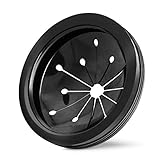
The CLEESINK splash guard collar is a 3-1/8 inch multi-function rubber baffle that drops into the sink flange opening of a standard disposer mount, and it addresses the single most common failure point in the entire appliance: the rubber splash guard. It suits any household whose disposer has started spitting food particles, splashing back, or rattling louder than it used to — which, in practice, is most disposers after a few years of bone and fibrous waste.
Key specs
- Type: replacement splash guard / sink baffle collar
- Opening: 3-1/8 inch
- Material: rubber, multi-function baffle design
- Fit: standard disposer sink flange opening class
- Installation: drop-in replacement — no tools beyond removing the old baffle
- Function: contains splash-back, reduces noise, guides waste into the grind chamber
Here is the ownership reality that product listings rarely explain: the splash guard is a consumable, and it typically fails long before the motor does. Rubber baffles stiffen with age, harden from hot water and food acids, and eventually tear at the flexible flaps. Once torn, three things happen at once. Waste and water splash back at the user. Larger pieces slip past the baffle unevenly and hit the impellers at odd angles, which is a common cause of jams that get blamed on the motor. And the noise level rises, because the baffle is part of the acoustic barrier between the grind chamber and the room.
Bone grinding accelerates this. Bone grit is abrasive, and every bone session drags hard fragments across the rubber flaps on their way down. Households that grind bones regularly replace splash guards more often than households that do not — which is worth knowing before you conclude that your disposer is dying when it is actually a ten-minute, low-cost part swap.
Replacement is simple but has two gotchas. First, verify the opening size against your existing flange; 3-1/8 inch is a common standard, but flanges vary and a baffle that is too small will not seat. Second, when you pull the old baffle out, clean the flange groove before pressing the new one in — trapped food debris prevents the new baffle from seating fully and causes it to pop out under load. Wear gloves; the flange underside is often sharp and always grimy.
Pros
- Restores splash containment and reduces noise immediately
- Addresses the most common wear item on any disposer
- Low-cost compared with replacing an appliance that is still healthy
- Drop-in installation with no tools required
- Improves feeding geometry, which reduces odd-angle jams
Cons
- Consumable — it will harden and tear again in time
- Must be matched to the flange opening size
- Does nothing for motor, torque, or grinding capability
- Cheap rubber formulations stiffen faster than better ones
This is the accessory to buy alongside any of the disposers above, not instead of one. Pair it with the Antrader support if you are installing a heavy 1 HP unit, and pair it with the Moen Chef Series or VEVOR if your bone load is heavy enough to chew through baffles quickly. If your disposer is loud, splashing, and jamming more than it used to, replace the baffle before you replace the appliance — the odds are decent that the machine is fine.
How to Choose
Choosing a disposer for bone duty comes down to five variables: horsepower, motor type and spindle speed, grinding chamber material, jam resistance, and physical fit. Get those right and brand becomes a secondary question about parts availability and warranty length. Get them wrong and you will be shopping again in two years.
Start with horsepower, and be honest about bone size
Horsepower is a proxy for torque, and torque is what breaks bone. The table below maps what you actually put down the sink to the minimum motor class that makes sense.
| What you’re grinding | Minimum HP class | Grinding chamber material | Jam resistance to insist on |
|---|---|---|---|
| Soft scraps, no
Affiliate disclosure. As an Amazon Associate we earn from qualifying purchases at no extra cost to you. Prices accurate as of the date shown. Best Under Sink Garbage Disposals for Heavy BonesCheck price on Amazon More ways to save on Amazon 
All Plants vs Brainrots Compared: Features & GameplayFor most players in 2026, the longest-running Roblox build of Plants vs... 
Best Golf Deals Review: Value Picks Worth BuyingThe best golf deals in 2026 are almost always last year’s flagship... 
Best XLR Cables for Microphones and Audio GearBest overall: the Cable Matters 2-Pack Premium XLR to XLR Cable in... 
Best Women’s Leather Backpacks for Work and TravelDirect answer: the best women’s leather backpack for most people who need... 
Best Wine Coolers for Kitchens: Compact PicksThe best wine cooler for kitchens overall is the Kalamera 24 inch,... 
Best Westinghouse Pressure Washers ComparedFor most homes, the best Westinghouse pressure washer is the Westinghouse ePX3500.... 
Best Water Fountains for Multiple CatsFor most households with two or three cats, the best water fountain... 
Best VR Cameras for Immersive 360 VideoFor most creators, the best VR camera in 2026 is an 8K... 
Best Ventless Bioethanol Indoor FireplacesThe best ventless bioethanol indoor fireplace choice for most households in 2026... 
Best Vacuums for Couches: Powerful & PortableThe best vacuum for couches is a cordless stick model with a... |