Key takeaways
-
22AWG or thicker (lower number) for the VBUS power conductors maintains 5A current without excess heat and voltage drop. Thin 26AWG or 28AWG charging-only cables often trigger slow-charge warnings on Pixel and Samsung phones at 6 ft or longer.
-
480 Mbps means USB 2.0. That is fine for charging and Android Auto, but it will transfer a 10GB video file in about 3 minutes. A 10 Gbps cable does the same in about 8-10 seconds but is thicker, shorter, and costs more.
-
Strain relief longer than 15mm with a tapered, flexible profile prevents the sharp 90-degree kink that kills cables. Short, rigid, decorative metal housings look premium but concentrate stress in one spot.
The best charging cable for Android in 2026 that won’t fray or slow charge is a USB-C to USB-C cable with a 100W to 240W PD 3.1 rating, USB 2.0 or higher data support, 22AWG or thicker power conductors, and a 15mm or longer flexible strain relief, with silicone jackets best for fray resistance and nylon braid best for abrasion resistance.
- Nylon Braided vs. Silicone: Which Actually Lasts Longer?
- Spec Comparison: What to Check Before You Buy
- Why Cables Start Slow Charging After a Few Months
- Decision Matrix: Pick by Your Situation
- Cost Per Use: Why a $17 Cable Is Cheaper Than a $7 Cable
- What Wears First and How to Prevent Fraying
- Bottom Line for 2026
- Frequently Asked Questions
Most premature cable failures are not about the brand. They happen at the 10-15mm of cable just behind the connector, where repeated bending breaks copper strands and then the phone starts slow-charging, disconnecting, or only charging at one angle. The right choice in 2026 comes down to jacket type, strain relief design, and whether the cable actually supports your phone’s fast-charge protocol, not just the wattage on the package.
As an Amazon Associate we earn from qualifying purchases at no extra cost to you.


Nylon Braided vs. Silicone: Which Actually Lasts Longer?
Nylon and silicone fail in different ways. Understanding that difference is the fastest way to stop buying a new cable every 6 months.
Nylon braided jackets
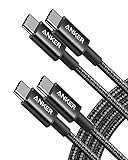
Nylon braid, as used on lines like the Anker PowerLine series, UGREEN nylon USB-C cables, and Cable Matters braided cables, is a woven sheath over an inner TPE layer. It resists abrasion, pet chewing, and dragging across desks or car seats very well. Manufacturer bend-test ratings for this type are commonly listed at 25,000 to 35,000 bends.
The weakness is fraying at the cut ends near the connector. Once the braid loosens from repeated 90-degree bends while charging in bed or in a car mount, individual fibers bloom outward, trap dust, and expose the inner jacket. Tight, stiff braids also transfer more bending force directly to the connector joint.
Silicone jackets
Silicone or liquid-silicone jackets, as used on the Anker PowerLine III Flow type, Belkin BoostCharge Pro Flex type, and similar soft-touch cables, have no weave to unravel. They stay flexible in cold cars, do not kink into permanent elbows, and distribute bend stress over a longer section. Listed bend ratings are often 20,000 to 30,000 bends, slightly lower on paper than nylon but more consistent in real use because there is no fray point.
The weakness is cut and puncture resistance. Silicone can be nicked by desk edges, zipper teeth, or office chair wheels more easily than nylon, and it attracts lint in pockets and bags.
Simple rule: choose silicone if your cables die from splitting or fraying behind the plug. Choose nylon braid if your cables die from rubbing, chewing, outdoor use, or being yanked across rough surfaces.
Spec Comparison: What to Check Before You Buy
Wattage alone does not guarantee fast charging for Android. A Samsung Galaxy S24 Ultra, Galaxy Z Fold, Google Pixel 8 / Pixel 9 series, OnePlus 12, and Motorola Edge phones use USB Power Delivery (PD) or PPS — Programmable Power Supply — to negotiate voltage in small steps. A cable must carry both the current and the e-marker chip data for 100W+ cables to maintain that negotiation.
| Cable type (examples) | Jacket | Lengths | Max power | Data speed | Power wires | Strain relief length | Listed bend life |
|---|---|---|---|---|---|---|---|
| Anker PowerLine III / UGREEN 100W nylon type | Nylon braid over TPE | 3 ft / 6 ft | 100W PD (20V/5A) | 480 Mbps USB 2.0 | 22AWG | 12-14 mm | 35,000 bends |
| Anker Flow / Belkin BoostCharge Pro Flex silicone type | Silicone | 3 ft / 6 ft | 100W PD (20V/5A) | 480 Mbps USB 2.0 | 22AWG | 16-20 mm, tapered | 25,000 bends |
| Samsung official 5A USB-C to USB-C | TPE / matte plastic | 3 ft / 6 ft | 100W PD with PPS / 45W Super Fast Charging 2.0 | 480 Mbps USB 2.0 | 21AWG equivalent | 14-15 mm | 20,000 bends |
| UGREEN 240W / Cable Matters 240W nylon type | Nylon braid | 3 ft / 6 ft / 10 ft | 240W PD 3.1 (48V/5A) | 480 Mbps USB 2.0 | 20-21AWG | 15-18 mm, extended | 30,000 bends |
| Short USB-C 3.2 Gen 2 cable, 1-1.5 ft | TPE or nylon | 1 ft / 1.5 ft | 100W PD | 10 Gbps USB 3.2 Gen 2 | 22AWG power + shielded pairs | 12-15 mm | 15,000-20,000 bends |
Three details matter most in that table:
-
22AWG or thicker (lower number) for the VBUS power conductors maintains 5A current without excess heat and voltage drop. Thin 26AWG or 28AWG charging-only cables often trigger slow-charge warnings on Pixel and Samsung phones at 6 ft or longer.
-
480 Mbps means USB 2.0. That is fine for charging and Android Auto, but it will transfer a 10GB video file in about 3 minutes. A 10 Gbps cable does the same in about 8-10 seconds but is thicker, shorter, and costs more.
-
Strain relief longer than 15mm with a tapered, flexible profile prevents the sharp 90-degree kink that kills cables. Short, rigid, decorative metal housings look premium but concentrate stress in one spot.
Why Cables Start Slow Charging After a Few Months
Slow charging is rarely the phone. It is increased resistance from broken strands, corroded pins, or a mismatched charger protocol.
USB-C PD starts at 5V and then steps up to 9V, 15V, or 20V after the phone and charger communicate. If one CC communication wire is damaged from bending, the system falls back to basic 5V / 1.5A to 2.4A charging — 7.5W to 12W instead of 25W to 45W. That turns a 70-minute full charge on a Galaxy S series into a 2.5-hour charge.
Voltage drop on long, thin cables causes the same symptom. A 10 ft cable with 28AWG conductors can lose 0.6V to 0.9V at 3A. The phone detects the sag and reduces current to stay safe. This is why a 6 ft or 10 ft cable needs thicker 22AWG to 20AWG power wires and, for 100W+, an e-marker chip.
To keep fast charge working, match the cable to the protocol:
-
Samsung 25W and 45W Super Fast Charging: needs USB-C to USB-C with 5A support and PPS. Older USB-A to USB-C cables will not trigger it even with a 45W brick.
-
Pixel 30W-37W PD PPS: needs USB-C to USB-C PD with PPS and a 30W+ PD PPS charger. Most 60W+ quality cables work, but thin gas-station cables do not.
-
OnePlus / OPPO SuperVOOC, Xiaomi HyperCharge, older Huawei SuperCharge: often need the brand’s original USB-A to USB-C or USB-C to USB-C cable with extra pins. A standard 100W PD cable will charge but at 10W-18W.
Decision Matrix: Pick by Your Situation
| If this is your situation | Best choice in 2026 | Why |
|---|---|---|
| Bedside / couch charging, cable bent at 90 degrees nightly | 6 ft silicone 100W USB-C to USB-C, right-angle connector on phone end | Soft jacket plus right-angle plug removes leverage on strain relief |
| Backpack, car, travel, gets stepped on or yanked | 3-6 ft nylon braided 100W or 240W PD cable | Braid resists abrasion; shorter length reduces voltage drop |
| Samsung S24 / S25 / Z series owner who wants 45W | 5A 100W USB-C cable with PPS support, 3-6 ft | Enables Super Fast Charging 2.0; 10 ft versions often lose PPS stability |
| Transfer photos/video to laptop weekly | 1.5-3 ft USB 3.2 Gen 2 10 Gbps 100W cable | 20x faster transfers than standard charge cables; short length keeps signal clean |
| Android Auto disconnects often | 1-3 ft USB-A to USB-C or USB-C to USB-C, USB-IF certified, TPE jacket | Short, data-rated, non-stiff cables maintain data pins; long braided cables cause dropouts |
| Buy once for laptop + phone + tablet | 6 ft 240W PD 3.1 nylon cable with e-marker | Handles 65W-140W laptops and still fast-charges phones; thicker gauge lasts longer |
General market price ranges in 2026: standard 60W nylon cables typically cost less than 100W silicone or 240W PD 3.1 cables. Expect to pay more for 10 Gbps data versions and for official Samsung, Google, or Belkin branded cables. A 3-pack of ultra-cheap no-name cables usually costs less upfront but fails earlier at the connector joint.
Cost Per Use: Why a $17 Cable Is Cheaper Than a $7 Cable
Fraying has a measurable cost. Take a common pattern:
A low-cost thin TPE cable lasts about 6 months with daily bedside use — roughly 180 plug cycles and 1,500 bends. At $7 to $9, that is about $0.04 to $0.05 per day, plus slow-charge time in the last month as strands break.
A thicker silicone or braided 100W cable in the $15 to $22 range typically lasts 18 to 24 months under the same use when it has proper strain relief, or about 540 to 720 days. That is $0.021 to $0.04 per day, with stable fast charging for most of its life.
The calculation flips only if you lose cables often. If you leave cables in hotels, rental cars, or offices, buy two mid-range 3 ft nylon cables instead of one premium 6 ft silicone cable.
What Wears First and How to Prevent Fraying
Field failure order on Android USB-C cables is consistent:
-
Strain relief split: the rubber collar develops a ring crack 5-8mm from the metal shell from repeated bending. Once cracked, the internal shield frays next.
-
One-sided charging: lint compacts into the phone’s USB-C port, preventing full insertion. Users wiggle the plug, which accelerates joint damage.
-
Pin corrosion: bathroom humidity, sweat during workouts, and car condensation corrode the 24 tiny USB-C pins, increasing resistance and heat.
To extend life without special tools:
-
Unplug by the hard plug housing, never by pulling the cord. Pulling adds 3-5 lbs of force directly to solder joints rated for far less.
-
Leave a 2-inch service loop instead of a hard 90-degree bend behind the phone. Hard bends concentrate stress; a gentle U-shape spreads it.
-
Clean the phone port every 2-3 months with a wooden toothpick and a blast of air, with the phone off. Do not use metal pins. Most intermittent charging is compacted lint, not a dead cable.
-
Do not coil tightly around a charger brick. Wrap loosely in 6-inch loops. Tight coils over 180 degrees permanently deform silicone and loosen nylon weave.
-
Keep one short cable for desk / Android Auto and one long cable for bed / travel. Using a 10 ft cable for everything multiplies tangles and yank failures.
Avoid the common mistake of using USB-A to USB-C adapters on a USB-C PD cable to keep an old car charger. The adapter blocks PD negotiation and limits most modern Android phones to 10W-12W, which reads as slow charging even with a perfect cable.
Bottom Line for 2026
For most Android users, the best charging cable for Android is a 6 ft silicone 100W USB-C to USB-C cable with PPS support for daily charging, plus a short 10 Gbps cable if you move large files. Travelers and families with pets should get the nylon braided 100W or 240W equivalent instead. In both cases, prioritize wire gauge, strain relief length, and PPS compatibility over braid color or wattage marketing — those three determine whether the cable still fast-charges in month 18 instead of fraying in month six.
Frequently Asked Questions
Does a 240W cable charge a phone faster than a 100W cable?
No, if the phone maxes at 25W, 37W, or 45W. The phone only draws what it negotiates. A 240W cable helps if you also charge a USB-C laptop, and its thicker conductors can run cooler at 6 ft or longer, but it will not make a Pixel or Galaxy charge beyond its designed limit.
Why does my cable say fast charging one day and slow charging the next?
That usually signals a loose USB-C connection from pocket lint, a cracked strain relief breaking one data wire intermittently, or a charger that overheated and dropped from PPS to standard PD. Clean the port, try the same cable with a known 25W+ PD PPS charger, and replace the cable if charging only works at certain angles.
Are right-angle USB-C cables better for gaming?
Yes for durability while playing in landscape mode. A 90-degree plug eliminates the lever force that splits straight connectors. Just confirm it still supports 5A / 100W and PPS if you need Samsung 45W or similar speeds — some slim right-angle gaming cables are limited to 60W.