Key takeaways
- 5,000mAh bank delivers about 3,100-3,300mAh to your phone – roughly 65-75% of an iPhone 15 / 16 or Galaxy S24 charge
- 10,000mAh bank delivers about 6,200-6,500mAh – roughly 1.3 to 1.5 full phone charges
- 20,000mAh bank delivers about 12,400-13,000mAh – roughly 2.5 to 3 full phone charges
The best portable cell phone charger for most people in 2026 is a 10,000mAh pocketable power bank with 20W+ USB-C Power Delivery, because it fully recharges a modern phone once with power to spare while staying under 200g. For iPhone MagSafe users, the best portable i phone charger is a 5,000-10,000mAh magnetic bank, while the best portable phone charger for travel is a 20,000mAh 65W bank that can also charge a laptop.
As an Amazon Associate we earn from qualifying purchases at no extra cost to you.


What actually matters: usable capacity, weight, and recharge speed
A top rated portable phone charger is not decided by the big number on the box. That 10,000mAh or 20,000mAh rating refers to the internal battery cells at 3.7V. Your phone charges at 5V-9V over USB, and conversion plus heat loses 30-40% of that energy.
Use this rule when comparing any best portable cell phone battery charger:
Usable output = Rated capacity x 3.7 / 5 x 0.85 efficiency factor
That means:
- 5,000mAh bank delivers about 3,100-3,300mAh to your phone – roughly 65-75% of an iPhone 15 / 16 or Galaxy S24 charge
- 10,000mAh bank delivers about 6,200-6,500mAh – roughly 1.3 to 1.5 full phone charges
- 20,000mAh bank delivers about 12,400-13,000mAh – roughly 2.5 to 3 full phone charges
Weight scales almost linearly with capacity. If you want pocketable daily carry, stay under 220g. If you want weekend travel backup, 350-450g in a backpack is acceptable. Anything over 500g feels like carrying a second phone plus a wallet.
Full recharge time for phones also depends on wattage, not just capacity. A 12W bank will take 2.5 to 3 hours for a full 0-100% iPhone or Android charge. A 20W-30W USB-C PD bank does it in 1.5 to 2 hours, with 0-50% in about 30 minutes.
Best portable phone battery charger specs compared
This comparison focuses on widely available types from established brands like Anker, INIU, UGREEN, Belkin, Nitecore, Charmast, Baseus and Sharge that remain current in 2026.
| Model Type | Rated Capacity | Usable Output (est.) | Weight | Size Approx. | Output / Recharge Tech | Best For |
|---|---|---|---|---|---|---|
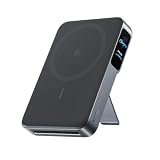
| Anker 621 Magnetic Battery (MagSafe type) | 5,000mAh | ~3,200mAh | 127g | 102 x 66 x 12mm | 7.5W magnetic wireless + USB-C | iPhone daily pocket carry |
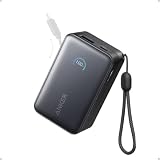
| INIU BI-B63 10,000mAh Mini / Charmast Mini type | 10,000mAh | ~6,400mAh | 175-195g | 105 x 65 x 20mm | 20W-22.5W USB-C PD + USB-A | Best portable phone charger for Android and iPhone daily use |
| UGREEN Nexode 12000mAh 100W type / Anker 737 type | 12,000-24,000mAh | ~7,400-14,800mAh | 280-440g | 125 x 70 x 30mm | 65W-100W USB-C PD, display | Travel, laptop + phone |
| Nitecore NB10000 Gen 2 | 10,000mAh | ~6,400mAh | 150g | 121 x 59 x 11mm | 18W USB-C PD, carbon fiber body | Ultralight hiking / EDC |
| Belkin BoostCharge Magnetic 8K + Stand type | 8,000mAh | ~5,100mAh | 220g | 110 x 70 x 15mm | 15W MagSafe + kickstand | iPhone desk / video calls |
General market ranges in 2026: mini 5,000mAh magnetic banks run $25-$45, compact 10,000mAh 20W banks run $20-$40, and high-output 20,000mAh+ 65W+ travel banks run $45-$90 depending on display, materials, and GaN circuitry.
Which best cell phone battery charger should you buy?
Best for daily pocket carry: 10,000mAh 20W mini
If you are searching for the best portable cell phone battery charger for everyday commuting, get a compact 10,000mAh model with 20W USB-C PD from INIU, Anker, UGREEN, or Charmast. It recharges an iPhone 15 Pro from 20% to 100% in about 1 hour 40 minutes with a USB-C to Lightning or USB-C to USB-C cable, and does the same for a Galaxy S23 / S24 or Pixel 8 in about 1 hour 30 minutes. You get about 1.4 charges total before the bank is empty, and it recharges itself overnight in 3-4 hours with an 18W+ wall plug.
This is also the best portable phone charger for Android overall, because most Android phones do not use MagSafe. Look for PPS and 22.5W Super Fast Charging support if you use Samsung, and 20W PD 3.0 if you use Pixel or Motorola.
Best portable iPhone charger: 5,000mAh magnetic bank
For iPhone 12 and newer, a magnetic MagSafe bank is the most convenient option. It snaps to the back and charges at 7.5W-15W without a cable. A 5,000mAh magnetic bank will take a phone from 20% to about 85% in 2 to 2.5 hours wirelessly. It is slower and less efficient than wired charging – you lose another 15-20% to heat – but it keeps your phone usable for maps and photos.
Choose a wired 10,000mAh bank instead if you need a full 0-100% charge in one go. Wireless magnetic is best as a top-up extender, not as the best cell phone battery charger for heavy travel days.
Best portable phone charger for travel: 20,000mAh 65W bank
For flights, road trips, and international travel, capacity and airline compliance matter more than pocketability. Under TSA and IATA rules, you can carry banks under 100Wh in cabin baggage without approval. A 20,000mAh bank is about 74Wh, so it is flight-legal.
A 65W-100W model like the UGREEN Nexode or Anker 737 class can recharge an iPhone 3 times, or recharge a phone once plus a MacBook Air to 60%. It also recharges itself much faster – about 1.2 to 1.5 hours with a 65W wall charger versus 5-6 hours for a basic 20,000mAh bank with only 18W input.
Pack a 1m 100W-rated USB-C to USB-C cable and a 30-45W dual-port wall plug. That combination covers phone, earbuds, and laptop with one brick.
Best cell phone solar charger: manage expectations
The best cell phone solar charger in 2026 is not a power bank with a tiny solar panel on top. Those palm-size panels produce only 1-1.5W in full sun, meaning 20-30 hours of sun for a single phone charge. They are useful only as emergency trickle maintainers.
If you camp or hike off-grid, buy a two-part system: a 10,000mAh lightweight bank like the Nitecore NB10000 plus a separate 20W-28W foldable solar panel with USB-C output. The foldable panel can recharge the bank in 4-6 hours of direct sun, while the bank charges your phone overnight. This is lighter, faster, and far more reliable than any all-in-one solar bank.
Decision matrix: pick by situation
| Your Situation | Pick This | Why |
|---|---|---|
| Office commuter, one phone, light use | 5,000mAh magnetic or mini wired | 127-150g, disappears in pocket, enough for 20% to 85% top-up |
| Heavy social / video / 5G all day | 10,000mAh 20W-30W USB-C PD | 1.5 charges, fastest 0-50% in 30 min, still pocketable |
| Two phones, family travel, or iPhone + iPad | 20,000mAh 22.5W-65W dual-port | Runs 2 devices at once, 2.5-3 phone charges |
| Business travel with laptop | 12,000-24,000mAh 65W-100W | Charges laptop and phone, self-recharges in ~1.5 hrs |
| Ultralight hiking, running vest | Carbon-shell 10,000mAh (Nitecore class) | 150g vs 195g standard, saves ~25% weight |
Worked example: If your Galaxy S24 has a 4,000mAh battery and you use 120% per day, you need about 4,800mAh delivered. A 10,000mAh bank delivering 6,400mAh covers that plus earbuds with about 1,000mAh left. A 5,000mAh bank delivering 3,200mAh would leave you short by evening, so step up to 10,000mAh.
Durability and ownership realities
What wears first is not the battery cells, it is the ports and cables. USB-C ports loosen after 12-18 months of daily pocket lint and sideways cable pulls. Blow out lint monthly with a dry soft brush, never a metal pin, and use short 15-30cm cables for pocket charging to reduce leverage.
Heat is the second killer. Do not charge your phone in direct sun on a dashboard with the bank stacked underneath. Magnetic wireless charging already runs 8-10C hotter than wired. If your phone pauses charging at 80%, that is thermal protection – move both devices into shade and remove thick cases.
Common mistakes: buying a no-name 30,000mAh bank that is heavier than your phone and never gets used, using a 5W old wall plug that takes 10 hours to refill a travel bank, and storing a bank at 0% for months. Lithium banks last longest when stored at 50-70% and topped up every 3 months. Expect 300-500 full cycles before capacity drops to 80% – about 2-3 years of daily use.
Maintenance and airline tips
- Recharge travel banks with a 30W or higher PD wall charger to cut refill time by half.
- Always carry power banks in carry-on, never checked luggage. Keep capacity under 100Wh (about 27,000mAh) for hassle-free boarding.
- Turn off magnetic banks after use; idle drain can empty a 5,000mAh bank in 7-10 days.
- Replace built-in-cable models if the cable frays – a loose integrated cable cannot be swapped like a separate USB-C cable.
FAQ
How many times will a 10,000mAh charger charge my phone?
About 1.3 to 1.5 times for most 2024-2026 phones with 3,800-4,500mAh batteries. You lose capacity to voltage conversion and heat, so you do not get 2.5 full charges despite the math on paper.
Is wireless or wired portable charging better?
Wired USB-C is faster, cooler, and 20-30% more efficient. Use magnetic wireless for convenience while walking or navigating, and wired for a fast full recharge during lunch or at the airport.
Do I need a different charger for iPhone vs Android?
Not anymore for wired charging. Any 20W+ USB-C PD bank works for both – you just change the cable. Only iPhone 12 and newer benefit from magnetic MagSafe alignment; most Android phones need a magnetic ring case to use the same feature.