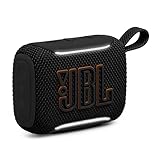
The best mini Bluetooth speaker for most people is the JBL Go 4 if you want the smallest body and lowest cost, the Tribit StormBox Micro 2 if you want more volume and a built-in strap, and the Sony SRS-XB100 if battery life matters most. All three are rated IP67, weigh under 300 g and cost far less than a full-size portable speaker. This guide ranks seven mini speakers by what they do well, then explains what you give up when you shrink a speaker, which numbers separate a good mini from a toy, and how to use one with an iPhone.
Specs below come from manufacturer pages and published third-party measurements. Where retailers or reviewers disagree on a figure, the more conservative number is used. Price position is described as a tier because street prices change weekly.
Our top picks
 LENRUE Small Portable Bluetooth Speaker with Lights
- Ultra-Lightweight & Portable: Incredibly 0.66lb light! With a…
- Breathing Lights & Backlit Logo Design: Features creative…
- Immersive TWS Surround Sound: Enjoy crystal-clear, 30W output…
| Product | Key specs | |
|---|---|---|
 Soundcore Select 4 Go Bluetooth Shower Speaker | Check price | |
 Portable Bluetooth Speaker 5.4 | Check price | |
| LENRUE Small Portable Bluetooth Speaker with Lights | Ultra-Lightweight & Portable: Incredibly 0.66lb light! With a… Breathing Lights & Backlit Logo Design: Features creative… Immersive TWS Surround Sound: Enjoy crystal-clear, 30W output… | Check price |
 Anker soundcore 2 Portable Bluetooth Speaker | Outdoor-Proof Speaker: Portable design with IPX7 waterproof protection… 24H Non-Stop Music: With Anker's world-renowned power management… Powerful Sound: The speaker features 12W power with… | Check price |
As an Amazon Associate we earn from qualifying purchases at no extra cost to you.
What “mini” really means: size classes
Search results mix three sizes under the “mini” label, and they sound different. Treat them as separate classes before you compare models.
| Class | Typical weight | Typical output | Typical battery (rated) | Example |
|---|---|---|---|---|
| Pocket (palm-sized) | 150-200 g | 4-5 W | 7-10 h | JBL Go 4 |
| Compact (hand-sized) | 250-300 g | 7-10 W | 12-16 h | Sony SRS-XB100, UE Miniroll, StormBox Micro 2 |
| Small portable | 400-600 g | 20-35 W | 12-14 h | JBL Flip-class speakers |
This guide covers the first two classes. If you want the third, see a full portable-speaker guide instead.
Comparison table of the seven picks
| Speaker | Best for | Weight | Rated battery | Rating | Price tier |
|---|---|---|---|---|---|
| JBL Go 4 | Smallest and cheapest | 190 g | 7 h | IP67 | Entry |
| Sony SRS-XB100 | Battery and strap | 274 g | 16 h | IP67 | Entry |
| Tribit StormBox Micro 2 | Loudest mini, bike and bag | hand-sized, listings vary | 12 h | IP67 | Entry |
| UE Miniroll | Design, shower, floating | 279 g | 12 h | IP67 | Mid |
| JBL Clip 5 | Carabiner, backpack | about 285 g | 12 h (some pages say 15 h) | IP67 | Entry to mid |
| Bose SoundLink Micro (2nd Gen) | Best sound in a mini | palm-sized with strap | 12 h | IP67 | Mid to premium |
| Soundcore Select 4 Go | Cheapest, longest runtime | very light | about 20 h per retailer listings | IP67 | Entry |
JBL Go 4: the pocket default
Spec line: 190 g, IP67, 7 hours rated, Bluetooth 5.4, Auracast support, built-in loop.
Best for: a first speaker, a travel companion or a gift. Skip if: you want it to last a full day.
- Pro: At 190 g it is the lightest speaker in this guide and drops into a pocket without noticing.
- Pro: It can join Auracast groups with newer JBL speakers, so you can later add a larger speaker and play the same track on both.
- Pro: JBL’s tuning is clear and slightly forward, which suits podcasts and pop at moderate volume.
- Con: Seven hours is the shortest battery in the guide.
- Con: Bass is thin; at high volume the small driver starts to sound strained.
Sony SRS-XB100: the long-battery mini
Spec line: 274 g, IP67, 16 hours rated, Bluetooth 5.3, SBC and AAC codecs, multiway strap, about 4.5 hours to charge.
Best for: people who forget to charge. Skip if: you want fast charging or a built-in microphone.
- Pro: Sixteen hours rated covers a long weekend of light use.
- Pro: The strap works on a handlebar, rail or backpack; it is more flexible than a simple loop.
- Pro: AAC support makes it a good match for an iPhone.
- Con: No quick-charge feature.
- Con: Loudest settings sound compressed because the driver is small.
Tribit StormBox Micro 2: the loud mini
Spec line: 10 W output, IP67, 12 hours rated, Bluetooth 5.3, up to 120 ft range, integrated strap.
Best for: bike rides, hikes, beach bags. Skip if: you want a premium brand ecosystem or a companion app with many options.
- Pro: Output is higher than most pocket speakers, so it is easier to hear over wind and road noise.
- Pro: The integrated strap is heavy duty and attaches to handlebars and bag loops.
- Pro: It is usually one of the lower-priced IP67 speakers from an established brand.
- Con: The sound signature is bass-heavy and can sound boomy at the top end of the volume range.
- Con: Spec listings disagree on weight and battery capacity across retailers, so check the box you buy.
UE Miniroll: the design pick
Spec line: 279 g, 12.3 x 10.5 x 4.8 cm, 7.5 W RMS, 12 hours rated, IP67, Bluetooth 5.3, silicone strap, floats.
Best for: the shower, the pool edge and the kitchen. Skip if: you want stereo pairing; the Miniroll does not support wireless stereo pairing.
- Pro: A clean, flat form factor with a loop that hangs on a shower head or a towel hook.
- Pro: Waterproof and floating, so a fall into water is a non-event.
- Pro: Clear, voice-forward sound suits podcasts and talk radio.
- Con: Fewer controls than larger speakers.
- Con: Costs more than the JBL Go 4 or Tribit for similar volume.
JBL Clip 5: the clip-on
Spec line: about 285 g, IP67, 12 hours rated (some pages state up to 15), Bluetooth 5.4, Auracast, integrated wide carabiner.
Best for: a backpack strap, a belt loop or a tent. Skip if: you want to place the speaker on a table; it can topple.
- Pro: The carabiner is built in, so there is nothing extra to lose.
- Pro: Output is a step above the Go 4.
- Pro: Auracast support matches the Go 4 and larger JBL models.
- Con: Its round shape does not stand stable on a smooth surface.
- Con: Published battery numbers conflict from 10 to 15 hours, so plan for about 10.
Bose SoundLink Micro (2nd Gen): the best-sounding mini
Spec line: IP67, 12 hours rated, Bluetooth 5.4, aptX Adaptive, USB-C, removable fabric strap, powder-coated steel grille.
Best for: people who prioritize sound quality over price. Skip if: you only want the cheapest speaker that works.
- Pro: Bose tunes the small driver to avoid the harsh, thin character of many mini speakers.
- Pro: It supports aptX Adaptive on compatible Android phones.
- Pro: A replaceable strap and metal grille make it feel more durable than a plastic speaker.
- Con: It costs more than every other speaker in this guide.
- Con: Twelve hours is similar to cheaper speakers; you are paying for tuning, not battery.
Soundcore Select 4 Go: the budget pick
Spec line: IP67, floats, about 20 hours per retailer listings, Bluetooth, USB-C.
Best for: kids, a shower speaker or a spare speaker for a drawer. Skip if: you want deep bass or high maximum volume.
- Pro: Lowest price in the guide, so losing one is not painful.
- Pro: Long battery rating and floating body.
- Pro: Anker’s app and warranty experience are generally straightforward.
- Con: Sound is basic; it lacks the refinement of Bose or UE.
- Con: Fewer reviews from independent labs than the big-brand speakers, so verify the spec on the page you buy from.
How to choose a mini speaker
Volume and output
Small speakers produce 4-10 W. Perceived loudness doubles for every roughly 10 dB, and an amplifier needs about ten times the power for that jump. That means a 10 W speaker is only modestly louder than a 5 W speaker, not twice as loud. A worked example: going from 4.2 W (Go 4 class) to 10 W (StormBox Micro 2 class) is about 3.8 dB louder, which is noticeable but not dramatic. Choose by sound character and battery before you choose by wattage.
Battery in real use
Rated hours assume moderate volume. At loud volume, expect about half. A 12-hour mini speaker gives you about six hours of loud listening, or a full 12 at conversation level. If you want to listen all weekend, pick the 16- to 20-hour speakers.
Mounting options
- Loop: light and simple (Go 4). Needs a hook or carabiner.
- Carabiner: clips to straps and loops (Clip 5).
- Strap: flexible for handlebars and rails (SRS-XB100, StormBox Micro 2, SoundLink Micro).
- Free-standing: stable for tables (Miniroll lies flat).
Water and dust
Every speaker in this guide is rated IP67: dust-tight and able to survive 30 minutes at 1 m. That is enough for rain, a splash, a quick dunk and sandy beach days. Do not leave any of them submerged on purpose, and rinse off salt water.
Best mini Bluetooth speaker for iPhone
Any of these speakers works with an iPhone, because Bluetooth pairing is standard. A few practical points matter:
- Codec: iPhones use AAC for Bluetooth audio. The Sony SRS-XB100 lists AAC support, and most speakers in this price class support it as well. aptX Adaptive, which the Bose Micro supports, is for Android phones and has no effect on an iPhone.
- Calls: A speaker with a built-in microphone can take calls and Siri requests. Check the box for a microphone symbol; many small speakers have one, but not all.
- Pairing: Put the speaker in pairing mode, open Settings, then Bluetooth, and tap the speaker’s name. Once paired, an iPhone reconnects automatically when the speaker is switched on.
- Battery: iPhones show the speaker’s battery in the Batteries widget for some models and not others, so rely on the speaker’s own indicator.
- Volume sync: The iPhone volume and the speaker volume work together. Set the iPhone near 75 percent and adjust the speaker for the final level to preserve headroom and reduce distortion.
For an iPhone user, the best everyday choices are the JBL Go 4 for budget, the Sony SRS-XB100 for long battery and AAC support, and the Bose SoundLink Micro (2nd Gen) for better sound.
What you give up with a mini speaker
| Trade-off | Mini speaker | Full-size portable |
|---|---|---|
| Bass below about 100 Hz | Weak or absent | Present, with some punch |
| Maximum volume | Fills a small room | Fills a large room or patio |
| Weight | 190-300 g | 550-1,000 g |
| Battery (rated) | 7-16 h | 12-24 h |
| Stereo effect | Mono, unless paired | Mono, wider with larger drivers |
| Price tier | Entry | Mid to premium |
A pair of minis is one way around the stereo limit. Many minis can pair with a second identical unit for left-right stereo, which makes a bigger difference than moving up one size class. Check that your speaker supports wireless stereo pairing before you buy two; the UE Miniroll, for example, does not.
Placement tricks that make a mini speaker sound bigger
A small speaker’s weakness is bass, and bass is strongly affected by where you put the speaker. These adjustments cost nothing and often matter more than moving up a price tier.
- Use a boundary. Place the speaker on a desk or shelf close to a wall. A nearby surface reflects low frequencies forward and can add several decibels of apparent bass. Keep it a few centimeters from the wall, not pressed against it, or the sound turns boomy.
- Raise it to ear height. Treble is directional. A speaker on the floor or inside a bag sounds dull; the same speaker on a shelf at ear height sounds clearer at lower volume, which also saves battery.
- Face it toward you. The Go 4, XB100 and Clip 5 all radiate mostly forward. Turning the speaker away from the listening position loses clarity.
- Avoid enclosed spaces. A speaker inside a cupboard, backpack pocket or cup holder gets muffled and tends to resonate. A cup holder may even rattle the speaker body at certain bass notes.
- Lower the bass boost if available. Bass boost modes on a mini speaker push the small driver hard, increase distortion and shorten battery life. If a speaker sounds harsh, turn the boost off before you decide it is a poor speaker.
The second point matters in a shower: a speaker hung from a shower head at head height with the grille aimed at the room will sound clearer than one resting on a shelf behind a curtain.
Care and ownership
- Rinse after salt water or chlorine. Use fresh water, then let it dry port-down.
- Do not charge wet. Dry the USB-C port first.
- Do not leave it in a hot car. Heat is the fastest way to reduce battery capacity.
- Replace the strap or loop when it frays. The strap is the part that carries the load on a bike or bag.
- Update firmware through the brand’s app where one exists.
Frequently Asked Questions
What is the best mini Bluetooth speaker overall?
The JBL Go 4 is the best overall for size and cost, the Sony SRS-XB100 is best for battery life, and the Bose SoundLink Micro (2nd Gen) has the best sound. Pick by what matters most to you: size, runtime or tuning.
Are mini Bluetooth speakers loud enough?
They are loud enough for a desk, a bedroom, a kitchen or a small campsite. They are not loud enough for a party or a large outdoor space. For those, step up to a speaker in the 400-600 g class or larger.
Can I use two mini speakers as a stereo pair?
Many can. JBL speakers with Auracast play the same track on multiple speakers, and Sony and Tribit offer their own pairing modes. Not every speaker does true left-right stereo, so check the spec page before buying a second one.
Which mini speaker has the longest battery life?
By manufacturer rating, the Soundcore Select 4 Go (about 20 hours per retailer listings) and the Sony SRS-XB100 (16 hours) lead this guide. The JBL Go 4 is rated at seven hours. Real use at higher volume is shorter than the rating.
Are mini speakers waterproof?
The ones in this guide are rated IP67, which means dust-tight and able to survive 30 minutes under 1 m of water. That covers rain, splashes, shower use and short accidental drops in a pool. Not every mini speaker has this rating, so check the label.
Is a mini speaker or a pair of earbuds better for travel?
Earbuds are better for private listening and for noisy places. A mini speaker is better for sharing music in a hotel room, tent or small group. If you travel with both, the speaker rarely needs to be bigger than 300 g.
More from Amazon
Programs that pair well with the guide above. Offers and eligibility are set by Amazon and may change.
Free shipping on eligible items, Prime Video and more. Eligible new members can start with a free trial.
Start a Prime free trialAd-free music streaming. Eligible new subscribers can start with a free trial.
Try Music Unlimited freeA Prime membership for ages 18-24 with a trial period. Eligibility is set by Amazon.
See Prime for Young AdultsAudiobooks and podcasts to listen to on the go. Eligible new members can start with a free trial.
Try Audible freeAs an Amazon Associate we earn from qualifying purchases.