
Key takeaways
- Pro: Loud and clear for its size, filling a hotel room or a small patio.
- Pro: IP68 survives beach sand, rain and a drop in the pool.
- Pro: USB-C lossless audio from a laptop adds a wired option for flights.
- Con: At 560 g it is the heaviest speaker in this guide except the Bose Flex.
- Con: SoundGuys measured about six hours at a steady 80 dB, so loud use is far below the rating.
The best travel speaker is small enough to disappear into a bag, tough enough to survive a suitcase and rated for a full day away from a charger. For most travelers that means the JBL Flip 7 for sound, the JBL Go 4 or Sony SRS-XB100 for minimum weight, and the Bose SoundLink Micro (2nd Gen) for the best sound in a very small body. This guide ranks seven travel speakers, explains the airline rules on lithium batteries, shows how to count speaker weight against your luggage allowance, and covers laptop and older iPod-era speaker questions.
Specs come from manufacturer pages and independent measurements, with the more conservative figure used where sources disagree. Prices are shown as tiers, not live amounts.
Our top picks


As an Amazon Associate we earn from qualifying purchases at no extra cost to you.
What makes a speaker a good travel speaker
- Weight and size. Under 300 g is easy to forget in a bag; 500 to 600 g is a deliberate choice; more than 900 g is a car-trip speaker.
- Durability. An IP67 or IP68 rating tolerates rain, sand and a spilled drink.
- Battery. Aim for at least 12 hours rated, because a travel day may include a long journey with no outlet.
- Charging. USB-C means the same cable charges the speaker, phone and tablet.
- Simple controls. Physical buttons work with wet hands and without an app.
Comparison of seven travel speakers
| Speaker | Weight | Rated battery | Rating | Charging | Best for | Price tier |
|---|---|---|---|---|---|---|
| JBL Go 4 | 190 g | 7 h | IP67 | USB-C | Lightest, cheapest | Entry |
| Sony SRS-XB100 | 274 g | 16 h | IP67 | USB-C | Long battery, small | Entry |
| UE Miniroll | 279 g | 12 h | IP67 | USB-C | Hotel room, shower | Mid |
| Bose SoundLink Micro (2nd Gen) | palm-sized | 12 h | IP67 | USB-C | Sound quality | Mid to premium |
| JBL Clip 5 | about 285 g | 12 h (10-15 h) | IP67 | USB-C | Bag clip | Entry to mid |
| JBL Flip 7 | 560 g | 14 h | IP68 | USB-C | Best sound-to-size | Mid |
| Bose SoundLink Flex (2nd Gen) | about 590 g | 12 h | IP67 | USB-C | Calls and balanced sound | Mid to premium |
JBL Flip 7: best overall travel speaker
Spec line: 560 g, IP68, 14 hours rated (16 with Playtime Boost), Bluetooth 5.4, Auracast, USB-C lossless audio, app equalizer.
Best for: travelers who want one speaker for hotel, beach and picnic. Skip if: every gram counts or you need a microphone.
- Pro: Loud and clear for its size, filling a hotel room or a small patio.
- Pro: IP68 survives beach sand, rain and a drop in the pool.
- Pro: USB-C lossless audio from a laptop adds a wired option for flights.
- Con: At 560 g it is the heaviest speaker in this guide except the Bose Flex.
- Con: SoundGuys measured about six hours at a steady 80 dB, so loud use is far below the rating.
JBL Go 4: lightest and cheapest
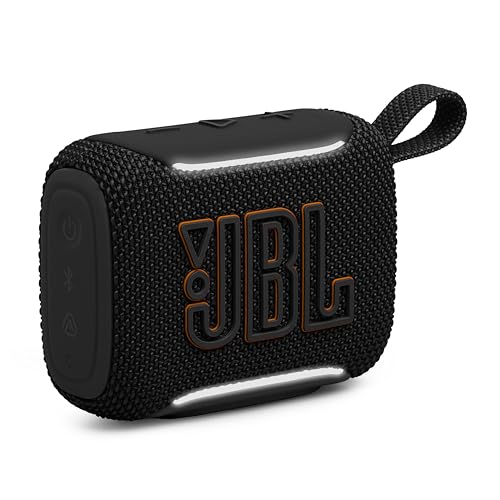
Spec line: 190 g, IP67, 7 hours rated, Bluetooth 5.4, Auracast, loop.
Best for: carry-on backpacks and day trips where weight is the main concern. Skip if: you want the speaker to last all day.
- Pro: Smallest speaker with a proper IP67 rating.
- Pro: Low price tier means a lost speaker is not a disaster.
- Pro: Auracast support lets you link it with a larger JBL speaker at home.
- Con: Seven hours rated is short for a long travel day.
- Con: Small driver, thin bass.
Sony SRS-XB100: best battery for a small speaker
Spec line: 274 g, IP67, 16 hours rated, Bluetooth 5.3, AAC and SBC, multiway strap, about 4.5 hours to charge.
Best for: long travel days and multi-day trips without a wall socket. Skip if: you want fast charging.
- Pro: Longest rated battery of the small speakers.
- Pro: The strap attaches to a bag, bike or hotel hook.
- Pro: AAC makes it a good match for an iPhone.
- Con: No quick charge.
- Con: Limited bass.
UE Miniroll: best for hotel rooms and showers
Spec line: 279 g, 12.3 x 10.5 x 4.8 cm, 7.5 W RMS, 12 hours rated, IP67, Bluetooth 5.3, silicone strap, floats.
Best for: a hotel bathroom, a bedside table or a pool. Skip if: you want wireless stereo pairing.
- Pro: Flat design that sits on a hotel counter or hangs on a hook.
- Pro: Floats and is waterproof.
- Pro: Clear voice-forward sound for podcasts and audiobooks.
- Con: No stereo pairing.
- Con: Costs more than speakers with similar volume.
Bose SoundLink Micro (2nd Gen): best sound in a tiny body
Spec line: IP67, 12 hours rated, Bluetooth 5.4, aptX Adaptive, USB-C, removable fabric strap.
Best for: travelers who care about tone and want it small. Skip if: you want the lowest price.
- Pro: Tuned to avoid the tinny sound of small speakers.
- Pro: Replaceable strap and metal grille suit rough handling.
- Pro: Supports aptX Adaptive on compatible Android phones.
- Con: Costs more than the Go 4 or XB100.
- Con: Battery is no better than cheaper speakers.
JBL Clip 5: best for clipping to a bag
Spec line: about 285 g, IP67, 12 hours rated (some sources 10 to 15), Bluetooth 5.4, built-in carabiner, Auracast.
Best for: backpackers and day-trippers who want the speaker attached. Skip if: you mostly listen on a table.
- Pro: The carabiner clips to a backpack, so it is always accessible.
- Pro: Louder than the Go 4.
- Pro: IP67 handles rain.
- Con: Does not stand reliably on a flat surface.
- Con: Published battery numbers conflict.
Bose SoundLink Flex (2nd Gen): best for calls on the road
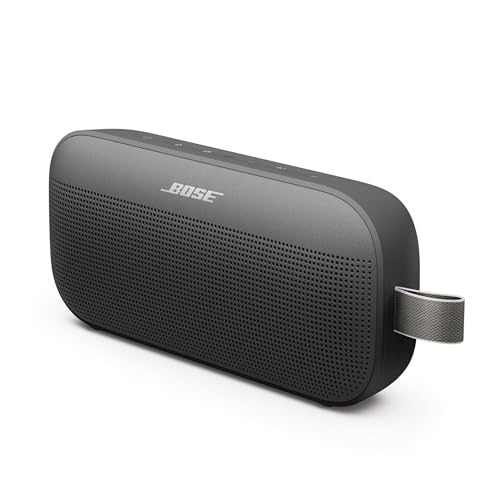
Spec line: IP67, 12 hours rated, about 590 g, Bluetooth 5.3, built-in microphone, aptX Adaptive, PositionIQ.
Best for: business travelers who want music in the hotel and the occasional call. Skip if: you want a lighter speaker.
- Pro: Balanced sound at moderate volume suits a hotel room.
- Pro: Built-in microphone for calls.
- Pro: PositionIQ keeps the tuning consistent in any orientation.
- Con: SoundGuys measured about seven hours of use, compared with 12 rated.
- Con: Heavier than the compact speakers.
Airline rules for speakers and batteries
Bluetooth speakers contain lithium-ion batteries, which aviation authorities regulate. The general rules, as published by aviation safety agencies such as the FAA, are consistent across most countries, but check your airline before you fly.
- Carry-on, not checked luggage. Devices with built-in lithium batteries are generally allowed in carry-on. Spare lithium batteries and power banks must travel in the cabin, not in checked bags.
- Under 100 Wh. Most portable speakers are far below the 100 Wh limit that triggers extra approval. The JBL Charge 6 battery is listed at about 34 Wh, which is well inside the limit. A power bank of 10,000 mAh holds roughly 37 Wh.
- Power bank rules. Power banks are treated as spare batteries, so keep them in the cabin. The Charge 6 power bank function does not change its classification as a device with a built-in battery.
- Switch it off. Turn the speaker off, not just muted, before it goes in a bag, so the button cannot be pressed accidentally.
- Security screening. A speaker may be pulled out for inspection. Pack it where you can reach it.
Weight math: count the grams against your allowance
Many budget airlines limit carry-on to 7 to 10 kg. A 560 g speaker is about 6 to 8 percent of that. A 190 g speaker is under 3 percent. A worked example for a one-bag traveler with a 8 kg allowance:
| Item | Weight | Share of 8 kg |
|---|---|---|
| JBL Go 4 | 190 g | 2.4 percent |
| Sony SRS-XB100 | 274 g | 3.4 percent |
| JBL Flip 7 | 560 g | 7.0 percent |
| JBL Charge 6 | 960 g | 12.0 percent |
For a weekend trip, 7 percent is acceptable. For a two-week one-bag trip, 2 to 3 percent is usually what travelers accept. The Charge 6 belongs in the car, not the carry-on.
Portable speakers for laptops and older devices
Some searches ask for speakers for a laptop or an iPod. A few practical notes:
- Laptops: Any Bluetooth speaker pairs with a laptop. For video calls or watching movies, check for audio lag; most modern speakers handle it, but a wired USB-C or 3.5 mm connection avoids delay entirely. The JBL Flip 7 supports USB-C audio from a computer.
- Laptop-specific small speakers: Compact USB-powered speakers and speakerphones are an option for desk use. A speakerphone like the Poly Sync 20 doubles as a travel speaker for calls.
- Older iPods and MP3 players: Players without Bluetooth need a speaker with a 3.5 mm line-in. Many modern small speakers have dropped the aux input, so check the specs. Alternatively, a small Bluetooth transmitter adds wireless audio to an older player.
- Battery-powered speakers: All speakers in this guide run on built-in batteries and charge over USB-C.
Which speaker for which kind of trip
| Trip type | Weight budget for a speaker | Pick | Reason |
|---|---|---|---|
| Carry-on only, one week | Under 300 g | Sony SRS-XB100 or JBL Go 4 | Lowest weight, IP67 |
| City break with hotel stays | Up to 600 g | JBL Flip 7 or Bose SoundLink Flex (2nd Gen) | Fills a hotel room with balanced sound |
| Beach or pool holiday | Up to 600 g | JBL Flip 7 or UE Miniroll | IP68 or floating, sand-safe |
| Backpacking, hostels | Under 300 g | JBL Clip 5 | Clips to the pack, shared-room friendly volume |
| Business travel with calls | Up to 600 g | Bose SoundLink Flex (2nd Gen) | Built-in microphone |
| Road trip by car | No tight limit | JBL Charge 6 | Large battery, power bank |
Charging abroad
Every speaker in this guide charges over USB-C, so you do not need a special charger. Most modern phone chargers and USB-C power bricks accept 100 to 240 V input, which covers wall power in nearly every country, so you only need a plug adapter, not a voltage converter. Check the small print on your charger for a range like 100-240V before you leave. A speaker that charges at a modest rate, such as 5 V at 2 A (10 W), fully charges the Go 4 in a couple of hours and a Flip-class speaker in three to four hours, so plug in overnight in the hotel rather than counting on a quick top-up at the airport.
A practical routine for a multi-day trip:
- Charge the speaker to full the night before you leave.
- Charge it again each night in the hotel along with the phone, using one multi-port USB-C charger.
- Keep a short cable and a small power bank in the day bag for beach days and train journeys.
- If the speaker will sit unused for the final days, leave it around half charged rather than full or empty.
Using a speaker in hotels and shared spaces
A speaker that sounds modest at home can be loud in a quiet hotel corridor or a hostel dorm. Reasonable habits make travel better for everyone:
- Keep the volume at a level only you can hear from the door. Sound level falls by about 6 dB each time you double the distance, so a speaker that seems moderate at 1 m is still audible through a thin wall.
- Use headphones in shared dorms, on trains, on planes and in waiting areas. Many airlines and train operators prohibit playing audio without headphones.
- Place the speaker on a soft surface, not directly on a bathroom counter or desk that carries vibration into the room next door.
- Turn the bass boost off in hotel rooms, because low frequencies pass through walls much more easily than treble.
- Be mindful in places of worship, museums and national parks where sound is not welcome.
Protecting the speaker and finding it again
A speaker packed in a suitcase takes the same knocks as the rest of the luggage. Put it in the middle of clothing, not against the shell, and keep the USB-C port free of lint. If you travel with a Beats Pill, Find My support helps you locate it if it is left in a taxi or a rental. For other speakers, a small luggage tag with an email address costs little and has helped many forgotten speakers find their owners. After a beach day, rinse the speaker in fresh water, dry it fully and wait until the USB-C port is dry before you charge it in the hotel.
Travel care and tips
- Pack the speaker in a soft pouch or a sock so the grille does not scratch.
- Bring one USB-C cable that works for the speaker, phone and earbuds case.
- Charge the speaker the night before a travel day and top up at the airport if there is a free outlet.
- In hotels, place the speaker on a hard surface at ear height for the best bass and clarity.
- Respect shared spaces: keep volume low in hotel corridors, trains and public areas.
Frequently Asked Questions
What is the best portable speaker for travel?
The JBL Flip 7 is the best balance of sound, durability and size at 560 g. For the lightest option, choose the JBL Go 4 at 190 g, and for the best battery in a small body, choose the Sony SRS-XB100 rated at 16 hours.
Can I take a Bluetooth speaker on a plane?
Yes. A speaker with a built-in lithium battery is generally allowed in carry-on luggage. Keep it in the cabin, switch it off, and keep spare batteries and power banks in the cabin too. Check your airline for the latest rules.
How long will a travel speaker battery last?
Rated figures assume moderate volume. At loud volume expect about half, so a 12-hour speaker lasts about six hours. Bring a power bank on trips longer than a weekend.
Should I get a waterproof travel speaker?
Yes, because beaches, pools, rain and hotel bathrooms all expose a speaker to water. An IP67 or IP68 rating also protects against dust and sand.
What is the best travel speaker for a laptop?
Any speaker in this guide works with a laptop over Bluetooth. For the best sound and no delay, the JBL Flip 7 also supports a wired USB-C audio connection. For calls, a speakerphone is better.
Is a bigger speaker worth carrying?
Only if you value bass and volume more than weight. For hotel rooms and small gatherings, a 300 g speaker is enough, while a 560 g speaker gives a noticeable step up in sound for a small cost in packing space.
More from Amazon
Programs that pair well with the guide above. Offers and eligibility are set by Amazon and may change.
Free shipping on eligible items, Prime Video and more. Eligible new members can start with a free trial.
Start a Prime free trialAd-free music streaming. Eligible new subscribers can start with a free trial.
Try Music Unlimited freeA Prime membership for ages 18-24 with a trial period. Eligibility is set by Amazon.
See Prime for Young AdultsAudiobooks and podcasts to listen to on the go. Eligible new members can start with a free trial.
Try Audible freeAs an Amazon Associate we earn from qualifying purchases.


