JBL sells so many portable speakers that the name alone does not tell you what to buy. The short answer: the Flip 7 is the best JBL for most people, the Charge 6 is the best for loud sound and long battery, the Clip 5 is the best for hiking and bags, the Go 4 is the best for a tight budget, the Xtreme 4 is the best for a big portable sound, and the PartyBox Club 120 is the best for events. This guide walks through JBL’s current portable lineup, who each model fits, what each gives up, and which non-JBL speakers are worth a look.
Specifications come from JBL’s published spec sheets and independent measurements. Where sources disagree, the more conservative number is shown. Price is given as an entry, mid or premium tier.
Our top picks
 JBL Charge 6
- Powerful JBL Pro Sound with AI Sound Boost:…
- Up to 28 hours of playtime + Fast…
- Multi-speaker connection by Auracast: Wouldn't it be great…
 JBL FLIP 5
- Wireless Bluetooth streaming
- 12 hours of playtime
- IPX7 waterproof
| Product | Key specs | |
|---|---|---|
| JBL Charge 6 | Powerful JBL Pro Sound with AI Sound Boost:… Up to 28 hours of playtime + Fast… Multi-speaker connection by Auracast: Wouldn't it be great… | Check price |
| JBL FLIP 5 | Wireless Bluetooth streaming 12 hours of playtime IPX7 waterproof | Check price |
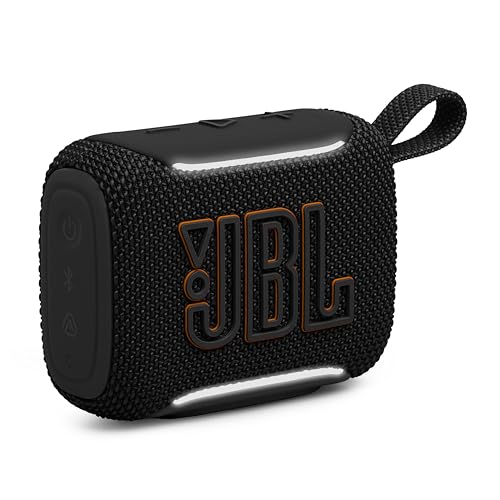 JBL Go 5 | Check price | |
 JBL Charge 6 | Check price |
As an Amazon Associate we earn from qualifying purchases at no extra cost to you.
JBL portable lineup at a glance
| Model | Weight | Rated battery | Rating | Best for | Price tier |
|---|---|---|---|---|---|
| JBL Go 4 | 190 g | 7 h | IP67 | Pocket, budget | Entry |
| JBL Clip 5 | about 285 g | 12 h (some pages 15 h) | IP67 | Backpack, hiking | Entry to mid |
| JBL Flip 7 | 560 g | 14 h (16 h with boost) | IP68 | All-round | Mid |
| JBL Charge 6 | 960 g | 24 h (up to 28 h with boost) | IP68 | Loud, long-lasting, power bank | Mid to premium |
| JBL Xtreme 4 | about 2.1 kg | 24 h (plus about 6 h boost) | IP67 | Big outdoor sound with strap | Premium |
| JBL PartyBox Club 120 | Large party speaker | 12 h | Splash proof | Parties, karaoke | Mid to premium |
All current JBL portable models in this table support Auracast, which means newer models can broadcast the same audio to each other. The Flip 7 and Charge 6 also support lossless audio over USB-C from a computer.
How JBL names its speakers
The names are a loose size ladder. Go is the smallest, Clip adds a carabiner, Flip is the cylinder, Charge is the larger cylinder with a power bank, Xtreme is the strap-carry speaker, Boombox is the large handle-carry speaker and PartyBox is the event-sized series with lights. The generation number is the year of redesign, so a Flip 7 replaces a Flip 6 and a Charge 6 replaces a Charge 5. Buying the current number matters because JBL changes Bluetooth versions, battery size and IP ratings between generations.
JBL Go 4: best JBL for a tight budget
Spec line: 190 g, IP67, 7 hours rated, Bluetooth 5.4, Auracast, loop.
Best for: carrying in a pocket or hanging on a bag. Skip if: you want to listen for more than a few hours between charges.
- Pro: Smallest speaker in the JBL line with a proper IP67 rating.
- Pro: Auracast support means you can later add a larger JBL speaker to the group.
- Pro: Lowest price tier in the guide.
- Con: Seven hours is short, and the small driver sounds strained at high volume.
- Con: Not a speakerphone replacement for a conference call.
JBL Clip 5: best for hiking and bags
Spec line: about 285 g, IP67, 12 hours rated (JBL Thailand lists up to 15 hours; other sources say 10 to 12), Bluetooth 5.4, integrated carabiner, Auracast.
Best for: clipping to a backpack, a belt, a tent loop or a bike frame with a third-party mount. Skip if: you will mostly place it on a table.
- Pro: The carabiner is built into the body and is wider than the Clip 4’s.
- Pro: The IP67 rating covers rain, mud and dust.
- Pro: Louder and fuller than the Go 4.
- Con: Plan on around 10 hours of use because retailer and review figures disagree.
- Con: The round shape does not sit stable on a flat surface without help.
JBL Flip 7: best JBL for most people
Spec line: 560 g, IP68, 14 hours rated (16 with Playtime Boost), 35 W RMS, Bluetooth 5.4, Auracast, USB-C lossless audio, JBL app with equalizer. No built-in microphone.
Best for: one speaker for the bag, the kitchen and the patio. Skip if: you need a speakerphone.
- Pro: Best size-to-volume balance in the lineup.
- Pro: IP68 is the highest rating among JBL’s portable cylinders.
- Pro: The app equalizer lets you tune bass, mids and treble.
- Con: SoundGuys measured about six hours at a steady 80 dB, so loud use is far below the rating.
- Con: No mic.
Relative to the Flip 6, the Flip 7 is a modest update: better Bluetooth range, USB-C lossless audio and Auracast support. SoundGuys summarized it as the same Flip with more features.
JBL Charge 6: best for loud sound and long battery
Spec line: 960 g, IP68, 24 hours rated (JBL Thailand lists 28), roughly 40 to 45 W, Bluetooth 5.4, power bank function.
Best for: the house, patio, camp trip, or any trip where you also need to charge your phone. Skip if: you prize small size above all else.
- Pro: The best battery of the cylinder-type JBL speakers.
- Pro: The USB-C power bank output charges a phone.
- Pro: Bigger drivers give fuller bass than the Flip 7.
- Con: Heavier at 960 g, nearly double the Flip 7.
- Con: Costs noticeably more than the Flip 7.
JBL Xtreme 4: best for big portable sound
Spec line: about 2.1 kg, IP67, 24 hours rated plus about 6 hours with Playtime Boost, Bluetooth 5.3, Auracast, strap, replaceable battery.
Best for: a beach trip, picnic or house party where you need to fill more space. Skip if: you carry the speaker daily.
- Pro: The strap makes a 2 kg speaker practical to carry on foot.
- Pro: Replaceable battery extends the life of the product.
- Pro: Bass depth is a clear step above the Charge 6.
- Con: Heavy and bulky for travel.
- Con: Sources disagree on its wattage and battery figures, so confirm the details at purchase.
JBL PartyBox Club 120: best for events
Spec line: 160 W RMS, two 5.25-inch woofers, two 2.25-inch tweeters, 34 Wh battery, up to 12 hours, light show, dual microphone and guitar inputs.
Best for: parties, karaoke and small events. Skip if: you want something truly portable on foot.
- Pro: Real party-level bass and volume.
- Pro: Inputs for microphones and guitars.
- Pro: Light show synced to the beat.
- Con: Heavy and large; it is a car-transport speaker.
- Con: Twelve hours at the rated level, but less at loud volume with lights.
JBL Boombox 4 and other large models
JBL also sells the Boombox 4, a large IP68 handle-carry speaker that sits between the Xtreme and the PartyBox in size. It suits buyers who want a loud home or yard speaker with bass and who do not plan to move it far. Because JBL changes large-speaker details more often than the small models, read the current spec page before you decide between the Xtreme 4, Boombox and PartyBox; the choice is about size, weight and whether you want lights and microphone inputs.
Which JBL should you buy? A decision matrix
| Your situation | Buy | Reason |
|---|---|---|
| Travel, pocket, first speaker | Go 4 | 190 g, IP67 |
| Hiking, backpack, camping | Clip 5 | Carabiner, IP67 |
| One speaker for everything | Flip 7 | 560 g, IP68, app EQ |
| Loud house or patio, long trips | Charge 6 | 24 h, power bank |
| Beach and picnic, big sound | Xtreme 4 | Strap, IP67, 24 h |
| Party, karaoke | PartyBox Club 120 | 160 W, mic inputs, lights |
Flip versus Charge: the most common comparison
These two speakers cost about a mid-tier step apart. The Flip 7 weighs 560 g, the Charge 6 weighs 960 g. The Flip is easier to carry; the Charge sounds bigger and lasts about 10 hours longer by the rating. Reviewers generally find the Flip 7 enough for a bedroom or small patio, and the Charge 6 better for a yard or camp. If you travel by plane or train, the Flip is the practical choice. If the speaker lives mostly at home or in a car, the Charge is worth the extra weight and cost.
A rough value calculation: treat the price gap between the two as a number G. If you listen five hours a week for two years, that is about 520 hours, so the extra power, runtime and bass costs G divided by 520 per hour. Spread over 520 hours, even a sizeable gap shrinks to a tiny cost per listening hour. If you will carry the speaker daily, the extra 400 g is a bigger cost than the price difference.
Auracast: linking JBL speakers
Auracast is a Bluetooth standard that lets one source send audio to many speakers. On current JBL models you start the broadcast on one speaker and join with others. It works across the Go 4, Clip 5, Flip 7, Charge 6 and Xtreme 4. It does not work with older PartyBoost-only speakers like the Flip 5 or Charge 4, so mixing old and new needs a different approach. In practice, buying a Go 4 as a second speaker to a Flip 7 or Charge 6 is the cheapest way to add a second room or a second side of the yard.
How to read a JBL spec sheet
JBL spec pages pack a lot of numbers into a small space, and a few of them are easy to misread.
- Playtime and Playtime Boost: The base figure is the runtime at moderate volume. Playtime Boost is a mode in the JBL app that lowers the maximum output slightly to add a couple of hours. It is a useful option on a long day, but it reduces peak volume.
- Output power (W RMS): JBL quotes continuous output rather than peak. Compare RMS to RMS. A 35 W Flip 7 against a 45 W Charge 6 is a small step in loudness, about 1 dB, and most of the difference you hear comes from the larger drivers and enclosure.
- IP ratings: The first digit is dust, the second is water. IP67 and IP68 both mean fully dust-tight. The second digit separates 1 m for 30 minutes (7) from deeper immersion (8). For normal use, the two are equivalent; treat IP68 as a bonus, not a necessity.
- Bluetooth version: Bluetooth 5.3 and 5.4 both support Auracast on JBL’s current models. The version matters less than whether the speaker has the Auracast feature enabled in firmware.
- Charging: All current models charge over USB-C. Only the Charge series offers power-bank output to charge other devices, which drains the speaker’s own battery quickly if you use it.
Common JBL buying mistakes
- Buying the previous generation by accident. Older stock of the Flip 6 or Charge 5 still sells. They are good speakers, but they lack Auracast and some newer features, so make sure the listing names the current number.
- Expecting a Clip 5 to behave like a Flip. It is a small speaker for a short walk or a campsite, not a living-room speaker.
- Ignoring weight. The Charge 6 and Xtreme 4 are excellent speakers that often stay at home because they are too heavy to carry daily.
- Assuming a PartyBox is waterproof. Splash proof is not the same as IP67; keep PartyBox speakers out of rain and away from pools.
- Counting on the largest battery rating. The Charge 6 rating of 24 to 28 hours is measured at moderate volume; loud outdoor use cuts that roughly in half.
Best alternatives to JBL
- Bose SoundLink Flex (2nd Gen): IP67, 12 hours rated, about 590 g, built-in microphone, and a smoother sound than the Flip 7. It is the usual JBL rival for people who care about tuning and calls.
- Soundcore Motion 300: 30 W, IPX7, about 13 hours rated. It costs less than the Flip 7 and gives a wide stereo-like sound.
- Sony ULT Field 1: IP67, a bass-boost ULT button, and a rated 12 hours. It is a good alternative when you want the biggest bass in a small speaker.
Ownership notes
- Update firmware through the JBL Portable app before blaming the speaker for pairing trouble.
- Rinse the speaker in fresh water after salt or chlorine and dry the USB-C port before charging.
- Do not leave the speaker in a hot car; the battery ages faster in heat.
- Store the speaker with about half a charge if you will not use it for months.
- Replace the Xtreme 4 or PartyBox battery when it fades instead of replacing the speaker, if JBL sells the module for your model.
Frequently Asked Questions
What is the best JBL portable speaker overall?
The JBL Flip 7 is the best overall. It balances size, loudness, waterproofing and features, and the app lets you tune the sound. The Charge 6 is a better pick if you want louder sound and longer battery and do not mind the extra weight.
Which JBL speaker is best for travel?
The Go 4 is the lightest at 190 g, and the Clip 5 adds a carabiner at about 285 g. For a better sound with a modest weight, the Flip 7 at 560 g is the best travel balance.
Is the JBL Charge 6 worth the extra cost over the Flip 7?
If you want louder sound, deeper bass, a battery that lasts about a day and the ability to charge your phone, yes. If you carry the speaker daily or need a small bag-friendly size, the Flip 7 is the better fit.
Are JBL speakers waterproof?
The Go 4, Clip 5 and Xtreme 4 are rated IP67, and the Flip 7 and Charge 6 are rated IP68. Both ratings include dust protection and immersion tests. PartyBox models are splash proof rather than waterproof, so keep them away from pools.
Can I connect two different JBL speakers?
Yes, if both support Auracast. The Go 4, Clip 5, Flip 7, Charge 6 and Xtreme 4 all do. Older PartyBoost-only speakers do not join Auracast groups.
How long do JBL speakers last?
Rated battery runs from 7 hours for the Go 4 to 24 hours or more for the Charge 6 and Xtreme 4. Real use at loud volume is about half the rating. The battery slowly loses capacity over several years of use.
More from Amazon
Programs that pair well with the guide above. Offers and eligibility are set by Amazon and may change.
Free shipping on eligible items, Prime Video and more. Eligible new members can start with a free trial.
Start a Prime free trialAd-free music streaming. Eligible new subscribers can start with a free trial.
Try Music Unlimited freeA Prime membership for ages 18-24 with a trial period. Eligibility is set by Amazon.
See Prime for Young AdultsAudiobooks and podcasts to listen to on the go. Eligible new members can start with a free trial.
Try Audible freeAs an Amazon Associate we earn from qualifying purchases.