Our Top Picks
The best rugged phone for most buyers is a mid-priced, big-battery model with an IP68/IP69K claim, NFC and a supported-bands list that matches their carrier, because durability only helps if the phone also connects reliably. In this group that points to the Blackview, OUKITEL and Ulefone listings, while the two 8849 models are pricier specialists with built-in projectors. We compared seven Amazon listings using only the claims in their titles.
Top picks at a glance

Ulefone Armor X13 Rugged Phones Unlocked, IP68/IP69K Waterproof Phone, MTk Helio G36 12GB+64GB, 50MP+24MP Night Vision Camera, 6.52" Display, 6320mAh, Android 16, NFC, Fingerprint ID, Black


As an Amazon Associate we earn from qualifying purchases. Product prices and availability are accurate as of the date/time indicated.

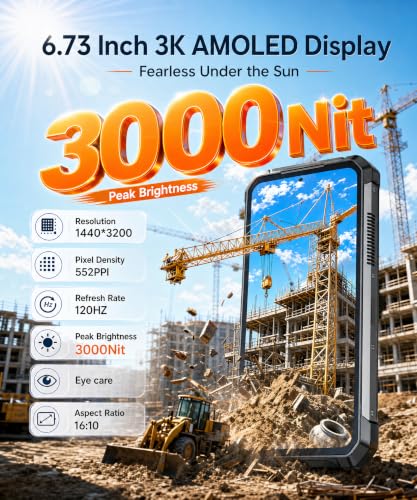
8849 Tank 5 eSIM Rugged Phone 5G, 6.73’’ 3K AMOLED Smartphone Android 16 | With 220LM/2K Projector, Waterproof Heavy Duty Industrial Work Cell Phone Unlocked,Large Battery OTG for Construction Camping



As an Amazon Associate we earn from qualifying purchases. Product prices and availability are accurate as of the date/time indicated.

G7 Rugged Phone Unlocked Android 16, 10600mAh Battery, 6.52'' Display | 16GB+64GB ROM Rugged Smartphone, 16MP+8MP Camera Cell Phone, 4G Dual SIM Waterproof Phone, IP68/IP69K/Fingerprint/Face ID/GPS


As an Amazon Associate we earn from qualifying purchases. Product prices and availability are accurate as of the date/time indicated.

8849 Tank X Phone 5G, Android 15 Rugged Smartphone with 220LM Projector | 6.78’’, Durable OTG Work Celular 512GB, IP68 Waterproof, Large Battery Unlocked Mobile Cell Phones for Outdoor Camping Hiking


As an Amazon Associate we earn from qualifying purchases. Product prices and availability are accurate as of the date/time indicated.

Blackview Rugged Phone 18GB+256GB 2TB Expand 10000mAh Battery Android 16 Gemini AI 6.56 Inch 90Hz, 4G T-Mobile Dual SIM IP69K Waterproof Rugged Smartphone Unlocked Fingerprint/NFC/OTG/GPS


As an Amazon Associate we earn from qualifying purchases. Product prices and availability are accurate as of the date/time indicated.

Ulefone Armor X12 Rugged Smartphone, Waterproof Phones Unlocked, Octa-core Android 13, 6GB+32GB, Dual SIM Global 4G LTE, 4860mAh Battery, Face Recognition, Bluetooth, NFC, Compass - Black


As an Amazon Associate we earn from qualifying purchases. Product prices and availability are accurate as of the date/time indicated.

Ulefone RugKing 3 Pro Rugged Phone Unlocked, Octa-core 16GB+128GB/2TB, Android 16, 6.56" 120Hz, 48MP+2MP+8MP, 5600mAh, IP69K & IP68 Proof, Water-Lock, Dock Charging, Al Assistant(Gemini), Orange


As an Amazon Associate we earn from qualifying purchases. Product prices and availability are accurate as of the date/time indicated.
| Model | Key point from the title | Price tier | Best for |
|---|---|---|---|
| Ulefone Armor X13 | IP68/IP69K, 6320mAh, 50MP+24MP night vision camera | Budget | Everyday rugged use on a tight budget |
| 8849 Tank 5 eSIM | 5G, 6.73” 3K AMOLED, 220LM/2K projector | Premium | Buyers who want a projector and 5G |
| OUKITEL G7 | 10600mAh battery, 4G dual SIM, IP68/IP69K | Budget | Maximum battery on a small spend |
| 8849 Tank X | 5G, 6.78” display, 220LM projector, 512GB | Premium | Camping and job-site projector use |
| Blackview 18GB+256GB | 10000mAh, 90Hz, 4G T-Mobile, IP69K | Mid-range | All-round balance of battery and storage |
| Ulefone Armor X12 | 4860mAh, Android 13, 6GB+32GB, NFC | Budget | Light use or a backup phone |
| Ulefone RugKing 3 Pro | 120Hz, 48MP main camera, 5600mAh, Water-Lock, dock charging | Mid-range | Smooth display and a better camera claim |
What is changing in rugged phones
Rugged phones used to mean thick, plain handsets for construction crews and field workers. The category now covers a wider mix, and the seven titles here show it. Battery capacity claims have climbed into five-figure milliamp-hour territory. Some models add 5G, AMOLED screens and 90Hz or 120Hz refresh rates that once belonged only to mainstream phones. Others add unusual extras such as built-in projectors, night vision cameras and dock charging.
Another change is the arrival of very new Android version numbers in listings. That is a seller claim, and it is worth confirming what actually ships and how long updates continue. Most rugged brands in this group are smaller manufacturers selling directly to Amazon shoppers rather than through carriers, so carrier compatibility, repair options and warranty handling vary and deserve your attention.
Accessory demand follows the same curve. Buyers now pair rugged phones with grips, cases and large power banks, and the add-on market can matter as much as the phone itself for people who spend long days away from an outlet.
Finally, the word rugged is not regulated in the way many buyers assume. A listing may mention IP68, IP69K or a drop-resistance standard, and each claim has a different meaning. These are general observations about the category, not statements about the performance of any one phone.
How the models were chosen
We read all seven titles side by side and compared battery capacity, memory, display, protection ratings, camera claims, network support and special features. We then layered on general knowledge about phone buying. Nobody on the team used or measured these units. Specifications in titles are seller claims, and anything missing is marked “check the listing” instead of guessed.
We also flagged oddities in the titles, such as the processor spelled “MTk”, the missing model name on the Blackview listing and the “16GB+64GB ROM” wording, because a confusing title often hides a confusing spec. When a listing mixes terms or omits ratings, we say so rather than fill in the gap.
Prices appear only as tiers relative to this group because they change frequently. We did not rank by star ratings or review counts.
Seven rugged phone listings, one by one
Ulefone Armor X13
The title lists IP68 and IP69K protection, a MediaTek Helio G36 processor (spelled “MTk” in the title), 12GB+64GB, a 50MP and 24MP night vision camera, a 6.52″ display, a 6320mAh battery, Android 16, NFC and fingerprint ID. It comes in black.
Look up how the Helio G36 handles the apps you rely on, since the title does not describe performance, and keep expectations modest for demanding games. The 12GB figure is probably memory plus virtual or extended memory, but the title does not explain, so check the listing for the true amount of RAM.
In practice this is the sort of listing that suits someone who wants a tough second phone for weekend trips or a workshop, not a power user. The night vision wording is a seller phrase, so expect the camera to be judged by sample photos on the page rather than by the label.
- Pros: dual protection ratings; sizeable battery; NFC; night vision camera claim.
- Cons: processor performance unstated; memory wording is ambiguous; modest storage of 64GB.
Check the listing for supported US bands, charging speed and software update plans. Ask before buying: will this processor feel quick enough for the apps I use daily?
8849 Tank 5 eSIM Rugged Phone 5G
The priciest listing here and the most ambitious. The title offers 5G, eSIM, a 6.73” 3K AMOLED display, Android 16, a 220LM/2K projector, waterproof heavy-duty construction, OTG, a large battery and a pitch for construction and camping.
A projector in a phone is a distinctive feature, but 220 lumens is a modest figure and image quality will depend heavily on darkness and distance. The unusual feature is a bet that you will use it. The title also leaves out the battery capacity, memory and any IP rating, so those are essential to check.
Think of the use case first. A site supervisor who wants to show drawings on a wall, or a camper who wants a movie at the tent, is the target buyer. Everyone else is paying for a feature they will seldom use, and the sealed-body durability and battery claims deserve the same scrutiny as on any rival.
- Pros: 5G; AMOLED display; projector; eSIM support claim.
- Cons: highest price tier; key specs missing from the title; projector use drains the battery and adds heat.
Never shine the projector into anyone’s eyes. Check the listing for the IP rating, battery size and supported bands. Question: will I truly use a pocket projector often enough to pay a premium?
OUKITEL G7 Rugged Phone
The headline is battery: 10600mAh. The title adds a 6.52” display, Android 16, 16GB+64GB ROM (an unusual wording to confirm), a 16MP and 8MP camera setup, 4G dual SIM, waterproofing, IP68/IP69K, fingerprint and face unlock, and GPS.
Capacity at this level is rare and costs weight, but it can mean multi-day use for light users. The camera numbers are modest, and 4G rather than 5G keeps the price down. The “ROM” label is odd next to 16GB, so ask the seller what the memory figures actually mean.
Picture a long field trip with no outlet, a cabin, or a delivery driver who runs navigation all day. That is where a battery this size can earn its keep. For someone who charges nightly at a desk, the extra capacity mostly adds weight.
- Pros: largest battery claim in the group; dual protection ratings; dual SIM; low price tier.
- Cons: 4G only; ambiguous memory wording; smaller camera sensors claimed; likely heavy.
Check the listing for weight, charging speed and the supported bands. Ask yourself: is a 10600mAh battery worth the weight in my pocket?
8849 Tank X Phone 5G
This second 8849 model runs Android 15 and offers 5G, a 6.78” display, a 220LM projector, OTG, 512GB of storage, IP68 waterproofing and a large battery, aimed at camping, hiking and work. It is unlocked.
The 512GB storage claim is generous, useful for maps, photos and videos in the field. IP68 is stated but IP69K is not, so it may not be rated for high-pressure hot water. As with its sibling, the battery capacity is not in the title.
The large storage makes more sense for people who download offline maps or record lots of video on trips, and OTG support suggests plugging in drives or accessories if the phone supports it. Confirm both on the listing, and ask how the phone handles heat when the projector runs for a long stretch.
- Pros: 5G; big storage; projector; IP68 claim.
- Cons: premium price tier; battery size unknown; an older Android version than most other listings here.
Check the listing for the battery capacity, chipset and bands. One question: do I need both 5G and a projector, or would a cheaper rugged phone suit me?
Blackview Rugged Phone, 18GB+256GB, 10000mAh
The title does not give a model name, which makes this listing harder to research. It cites 18GB+256GB with up to 2TB expansion, a 10000mAh battery, Android 16, Gemini AI, a 6.56 inch 90Hz screen, 4G with T-Mobile mention, dual SIM, IP69K, fingerprint, NFC, OTG and GPS.
It balances big battery, big storage and a smoother 90Hz refresh rate at a mid-range price. The T-Mobile wording is encouraging for US buyers, but it does not prove it will work on every network. Note that IP68 is not listed, only IP69K.
This is the listing to consider if you want one phone that does a bit of everything. A trade worker could keep maps, manuals and photos on it, and the 2TB expansion wording presumably refers to microSD capacity, though the title does not say so. Verify the slot and the largest card size it supports.
- Pros: large battery; plenty of storage plus expansion claim; 90Hz screen; NFC.
- Cons: no model name; 4G only; IP68 not stated in the title; weight unknown.
Check the listing for the exact model name, update policy and supported bands. Before buying, ask: how will I get support or a replacement if something fails?
Ulefone Armor X12
The weakest class in the group. The title lists Android 13, 6GB+32GB, 4G LTE dual SIM, a 4860mAh battery, face recognition, Bluetooth, NFC and a compass. It does not state IP ratings in the title, which is surprising for a rugged phone.
With the smallest battery, the least storage and the oldest Android version here, this is best seen as a backup or light-duty phone. It may suit a spare for a toolbox or a vehicle. For daily use by someone who stores many apps and photos, 32GB can fill quickly.
Its best role is as a dedicated tool phone: a navigation unit in a truck, a spare in a bag, or a phone for a teenager who drops everything. The compass mention fits outdoor use, but confirm it is a hardware sensor that works as expected.
- Pros: lowest price tier; NFC; compass; dual SIM.
- Cons: older Android version; smallest battery; limited storage; rating details missing from the title.
Check the listing for the IP rating, screen size and update policy. Question: would a newer listing for a little more money give me a longer useful life?
Ulefone RugKing 3 Pro
The title lists 16GB+128GB with a 2TB expansion option, Android 16, a 6.56″ 120Hz display, a 48MP+2MP+8MP camera set, a 5600mAh battery, IP69K and IP68, Water-Lock, dock charging and a Gemini assistant. It is orange.
The 120Hz screen and 48MP lead sensor are the most mainstream-style claims in the group, and Water-Lock sounds like a wet-screen feature, though the title does not explain it. Dock charging suggests contacts for a cradle, which can be useful on a workbench or in a vehicle. The battery is smaller than the 10000mAh models.
Because the title mentions both IP69K and IP68, this phone is pitched at wet and dirty jobs, with a display that is meant to feel more like a modern phone than an industrial tool. Whether a faster screen is worth giving up battery capacity depends on how often you can top up.
- Pros: 120Hz display claim; higher-megapixel main camera; dual ratings; dock charging.
- Cons: battery smaller than the big-battery rivals; extra camera sensors are small; the dock may not be included.
Check the listing for whether a dock ships in the box and for the supported bands. Ask: do I value a smoother screen more than a bigger battery?
Which matters most: battery, durability or speed
If you are away from power for days, battery wins, and the OUKITEL and Blackview titles claim the biggest cells. If you work around water, dust or cleaning sprays, durability ratings matter most, and listings that state both IP68 and IP69K cover more cases than those that state only one. If you use the phone for navigation, messaging and camera work all day, a faster screen and processor claim like the RugKing 3 Pro’s may matter more than another thousand milliamp-hours.
Few buyers get all three. A large battery adds weight, a smoother display uses more power, and very strong protection adds bulk. Decide which one you would sacrifice last and choose around it, then use the listing details to confirm the claims.
Rugged phone buying guide
Rugged phones trade size and price for toughness, so the right pick depends on your environment. These sections convert title claims into questions.
Durability ratings
IP68 generally concerns dust and immersion, while IP69K concerns high-pressure, high-temperature water jets. Neither guarantees drop survival. Some listings mention only one rating. A manufacturer’s drop claim, where given, depends on the maker’s own method, so look for specific heights and surfaces on the listing. Always close port covers fully and follow the user guide for rinsing after exposure to salt water or chemicals.
Battery
Capacity in milliamp-hours indicates stored charge, but screen brightness, network strength and apps decide the runtime. Larger batteries take longer to charge and add weight. Charging speed is therefore as important as capacity, and the titles here seldom state it.
Connectivity and carrier support
This is the most common cause of regret. Check that the phone supports the LTE or 5G bands your carrier uses, plus voice over LTE if your carrier requires it. Look for NFC if you want contactless payments. A listing that names a US carrier gives a hint but is not a guarantee.
Display and processor
AMOLED screens and higher refresh rates look better, while entry-level processors may stutter in demanding apps. Brightness and glove or wet-touch support matter outdoors, and titles rarely cover them.
Cameras
Megapixel counts are not a quality measure. A 50MP sensor in a budget phone can still produce ordinary photos. Night vision wording is a seller claim, so treat it as a feature to verify.
Memory, storage and software
Confirm real RAM versus extended memory, check for a microSD slot where expansion is claimed, and ask about updates. A rugged phone often stays in service for years, so security patches matter.
Care and long-term ownership
Rugged does not mean maintenance-free. Rinse the phone with clean water if the manual allows it after exposure to mud or sand, keep the charging port and any covers clean and dry, and check seals for cracks. Seals can wear with age, and a rating applies to a new, undamaged phone. Replace worn port covers, and keep a screen protector on if the screen is not described as strengthened. Ask about warranty terms and repair options before buying, since smaller brands vary widely.
Who should skip a rugged phone
If you rarely face water, dust or drops, a mainstream phone in a good case may be lighter, faster and better supported. Rugged models make sense when the environment is genuinely hard on devices, when you need a multi-day battery, or when you want a durable backup. Otherwise, the bulk can be an annoyance.
Safety
Do not charge a damaged or swollen battery, and stop using it if it gets unusually hot. Use the supplied or an approved charger, follow the manufacturer’s instructions, and keep the projector light away from eyes. Do not use any phone while driving.
| Spec concept | What to look for | Why it matters |
|---|---|---|
| Ingress protection | IP68 and IP69K stated, with user guide detail | Dust, immersion and washdown protection differ |
| Battery and charging | mAh, charge speed and charger included | Capacity without fast charging means long refills |
| Network bands | Your carrier’s LTE and 5G bands and VoLTE | Poor band support means weak coverage |
| Memory and storage | Real RAM, storage and microSD slot | Titles often mix physical and virtual memory |
| Software | Android version and update promise | Security patches over years of use |
| Size and weight | Stated weight and thickness | Pocket comfort and hand fatigue |
Battery runtime worked example
These figures are illustrative assumptions, not measurements. Phone makers quote capacity in mAh at a nominal voltage, and a common planning figure is about 3.85 V. On that basis, a 10,000 mAh battery holds roughly 38.5 Wh, a 5,600 mAh battery about 21.6 Wh and a 4,860 mAh battery about 18.7 Wh.
If we assume a day of mixed use averages around 1.2 W, which is a made-up round figure, then 38.5 Wh would last about 32 hours, 21.6 Wh about 18 hours and 18.7 Wh about 15.6 hours. Heavier use such as constant 5G, a bright display or the projector could push consumption well above that, shortening each estimate. Charging losses and battery aging reduce the real numbers further. Use the arithmetic to compare capacity ratios, not to predict your exact day.
Charging adds another angle. If a 10,000 mAh battery (about 38.5 Wh) were refilled by an 18 W charger, and ignoring losses, a full charge would need roughly two hours at best, and more in practice. A smaller battery on the same charger refills sooner. The titles here do not state charging power, so find it on the listing before assuming a quick top-up.
Mistakes buyers make
Ignoring network bands. A great phone that cannot use your carrier’s bands is a poor purchase.
Chasing mAh alone. Charging speed, weight and software efficiency matter just as much.
Trusting vague memory wording. Terms like 12GB+64GB or 16GB+64GB ROM need clarifying.
Assuming rugged means indestructible. Ratings have limits, and screens can still crack.
Skipping the update question. Smaller brands may offer few patches.
Forgetting the screen. Most listings in this group describe the body, not the glass. Check what protects the display and whether a protector is included.
Buying gimmicks first. A projector or night vision camera is fun but does not replace good basics.
Forgetting accessories. A rugged phone case for work or a power bank can matter for some jobs. See also our guides to power banks for cell phones and solar power banks.
Verdict by use case
Best value for battery: the OUKITEL G7 for its 10600mAh claim, or the Blackview listing for more storage and a smoother screen.
Budget everyday rugged phone: the Ulefone Armor X13.
Smoother screen and camera: the Ulefone RugKing 3 Pro.
Projector and 5G: the 8849 Tank 5 or Tank X, only if you will use the projector.
Backup or light-duty: the Ulefone Armor X12, accepting its smaller battery, older Android version and limited storage.
If you are unsure: start with the Blackview or RugKing 3 Pro listings, read the full page for bands and update policy, and choose whichever answers more of your questions in writing. A listing that is specific about its claims is easier to trust than one that is not.
If you want a mainstream phone instead, see the newest Android phones, and if you plan to hold a large handset one-handed, consider phone grips for large phones.
Frequently asked questions
What does IP68 or IP69K mean on a rugged phone?
The IP code describes dust and water protection. In general, IP68 refers to dust-tight protection and the ability to be submerged under conditions the maker defines, while IP69K refers to resistance to close-range, high-pressure, high-temperature water jets. These are manufacturer claims under set conditions, and they do not cover every real-world situation such as salt water, soap or drops. Check the listing and the user guide for the exact depth, time and port-cover instructions.
Will a rugged phone work on my US carrier?
It might, but you must verify it. Unlocked phones from overseas brands often support a limited set of US network bands, and missing bands can mean slow data, weak coverage or no voice over LTE. Look for the supported bands in the listing, compare them with your carrier’s published list, and ask the seller if you are unsure. One listing here mentions T-Mobile, which is helpful but not a guarantee of full coverage.
Are rugged phones heavier than regular phones?
Generally yes. Thicker frames, rubber bumpers, sealed ports and large batteries add weight and bulk, so a rugged phone is usually chunkier than a mainstream phone. That is the trade-off for durability and battery life. The titles here give no weights, so check the listing and, if you can, compare against a phone you already carry to see whether the pocket fit works for you.
How long do rugged phone batteries last?
Capacity is only part of the answer. A 10,000 mAh battery holds roughly twice the charge of a typical 5,000 mAh one, but screen brightness, 5G use, a bright display and background apps can all drain it faster. As a planning guess, big-battery rugged phones often last into a second day of normal use, though the real result depends on you. Check charging speed too, since a huge battery can take a long time to refill.
How long will a rugged phone get software updates?
Many rugged phones from smaller brands receive fewer updates than mainstream phones, and the listings here do not state an update policy. Because security patches matter for any phone you carry for work, look for a written commitment from the maker, or plan to replace the phone sooner. Be cautious with listings that advertise a very new Android version, since you should confirm what version actually ships.
Is a built-in projector on a rugged phone useful?
It can be fun for camping, toolbox talks or a quick presentation in a dim space, but it has limits. A figure like 220 lumens is small compared with dedicated projectors, so you need darkness, a close wall and low expectations. Projection also drains the battery and generates heat. Treat it as a bonus feature, not the main reason to buy, and never point the beam at anyone’s eyes.