The best solar power banks for most people are a high-capacity USB-C battery with a built-in panel for emergency top-ups—not a solar panel that can quickly refill the battery during a normal day.
Solar cells on compact power banks are small, shaded easily, and usually produce far less energy than the battery can store. Choose by usable battery capacity and wired charging speed first, then treat solar charging as a backup feature. For serious off-grid use, a separate folding solar panel paired with a rugged power bank is usually the better setup.
Our top picks
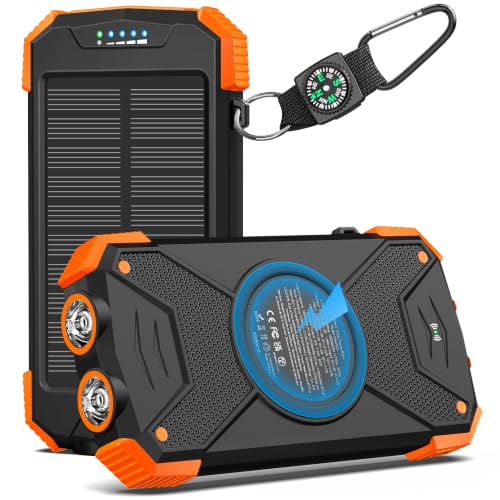 BLAVOR Solar Power Bank 10
- Brand-Oriented and Outdoor Charger Pro: With over 10…
- Leading USB C Input Output Tech and Wireless:…
- Premium Battery and Smallest Solar Charger: BLAVOR uses…

As an Amazon Associate we earn from qualifying purchases at no extra cost to you.
Best solar power banks at a glance
| Pick | Best for | Battery and charging | Solar design | Approx. weight | Typical market range |
|---|---|---|---|---|---|
| BLAVOR 10,000mAh Solar Charger | Light emergency carry | 10,000mAh rated; USB charging; wireless charging on supported versions | Small built-in panel | About 0.5 lb / 225g | Check on Amazon |
| Hiluckey HIS7 Solar Charger | Higher capacity and camping backup | 25,000mAh rated; multiple USB outputs; fast wired charging varies by revision | Four-panel folding array | About 1.1 lb / 500g | Check on Amazon |
| ADDTOP 25,000mAh Solar Charger | Budget multi-panel charging | 25,000mAh rated; USB outputs; commonly listed with up to 22.5W output | Four folding panels | About 1.0–1.2 lb / 450–550g | Check on Amazon |
| Goal Zero Venture 35 | Rugged trips with a separate solar panel | 9,600mAh rated; USB-C Power Delivery up to 18W | No built-in panel; compatible with Nomad panels | About 0.6 lb / 270g | Check on Amazon |
Capacities above are manufacturer-rated cell capacities. Usable USB output is normally lower because of voltage conversion, cable losses, heat, and the phone’s charging circuitry. A practical rule is to expect roughly 60–75% of the printed capacity at the phone.
Our picks by situation
Best for a lightweight emergency kit: BLAVOR 10,000mAh
A 10,000mAh BLAVOR-style solar charger is the sensible choice for day hikes, festivals, commuting emergencies, and occasional blackouts. It is smaller and easier to carry than four-panel models, and its capacity is enough for roughly one and a half to two full charges for many modern phones.
The built-in panel is useful for slowing battery drain or adding a small amount of energy when the charger is left in direct sun. It is not a reliable way to recharge the entire power bank. Wireless charging can be convenient, but it is slower and less efficient than using a cable, particularly outdoors where alignment can shift.
Choose this type if your priority is low weight. Avoid it if you need to charge two phones repeatedly or if your phone has a large battery above about 5,000mAh.
Best built-in-panel option for camping: Hiluckey HIS7
The Hiluckey HIS7’s four-panel folding design exposes substantially more solar area than a single-panel brick. That makes it a better choice for camping, travel, and emergency preparedness when you can leave the panels unfolded in direct sunlight for several hours.
Its 25,000mAh rating provides useful reserve capacity, but the larger battery also takes longer to refill. The multiple USB outputs are practical for sharing power, although connecting several devices divides the available output and can reduce charging speed. It is bulky in a pocket, yet reasonable in a backpack.
This is the better built-in solar choice when you want one self-contained unit and accept that solar charging is measured in partial top-ups rather than a quick refill.
Best budget alternative: ADDTOP 25,000mAh Solar Charger
ADDTOP’s four-panel 25,000mAh format is aimed at shoppers who want a large reserve without buying a separate panel and battery. Models in this line are commonly advertised with multiple USB ports and output figures reaching 22.5W, but check the exact revision: port combinations, USB-C input, and fast-charging support can differ.
Its main advantage is value per stored watt-hour. Its compromises are familiar: substantial weight, a slow built-in solar panel, and less dependable water resistance than a dedicated outdoor power system. Treat the unit as splash-resistant only when the specific listing states an ingress rating, and keep its ports covered around dust and rain.
Best for serious outdoor use: Goal Zero Venture 35 with a Nomad panel
The Venture 35 is not a built-in solar power bank, but it is a more capable outdoor solution. The battery is rated at 9,600mAh, supports USB-C Power Delivery up to 18W, and has an IP67-style rugged design in the Venture range. Pairing it with a compatible Goal Zero Nomad panel gives the solar cell a larger surface area and a better angle toward the sun than a panel attached to a handheld battery.
This combination costs more and requires two pieces, but it is easier to replace or upgrade separately. It is the strongest option for frequent camping, backpacking, and people who need predictable solar collection rather than a novelty charging feature.
Best separate panel to pair with a power bank: FlexSolar 20W Foldable Solar Panel Charger

The guidance above says a separate panel plus a rugged battery usually beats a power bank with a tiny built-in cell. The FlexSolar 20W is a straightforward way to try that approach. The listing describes a foldable panel with 5V USB-A and USB-C outputs, an IP67 waterproof rating and a compact, lightweight format for camping and hiking. Outdoor testing sites that rank panels have repeatedly put FlexSolar models near the top for charging speed.
It suits hikers and campers who already own a power bank or want to top up a phone directly in sunlight. You clip or strap it to a pack, aim it at the sun, and plug a cable straight into the phone or into a power bank with pass-through support. Because the panel is larger than the cells inside a built-in model, it gathers noticeably more sunlight per hour.
The strengths are the large collecting area, water resistance and the fact that it is a separate part, so you can replace the battery or the panel on its own. The drawbacks are that it provides trickle-style output of 5V, so it will not fast-charge, and it does not store power by itself. Cloud cover, heat and angle all cut output. Weight is not listed in the summary data. Compare it with the Goal Zero Venture 35 and Nomad pairing in this guide: this is the budget-tier route to the same idea.
Best high-output foldable panel: BigBlue 60W Portable Solar Panels

If you want to charge more than a phone, a larger panel makes sense. The BigBlue listing describes a 60W foldable panel with a built-in kickstand, an IP68 rating and multiple outputs: 45W USB-C Power Delivery, 20W USB-A and a DC port. That makes it capable of feeding a tablet, a camera battery or a compact power station as well as a phone.
It suits basecamp use, van travel and emergency kits where the panel can sit unfolded in direct sunlight for hours. The kickstand helps you angle the panel toward the sun without improvising a support.
Strengths include the high stated output, the sturdy water and dust rating and the useful port mix. Weaknesses are the bulk and weight compared with a pocket power bank, the mid-range to premium price tier and the need to pair it with a battery for evening use. Real output depends heavily on sun angle and weather, so treat the 60W figure as a ceiling rather than a typical number. This is overkill for a day hike and an excellent choice for a weekend away from mains power.
Best for rugged panel pairing: Goal Zero Nomad 20 Solar Panel
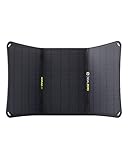
The Goal Zero Venture 35 pick above references a Nomad panel as its partner, and the Nomad 20 is the smaller of those panels. The listing describes a foldable 20-watt monocrystalline panel with an 8mm output and a USB port, built for outdoor use alongside Goal Zero batteries.
It fits backpackers and campers who want a proven ecosystem and are willing to pay a premium tier for it. The panel is built to be strapped to a pack and left in the sun while you hike or sit at camp, then folded away.
The advantages are the quality build, the established pairing with the Venture battery line and the good reputation among outdoor reviewers. The disadvantages are the premium price tier and the fact that a cheaper 20W panel from another brand produces similar raw power. Pay for it if you value durability and the matching ecosystem; skip it if you only need occasional emergency top-ups.
Best large-capacity reserve: YELOMIN 38,800mAh Solar Power Bank
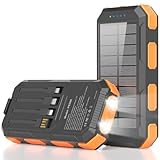
Some buyers want a lot of stored energy and treat the solar cell as an emergency extra. The YELOMIN listing describes a 38,800mAh power bank with 22.5W USB-C fast charging, four built-in cables and solar charging as a backup. A battery this size can recharge a typical phone several times from a wall outlet before a trip.
It suits road trips, power outage kits and families who want one battery that covers several devices. Built-in cables reduce the chance of arriving without the right one.
Strengths are the large capacity, the fast-charge rating and the integrated cables. The main weakness is the same as every high-capacity power bank with a small panel: refilling it from the sun would take many days, so plan to charge it from the wall. Printed capacity is also higher than usable capacity, as the numbers section above explains, and built-in cables are less flexible than separate ones if one fails. Weight and ingress rating are not listed in the summary data.
Best budget mid-capacity option: GOODaaa 24,000mAh Solar Power Bank
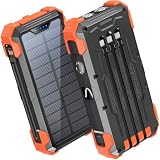
GOODaaa’s listing describes a 24,000mAh power bank with four built-in cables, fast charging and an SOS flashlight. It sits between the compact 10,000mAh BLAVOR and the 25,000mAh multi-panel designs, and it is priced at the budget tier.
It is a sensible choice for a glovebox or go-bag where the main job is to hold a charge and the solar cell is a backup. The flashlight adds a practical emergency feature.
The positives are the capacity for the price tier, the built-in cables and the flashlight. The negatives are brand recognition, unknown real-world panel performance and no stated ingress rating in the summary data. For regular outdoor use in rain or dust, the IP-rated panels above are a safer bet. Compared with ADDTOP, it is a similar concept in a simpler single-panel form.
What the numbers mean in actual phone use
Suppose your phone has a 4,500mAh battery and your power bank is rated at 25,000mAh. The printed figures cannot be compared directly because the power bank’s cells are usually measured around 3.7 volts, while USB output is around 5 volts or higher. After conversion losses, assume 65% usable capacity:
25,000mAh × 0.65 = about 16,250mAh delivered by USB.
Then divide by the phone’s battery rating:
16,250 ÷ 4,500 = about 3.6 theoretical charges.
In practice, allow for the phone being used while charging, heat, cable losses, and battery-protection limits. Three full charges is a more realistic planning figure. A 10,000mAh unit may provide about one full charge plus a partial second charge for the same phone.
Solar performance: the detail listings often hide
- Panel area matters. Four folding panels can collect several times more energy than one narrow panel mounted on a battery case.
- Rated watts are not guaranteed watts. Bright sun, panel angle, temperature, dust, and shadows can reduce output sharply.
- Solar charging is slow at this size. A built-in panel may add a useful partial charge over a full sunny day, but a complete refill can take multiple days.
- Do not charge in a hot car. Dark batteries and phones can become hot enough to trigger charging slowdowns or accelerate battery wear.
- Keep the phone separate while solar charging. Let the panel replenish the power bank first, then charge the phone from the stored battery. This avoids unstable output from passing clouds.
Decision matrix
| Your situation | Recommended format | Why | Accept the trade-off |
|---|---|---|---|
| Rare emergencies, smallest bag | 10,000mAh single-panel unit | Lower weight and enough capacity for a phone top-up | Very slow solar recovery |
| Weekend camping, one or two phones | 20,000–25,000mAh four-panel unit | More reserve and more usable solar area | About twice the bulk of a compact model |
| Frequent outdoor use | Rugged power bank plus folding solar panel | Better collection, faster wired charging, replaceable components | Higher cost and two-piece setup |
| Fast-charging modern phone | USB-C PD power bank rated at 18W or more | Shorter charging stops and wider device compatibility | Built-in solar models may not support the advertised speed on every port |
Solar Power Bank Types Compared
| Type | Solar Refill Speed | Best For | Weakness | Price Tier |
|---|---|---|---|---|
| Power bank with one small built-in panel | Very slow | Emergency backup top-ups | Panel too small for real refills | Budget |
| Power bank with folding multi-panel array | Slow to moderate | Camping, power outages | Bulky, panels exposed to damage | Budget to mid-range |
| Separate foldable panel plus battery | Moderate | Multi-day trips | Two items to carry | Mid-range |
| Large panel with USB-C PD output | Fastest | Basecamp, van travel, tablets | Heavy, needs good sun | Mid-range to premium |
How Much Solar Output to Expect
Outdoor panel tests measure the energy generated in one hour of direct and indirect sunlight, and the results show a wide gap between claims and real life. A few rules of thumb help.
- Look at panel wattage, not battery size. A tiny panel on a large battery refills at a trickle. A panel of about 10 to 20 watts is the practical starting point for phone-level top-ups.
- Judge capacity in watt-hours. Divide milliamp-hours by 1,000 and multiply by about 3.7 volts for a rough figure. A 10,000mAh bank is around 37 watt-hours, and usable output is lower.
- Expect partial sun. Clouds, haze, tree cover and a poor angle can cut output sharply. Rotate the panel toward the sun every hour or so.
- Heat hurts. Leaving a power bank baking in a closed car or on a dark surface reduces its efficiency and battery life.
Waterproof Ratings Explained
| Rating | What It Means | Suitable For |
|---|---|---|
| IPX4 or IPX5 | Splash or light spray resistant, not dust rated | Light rain, sweat |
| IP65 | Dust tight and resistant to water jets | Hiking in rain |
| IP67 | Dust tight, survives brief immersion | Kayaking, wet camping |
| No rating listed | Assume not weatherproof | Indoor and car use |
Many solar power banks advertise water resistance without a formal rating. If the listing does not give an IP number, treat it as splash resistant at best and keep the ports covered.
Mistakes to Avoid When Buying a Solar Power Bank
- Believing the solar claim. A power bank described as charging itself in a day is not realistic. Charge it from a wall outlet before a trip.
- Ignoring weight. A 50,000mAh unit can weigh more than a pound and a half, which matters on a long hike.
- Trusting capacity numbers across brands. Printed milliamp-hour figures are measured at the cell and do not match what reaches your phone.
- Skipping the cable check. Look for USB-C in and out if you want fast charging, and check whether built-in cables are your only option.
- Charging at high temperature. Lithium cells age faster in heat, so keep the unit shaded when possible.
Who Should Skip a Solar Power Bank
- Commuters and travelers with regular access to outlets, who are better off with a lighter standard power bank.
- Anyone who needs to charge a laptop or several devices daily off-grid, where a portable power station and a larger panel fit better.
- People who expect full recharges from sunlight in a day.
- Hikers counting every ounce, where a standard 10,000mAh bank without solar saves weight.
Durability and ownership realities
The first parts to wear are usually the USB port covers, hinge points on folding panels, and cable connectors—not the solar cells themselves. Repeatedly hanging a heavy battery from a backpack can stress the panel hinges, so place the unit on a stable surface when charging.
Wipe panels with a soft, slightly damp cloth. Grit can scratch the surface and reduce light transmission. Do not use abrasive cleaners, and do not fold panels while wet. Recharge the battery every three to six months during storage; leaving a lithium battery completely empty for a long period can make it difficult or impossible to recover.
Water resistance is not the same as waterproof operation. Close port covers before exposure, avoid charging while the unit is wet, and check the stated IP rating rather than relying on phrases such as “outdoor” or “waterproof.” A flashlight, compass, and wireless charging pad can be useful extras, but they should not outweigh a weak USB-C implementation or an unprotected battery.
Frequently Asked Questions
Do solar power banks really charge from the sun?
They do, but slowly. A small built-in panel adds only a small amount of charge over several hours, so treat it as an emergency top-up.
How long does it take to charge a solar power bank with the sun?
It depends on panel size and sunlight. A built-in panel on a large battery can take many days of direct sun. A separate panel of 20 watts or more is much faster.
Are solar power banks waterproof?
Only if the listing gives an IP rating. Many advertise water resistance without one. Look for IPX5 or higher if you will use it in rain.
Can I take a solar power bank on a plane?
Lithium power banks generally must go in carry-on baggage, and airlines limit capacity in watt-hours. Check your airline’s rules before flying with a large unit.
Is a bigger mAh number always better?
No. A bigger battery weighs more and takes far longer to refill from solar. Pick the capacity that matches your devices and trip length.
Can I charge my laptop with a solar power bank?
Only models with high-wattage USB-C Power Delivery output can charge a laptop. Most solar power banks are designed for phones and small devices.
Bottom line
Buy the BLAVOR 10,000mAh format for occasional emergency use and minimum weight. Pick the Hiluckey HIS7 or ADDTOP four-panel format when you want the most practical built-in solar collection and a large reserve. For repeated camping or dependable off-grid charging, skip the tiny integrated panel and choose a rugged power bank such as the Goal Zero Venture 35 with a separate folding solar panel. In every case, judge usable capacity and wired charging speed first; consider the solar panel valuable backup, not a fast fuel source.
What to Look For in a Solar Power Bank
Watt-Hours Beat Milliamp-Hours
Rated capacity in mAh is quoted at the cell voltage, usually about 3.7 V. Multiply mAh by 3.7 and divide by 1,000 and you get watt-hours: a 10,000 mAh pack is roughly 37 Wh, and a 25,000 mAh pack is roughly 92.5 Wh. A modern phone battery holds somewhere around 15 to 19 Wh, but conversion losses between the cells and the USB port mean a bank usually delivers only about 60 to 70 percent of its rated figure to a phone. The watt-hour number also matters for travel, because airline rules generally limit spare lithium batteries in carry-on bags to 100 Wh without special approval. Confirm the policy with your airline.
Panel Output Versus Battery Size
A panel’s watt rating is a peak figure under ideal, perpendicular sunlight. As an illustration, assume a small built-in panel delivers a real 1 W for five usable sun hours: that is about 5 Wh, or roughly 13 percent of a 37 Wh bank. A full refill would take about a week of perfect days, and a 25,000 mAh bank would need close to three weeks. A separate folding panel, as in the Goal Zero Venture 35 with a Nomad panel pairing, lets you aim the panel at the sun while the battery stays shaded and cool.
Wired Recharge Speed and Output Ports
Most solar banks will spend far more time charging from a wall adapter than from the sun, so input speed counts. A 37 Wh bank refilled at 18 W takes about two to three hours once losses are included, while a bank limited to a 5 V, 2 A input (10 W) needs closer to ten hours for a 92.5 Wh battery. Look for a USB-C port that handles both input and output.
Weather and Impact Resistance
Ingress ratings use a two-digit code. IPX4 means splash resistant, IP65 adds dust protection and water jets, and IP67 covers a one-metre dunk for 30 minutes. Many solar banks list only a loose "waterproof" claim, so look for the actual code. Lithium-ion cells also resist charging near or below freezing, so keep the bank inside a jacket on cold trips and confirm the operating range on the spec sheet.
Which Solar Power Bank Should You Buy?
| If you… | Choose… |
|---|---|
| Want a light backup that lives in a bag, glovebox or emergency kit | BLAVOR 10,000mAh |
| Do weekend camping and prefer one self-contained unit with a panel on the body | Hiluckey HIS7 |
| Need many phone refills from one battery and can accept extra weight | ADDTOP 25,000mAh Solar Charger |
| Plan to fly with it and want to stay under the 100 Wh carry-on guideline | ADDTOP 25,000mAh Solar Charger (about 92.5 Wh by the standard formula; confirm the labeled Wh) |
| Spend several days off-grid and want to angle the panel independently | Goal Zero Venture 35 with a Nomad panel |
Common Mistakes When Buying a Solar Power Bank
- Treating the panel as the main charger. On compact banks, sunlight is an emergency top-up. Charge from the wall before every trip.
- Shopping by mAh alone. Two packs with the same mAh label can differ in real delivered energy because of voltage conversion and circuit efficiency.
- Leaving the bank baking in direct sun. Dashboards and tent roofs get hot enough to stress lithium cells. Clip the bank where the panel gets light but the body can breathe.
- Ignoring the cable. Fast charging over USB-C usually needs a USB-C to USB-C cable rated for the wattage. A thin cable can quietly cap the speed.
- Trusting vague waterproof wording. Without an IP code, assume splash resistance at best and keep port covers closed.
Questions
How long does a built-in panel take to charge a phone?
Under strong direct sun, a small panel may add a few watt-hours per hour at best, and many report far less in haze or partial shade. Plan on a slow trickle rather than a quick charge.
Can the bank charge a phone while it recharges itself?
Some models support pass-through charging, but it can generate extra heat and is not universal. Confirm the manufacturer’s guidance for the specific unit.
More from Amazon
Programs that pair well with the guide above. Offers and eligibility are set by Amazon and may change.
Free shipping on eligible items, Prime Video and more. Eligible new members can start with a free trial.
Start a Prime free trialAd-free music streaming. Eligible new subscribers can start with a free trial.
Try Music Unlimited freeA Prime membership for ages 18-24 with a trial period. Eligibility is set by Amazon.
See Prime for Young AdultsAudiobooks and podcasts to listen to on the go. Eligible new members can start with a free trial.
Try Audible freeAs an Amazon Associate we earn from qualifying purchases.