Key takeaways
- Panel area matters. Four folding panels can collect several times more energy than one narrow panel mounted on a battery case.
- Rated watts are not guaranteed watts. Bright sun, panel angle, temperature, dust, and shadows can reduce output sharply.
- Solar charging is slow at this size. A built-in panel may add a useful partial charge over a full sunny day, but a complete refill can take multiple days.
- Do not charge in a hot car. Dark batteries and phones can become hot enough to trigger charging slowdowns or accelerate battery wear.
- Keep the phone separate while solar charging. Let the panel replenish the power bank first, then charge the phone from the stored battery. This avoids unstable output from passing clouds.
The best solar power banks for most people are a high-capacity USB-C battery with a built-in panel for emergency top-ups—not a solar panel that can quickly refill the battery during a normal day.
Solar cells on compact power banks are small, shaded easily, and usually produce far less energy than the battery can store. Choose by usable battery capacity and wired charging speed first, then treat solar charging as a backup feature. For serious off-grid use, a separate folding solar panel paired with a rugged power bank is usually the better setup.
Our top picks
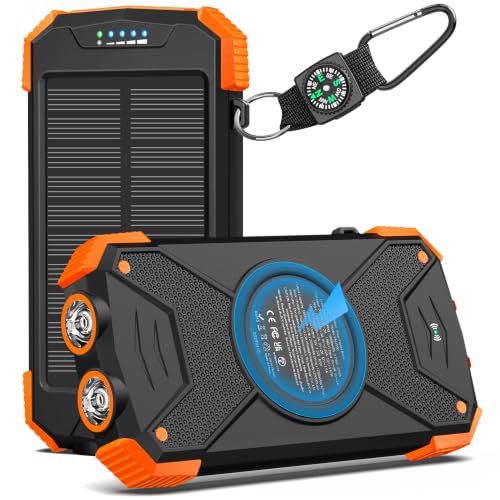


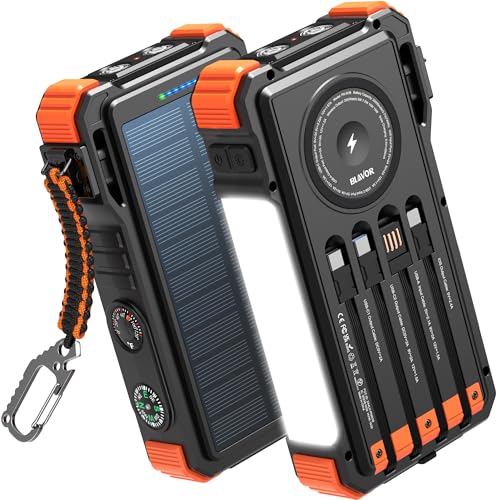
As an Amazon Associate we earn from qualifying purchases at no extra cost to you. Ratings are shown as listed on Amazon.
Best solar power banks at a glance
| Pick | Best for | Battery and charging | Solar design | Approx. weight | Typical market range |
|---|---|---|---|---|---|
| BLAVOR 10,000mAh Solar Charger | Light emergency carry | 10,000mAh rated; USB charging; wireless charging on supported versions | Small built-in panel | About 0.5 lb / 225g | $25–$45 |
| Hiluckey HIS7 Solar Charger | Higher capacity and camping backup | 25,000mAh rated; multiple USB outputs; fast wired charging varies by revision | Four-panel folding array | About 1.1 lb / 500g | $35–$60 |
| ADDTOP 25,000mAh Solar Charger | Budget multi-panel charging | 25,000mAh rated; USB outputs; commonly listed with up to 22.5W output | Four folding panels | About 1.0–1.2 lb / 450–550g | $30–$55 |
| Goal Zero Venture 35 | Rugged trips with a separate solar panel | 9,600mAh rated; USB-C Power Delivery up to 18W | No built-in panel; compatible with Nomad panels | About 0.6 lb / 270g | $70–$100 |
Capacities above are manufacturer-rated cell capacities. Usable USB output is normally lower because of voltage conversion, cable losses, heat, and the phone’s charging circuitry. A practical rule is to expect roughly 60–75% of the printed capacity at the phone.
Our picks by situation
Best for a lightweight emergency kit: BLAVOR 10,000mAh
A 10,000mAh BLAVOR-style solar charger is the sensible choice for day hikes, festivals, commuting emergencies, and occasional blackouts. It is smaller and easier to carry than four-panel models, and its capacity is enough for roughly one and a half to two full charges for many modern phones.
The built-in panel is useful for slowing battery drain or adding a small amount of energy when the charger is left in direct sun. It is not a reliable way to recharge the entire power bank. Wireless charging can be convenient, but it is slower and less efficient than using a cable, particularly outdoors where alignment can shift.
Choose this type if your priority is low weight. Avoid it if you need to charge two phones repeatedly or if your phone has a large battery above about 5,000mAh.
Best built-in-panel option for camping: Hiluckey HIS7
The Hiluckey HIS7’s four-panel folding design exposes substantially more solar area than a single-panel brick. That makes it a better choice for camping, travel, and emergency preparedness when you can leave the panels unfolded in direct sunlight for several hours.
Its 25,000mAh rating provides useful reserve capacity, but the larger battery also takes longer to refill. The multiple USB outputs are practical for sharing power, although connecting several devices divides the available output and can reduce charging speed. It is bulky in a pocket, yet reasonable in a backpack.
This is the better built-in solar choice when you want one self-contained unit and accept that solar charging is measured in partial top-ups rather than a quick refill.
Best budget alternative: ADDTOP 25,000mAh Solar Charger
ADDTOP’s four-panel 25,000mAh format is aimed at shoppers who want a large reserve without buying a separate panel and battery. Models in this line are commonly advertised with multiple USB ports and output figures reaching 22.5W, but check the exact revision: port combinations, USB-C input, and fast-charging support can differ.
Its main advantage is value per stored watt-hour. Its compromises are familiar: substantial weight, a slow built-in solar panel, and less dependable water resistance than a dedicated outdoor power system. Treat the unit as splash-resistant only when the specific listing states an ingress rating, and keep its ports covered around dust and rain.
Best for serious outdoor use: Goal Zero Venture 35 with a Nomad panel
The Venture 35 is not a built-in solar power bank, but it is a more capable outdoor solution. The battery is rated at 9,600mAh, supports USB-C Power Delivery up to 18W, and has an IP67-style rugged design in the Venture range. Pairing it with a compatible Goal Zero Nomad panel gives the solar cell a larger surface area and a better angle toward the sun than a panel attached to a handheld battery.
This combination costs more and requires two pieces, but it is easier to replace or upgrade separately. It is the strongest option for frequent camping, backpacking, and people who need predictable solar collection rather than a novelty charging feature.
What the numbers mean in actual phone use
Suppose your phone has a 4,500mAh battery and your power bank is rated at 25,000mAh. The printed figures cannot be compared directly because the power bank’s cells are usually measured around 3.7 volts, while USB output is around 5 volts or higher. After conversion losses, assume 65% usable capacity:
25,000mAh × 0.65 = about 16,250mAh delivered by USB.
Then divide by the phone’s battery rating:
16,250 ÷ 4,500 = about 3.6 theoretical charges.
In practice, allow for the phone being used while charging, heat, cable losses, and battery-protection limits. Three full charges is a more realistic planning figure. A 10,000mAh unit may provide about one full charge plus a partial second charge for the same phone.
Solar performance: the detail listings often hide
- Panel area matters. Four folding panels can collect several times more energy than one narrow panel mounted on a battery case.
- Rated watts are not guaranteed watts. Bright sun, panel angle, temperature, dust, and shadows can reduce output sharply.
- Solar charging is slow at this size. A built-in panel may add a useful partial charge over a full sunny day, but a complete refill can take multiple days.
- Do not charge in a hot car. Dark batteries and phones can become hot enough to trigger charging slowdowns or accelerate battery wear.
- Keep the phone separate while solar charging. Let the panel replenish the power bank first, then charge the phone from the stored battery. This avoids unstable output from passing clouds.
Decision matrix
| Your situation | Recommended format | Why | Accept the trade-off |
|---|---|---|---|
| Rare emergencies, smallest bag | 10,000mAh single-panel unit | Lower weight and enough capacity for a phone top-up | Very slow solar recovery |
| Weekend camping, one or two phones | 20,000–25,000mAh four-panel unit | More reserve and more usable solar area | About twice the bulk of a compact model |
| Frequent outdoor use | Rugged power bank plus folding solar panel | Better collection, faster wired charging, replaceable components | Higher cost and two-piece setup |
| Fast-charging modern phone | USB-C PD power bank rated at 18W or more | Shorter charging stops and wider device compatibility | Built-in solar models may not support the advertised speed on every port |
Durability and ownership realities
The first parts to wear are usually the USB port covers, hinge points on folding panels, and cable connectors—not the solar cells themselves. Repeatedly hanging a heavy battery from a backpack can stress the panel hinges, so place the unit on a stable surface when charging.
Wipe panels with a soft, slightly damp cloth. Grit can scratch the surface and reduce light transmission. Do not use abrasive cleaners, and do not fold panels while wet. Recharge the battery every three to six months during storage; leaving a lithium battery completely empty for a long period can make it difficult or impossible to recover.
Water resistance is not the same as waterproof operation. Close port covers before exposure, avoid charging while the unit is wet, and check the stated IP rating rather than relying on phrases such as “outdoor” or “waterproof.” A flashlight, compass, and wireless charging pad can be useful extras, but they should not outweigh a weak USB-C implementation or an unprotected battery.
Bottom line
Buy the BLAVOR 10,000mAh format for occasional emergency use and minimum weight. Pick the Hiluckey HIS7 or ADDTOP four-panel format when you want the most practical built-in solar collection and a large reserve. For repeated camping or dependable off-grid charging, skip the tiny integrated panel and choose a rugged power bank such as the Goal Zero Venture 35 with a separate folding solar panel. In every case, judge usable capacity and wired charging speed first; consider the solar panel valuable backup, not a fast fuel source.