Key takeaways
- Tulip nozzle: Best for a broad, ridged swirl on pie, hot chocolate, and plated desserts.
- Straight nozzle: Useful for filling pastries, piping lines, and making smaller portions with better control.
- Star nozzle: Helpful for sharper ridges and decorative cupcakes, but not included with every dispenser.
- Long filling tip: Worth buying separately if you fill doughnuts, choux pastry, or cream puffs.
The best whipped cream dispensers for home use are the 0.5-liter stainless-steel models from established brands such as iSi or Mosa: they offer enough capacity for most desserts, use widely available 8-gram nitrous oxide chargers, and are easier to clean and store than larger professional units.
Our top picks


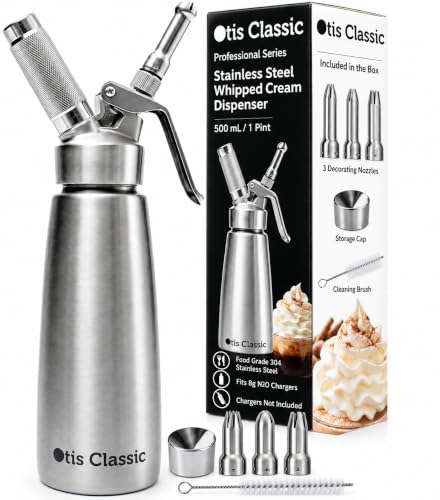
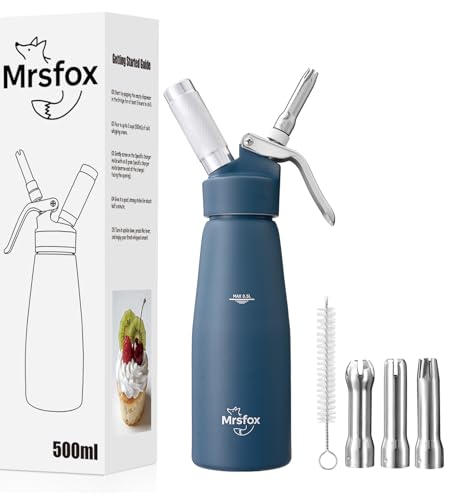
As an Amazon Associate we earn from qualifying purchases at no extra cost to you. Ratings are shown as listed on Amazon.
Best whipped cream dispensers by home-cooking situation
| Best for | Recommended type | Why it fits | Main compromise |
|---|---|---|---|
| Occasional desserts and small kitchens | 0.25-liter aluminum or stainless-steel dispenser | Compact and economical for one or two servings | Limited capacity; smaller models can be less forgiving with thick mixtures |
| Most families and regular baking | 0.5-liter stainless-steel dispenser | Good balance of capacity, control, durability, and storage | Usually requires one charger per batch |
| Large gatherings or batch preparation | 1-liter professional-style dispenser | Produces more servings before refilling | Heavier, taller, and more expensive; contents may lose quality before they are used |
| Frequent hot and cold kitchen use | Stainless-steel model rated for both cold and warm preparations | More durable and less vulnerable to dents or staining | Costs more than basic aluminum models |
Our shortlist of the best whipped cream dispensers
Best overall: iSi Gourmet Whip, 0.5 liter
The iSi Gourmet Whip is the safest all-purpose recommendation for home cooks who want one dispenser for whipped cream, dessert toppings, sauces, and culinary foams. Its 0.5-liter size is large enough for a cake, a bowl of desserts, or several drinks without becoming awkward to refrigerate. iSi offers versions with a stainless-steel bottle and head, while some regional versions and older lines use different body materials, so check the exact model before buying.
The standard package generally includes a straight stainless-steel nozzle and a tulip-style nozzle. That combination covers most home applications: the straight tip is useful for controlled rosettes and filling, while the tulip tip creates a wider decorative shape. iSi’s 8.4-gram cream chargers are the usual match for its half-liter dispensers. Use chargers labeled for culinary use and check the dispenser manual rather than assuming every charger is compatible.
Choose this model if you value replacement parts and long-term ownership. The gasket, valve seal, charger holder, and nozzles are the components most likely to need replacement over time, and a brand with a visible parts system is preferable to a dispenser that must be discarded after a small seal failure.
Best budget configuration: a 0.5-liter aluminum dispenser with standard 8-gram chargers
A basic aluminum dispenser can be a sensible choice when you make whipped cream only a few times per month. These models are often lighter and less expensive than stainless-steel versions, and many accept standard 8-gram N2O chargers. Look for a head made from metal rather than brittle plastic, a clearly specified maximum fill line, and at least two removable nozzles.
Aluminum has disadvantages. It is more prone to scratches and dents, may develop cosmetic staining, and should not be treated as automatically compatible with every acidic mixture. Avoid storing lemon-heavy, fruit-based, or salty preparations in an aluminum bottle unless the manufacturer specifically permits them. For plain dairy cream used promptly, a good aluminum unit can provide excellent value.
Best for durability: a stainless-steel 0.5-liter Mosa or iSi dispenser
Mosa and iSi both have established culinary dispenser ranges, although exact materials, nozzle sets, and charger requirements vary by model and market. A stainless-steel 0.5-liter unit is the better long-term purchase for cooks who use a dispenser weekly, transport it to gatherings, or also prepare flavored creams and sauces.
Stainless steel resists dents better than aluminum and is less likely to retain odors. It is also easier to inspect for damage around the threads and head connection. The trade-off is weight: a filled 0.5-liter stainless dispenser commonly weighs roughly 0.8 to 1.1 kilograms before adding a charger, depending on its construction. That is still manageable, but noticeably heavier than a lightweight aluminum model.
Best for parties: a 1-liter professional-style dispenser
A 1-liter dispenser makes sense when you regularly serve a crowd. Depending on the recipe and desired texture, one batch can provide approximately 20 to 30 dessert portions when each portion uses 30 to 40 milliliters of whipped cream. It reduces interruptions during a party, but it is not automatically more economical: a larger batch may sit unused, and many models require two chargers or a charger system specified by the manufacturer.
Check refrigerator height before buying. A 1-liter dispenser is often around 30 to 35 centimeters tall when assembled, while a 0.5-liter unit is commonly around 25 to 28 centimeters. Measure the shelf, not just the refrigerator door compartment. Larger dispensers are also harder to rinse thoroughly in a small sink.
Capacity, materials, and charger compatibility compared
| Feature | 0.25 liter | 0.5 liter | 1 liter |
|---|---|---|---|
| Typical servings at 35 ml each | About 5–7 | About 12–15 | About 25–30 |
| Typical charger pattern | One 8 g charger | One 8–8.4 g charger | Often two 8 g chargers or a specified larger system |
| Approximate empty weight | 0.3–0.6 kg | 0.6–1.1 kg | 0.9–1.5 kg |
| Best material choice | Aluminum for light use; steel for durability | Stainless steel for regular use | Stainless steel for stability and repeated batches |
| Storage concern | Easy to fit in a door or small refrigerator | Check shelf height and head clearance | Requires substantial upright refrigerator space |
Do not confuse N2O cream chargers with carbon dioxide soda chargers. Whipped cream dispensers require food-grade nitrous oxide, commonly sold in 8-gram chargers. Some brands recommend their own chargers because of seal dimensions, gas purity, or warranty conditions. A charger that physically fits may still be unsuitable if the manufacturer does not approve it.
Nozzle options that matter in practice
- Tulip nozzle: Best for a broad, ridged swirl on pie, hot chocolate, and plated desserts.
- Straight nozzle: Useful for filling pastries, piping lines, and making smaller portions with better control.
- Star nozzle: Helpful for sharper ridges and decorative cupcakes, but not included with every dispenser.
- Long filling tip: Worth buying separately if you fill doughnuts, choux pastry, or cream puffs.
More nozzles do not necessarily mean a better dispenser. A removable nozzle that can be brushed internally is more valuable than a large collection of decorative tips that are difficult to clean. Also check whether the tips are stainless steel or plated metal; stainless steel is preferable for repeated washing.
How to choose the right size: a worked calculation
Suppose six people will each receive two desserts, with approximately 30 milliliters of cream per dessert. The requirement is:
6 people × 2 desserts × 30 ml = 360 ml of finished cream.
A 0.5-liter dispenser is the practical choice because it provides room below the maximum fill line and leaves some allowance for expansion. A 0.25-liter dispenser is too small, while a 1-liter model adds unnecessary bulk. Remember that the bottle’s stated capacity is not always the amount of liquid you should pour in. Follow the marked fill line, because overfilling reduces expansion space and can cause poor texture or inconsistent dispensing.
Cleaning and ownership realities
Cleaning is where inexpensive dispensers often become frustrating. Immediately after use, release the remaining pressure according to the manual, unscrew the head, and wash the bottle, gasket, valve, charger holder, and nozzle separately. Do not merely rinse the nozzle exterior: cream can remain inside the narrow passage and sour between uses.
- Dispense or safely release the contents before opening the bottle.
- Remove the nozzle and charger holder.
- Wash every removable part with warm water and dish soap.
- Use the supplied cleaning brush, if provided, on the nozzle and valve channel.
- Rinse thoroughly and allow every part to dry fully before reassembly.
Inspect the head gasket and valve seal regularly. These soft parts usually wear before the metal bottle does. A dispenser that hisses around the head, leaks liquid, or produces weak foam may need a new gasket rather than a new bottle. Never force a blocked valve or puncture a charger manually. If a nozzle is clogged, depressurize the unit as directed and clean it after disassembly.
Final buying advice
For most households, buy a 0.5-liter stainless-steel dispenser with at least two metal nozzles and confirmed compatibility with readily available 8-gram N2O chargers. Select a 0.25-liter model only when storage and small portions are the priority. Choose 1 liter when you routinely serve large groups and have enough refrigerator space. The best whipped cream dispensers are not simply the ones with the most attachments; they are the ones whose capacity, seals, charger system, and cleaning routine match how often you actually cook.