Key takeaways
- Pro: Android Central names it the model to get if you just want a go-anywhere Bluetooth speaker with great sound.
- Pro: the flat, tilted shape sends sound upward and outward even when it lies on its back, so placement is forgiving.
- Pro: Bose describes the 2nd Gen as using improved drivers and a clearer mid-range than the original Flex.
- Con: 12 hours is shorter than JBL’s Charge 6 or the Sony ULT Field 3.
- Con: loud outdoor listening in a large open space exceeds what a speaker of this size can do.
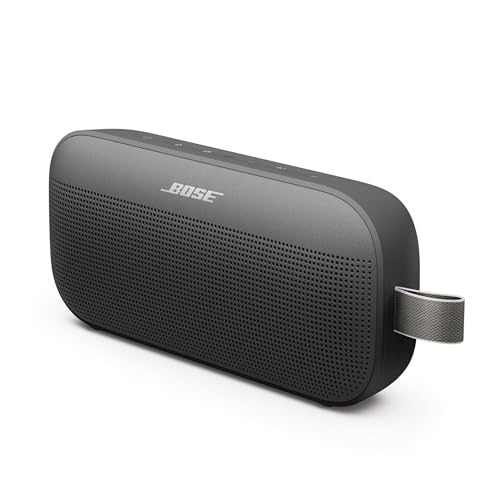
The best Bose portable speaker for most people is the SoundLink Flex (2nd Gen): it is IP67 rated, runs about 12 hours per charge, includes a microphone for calls and costs well below the bigger models. Choose the SoundLink Micro (2nd Gen) if size and price matter more than sound, and the SoundLink Max if you want Bose’s deepest bass and stereo spread in a portable body. The SoundLink Plus fills the gap between them, and the older Revolve II is only worth buying at a clear discount.
This guide covers Bose’s current SoundLink lineup, who each model fits, the trade-offs the company does not put on the box, and three alternatives from other brands. It is based on Bose’s published specifications and published reviews, such as the Android Central comparison of the SoundLink range, and not on personal testing.
Our top picks


As an Amazon Associate we earn from qualifying purchases at no extra cost to you.
The Bose SoundLink lineup compared
| Model | Best for | Water rating | Battery claim | Weight | Mic | Price tier |
|---|---|---|---|---|---|---|
| SoundLink Micro (2nd Gen) | Pocket, bag, gym | IP67 | 12 h | 0.7 lb (about 320 g) | No | Entry |
| SoundLink Flex (2nd Gen) | All-round daily speaker | IP67 | 12 h | 1.3 lb (about 590 g) | Yes | Mid |
| SoundLink Plus | Bigger sound for a home and a patio | Water resistant | Mid-teens hours | Between Flex and Max | Yes | Mid to premium |
| SoundLink Max | Deepest bass, stereo, party | IP67 | 20 h | Gym-bag size | Yes | Premium |
| SoundLink Revolve II | 360-degree sound at a bargain | Splash resistant | About 13 h | About 1 kg | Yes | Mid (older) |
Bose lists the Micro, Flex, Plus and Max as its current SoundLink portable family, with the Revolve II still shown on its portable page. Specifications for the Plus and Revolve II are given as ranges here because Bose and retailers describe them differently and stock changes; check Bose’s compare page before you buy.
Bose SoundLink Flex (2nd Gen): the one most buyers should get
Spec line: IP67, about 12 hours, 1.3 lb, built-in microphone, stereo pairing, USB-C charging, rubber body with a tear-resistant strap loop.
Best for: a daily speaker for a desk, a hike, a beach bag and phone calls.
Skip if: you want a power bank or a 24-hour battery.
- Pro: Android Central names it the model to get if you just want a go-anywhere Bluetooth speaker with great sound.
- Pro: the flat, tilted shape sends sound upward and outward even when it lies on its back, so placement is forgiving.
- Pro: Bose describes the 2nd Gen as using improved drivers and a clearer mid-range than the original Flex.
- Con: 12 hours is shorter than JBL’s Charge 6 or the Sony ULT Field 3.
- Con: loud outdoor listening in a large open space exceeds what a speaker of this size can do.
Bose SoundLink Micro (2nd Gen): the smallest option
Spec line: IP67, about 12 hours, 0.7 lb, mono sound, no microphone, stereo pairing, silicone strap.
Best for: bikes, backpacks, travel and a cheap second speaker.
Skip if: you need calls or any real low-end depth.
- Pro: very small and light, with a built-in strap that hangs on bags and bars.
- Pro: Bose describes it as having a surprisingly full sound for a speaker this size.
- Pro: it can be stereo-paired with another Bose speaker that has the shortcut button.
- Con: no microphone, so it cannot take phone calls or use voice assistants.
- Con: it is a single mono speaker, so it sounds narrow beside the Flex or Max.
Bose SoundLink Max: deep bass and a stereo spread
Spec line: IP67, up to 20 hours, USB-C, 3.5 mm AUX input, carry handle and strap, stereo output.
Best for: a one-speaker home system, a patio or a small party.
Skip if: you want a hiking speaker or the lowest price.
- Pro: Bose describes it as the deepest bass in its SoundLink line while still fitting in a gym bag.
- Pro: AUX input and USB-C make it practical for a TV, a turntable or a laptop.
- Pro: it pairs with other Bose speakers using the shortcut button.
- Con: it sits in the premium price tier at full list price, and Bose has discounted it several times, so it is worth waiting for a reduced price.
- Con: no floating design and no power bank.
Bose SoundLink Plus: the middle option with less presence
Spec line: mid-range portable size, water resistant, stereo-style sound, microphone.
Best for: buyers who find the Flex too small but do not want the Max price tier.
Skip if: a discount on the Max or Flex is available.
- Pro: bigger sound than the Flex and easier to carry than the Max.
- Pro: Bose lists it in the same pairing family as the Micro, Flex and Max.
- Pro: the Plus is often discounted, according to Android Central’s guide.
- Con: it can feel like a compromise, because the price gap to the Max narrows during sales.
- Con: it has less outdoor reach than the Max.
Bose SoundLink Revolve II: 360-degree sound, older design
Spec line: about 13 hours, splash resistant (not fully waterproof), 360-degree sound, around 1 kg.
Best for: people who want even sound in a room where listeners are on all sides.
Skip if: you need real waterproofing or the latest codecs.
- Pro: Bose’s 360-degree design suits a coffee table or a kitchen shelf.
- Pro: balanced sound with natural mids.
- Pro: it is an easy speaker to place because it has no front or back.
- Con: the water resistance is lower than the IP67 models.
- Con: it is an older generation, so check the stock date and the battery condition.
Three alternatives worth comparing
JBL Charge 6
IP68, about 24 hours, about 960 g and a built-in power bank. It beats the Flex on battery and water rating, and reviewers such as SoundGuys call it the best overall portable speaker of 2026. Choose it if runtime and a phone-charging function matter more than Bose’s tonal balance.
Sony ULT Field 3
IP67, about 24 hours, about 1.2 kg and a bass button. It is a better fit than the Flex for people who like heavy low end, and fast charging gives roughly 2 hours of playback from 10 minutes. It does not support LDAC, which only the larger ULT Field 5 does.
Soundcore Motion 300
IPX7, about 13 hours, 30 W from two 15 W full-range drivers. It is the value alternative to the Flex when you want stereo-style output and more headroom without moving to the Max price tier.
Where Bose speakers win and where they lose
Bose’s approach is tone first. Reviewers consistently describe the SoundLink range as balanced, with a clear vocal range and bass that is full without being exaggerated. That makes them a strong choice for podcasts, acoustic music, jazz and spoken word, and for people who dislike the heavily boosted low end of party speakers. The weak spots are practical. Battery claims of 12 hours on the Micro and Flex trail the 24-hour class from JBL and Sony, none of the current models floats, only the larger ones add useful inputs, and none of the speakers in the range has a built-in power bank function.
There is also the question of ecosystem. Bose speakers work as standalone Bluetooth devices, and the Bose Music app adds stereo pairing and firmware updates, but they do not join multi-room systems the way Sonos speakers do, and they do not use the Auracast sharing that the newest JBL speakers use. If you already own other Bose speakers, the pairing family is a reason to stay; if you own none, a rival with a longer battery may suit better.
Who should skip Bose portable speakers
- Anyone who needs 20-plus hours from a small speaker; the Flex and Micro run about 12 hours.
- Buyers who want a floating speaker for a pool or boat; Bose does not make one in this line.
- People who want a phone-charging function on the speaker itself.
- Shoppers on a strict budget who would rather buy two Soundcore speakers than one Bose.
How to choose between Bose models: a worked example
Use these steps to decide in under five minutes.
- Decide where it lives. If most use is at a desk or in a kitchen, a Flex is enough. If it is mostly outdoors with friends, aim for the Max.
- Count the hours. A 12-hour claim becomes about 6 hours at loud volume. If you want a full day at a beach, that needs a charger or a bigger battery, which points to the Max (20 hours) or the JBL Charge 6.
- Check for calls. If you want to take calls on speaker, skip the Micro because it has no microphone.
- Decide on pairing. Two Micros or a Micro and a Flex cost less than a Max and give stereo separation, which is useful if you plan to buy a second speaker anyway.
| Your priority | Pick |
|---|---|
| Smallest and cheapest | SoundLink Micro (2nd Gen) |
| Best all-rounder | SoundLink Flex (2nd Gen) |
| Deepest bass, home and patio | SoundLink Max |
| Room-filling 360 sound | SoundLink Revolve II (if discounted) |
| Longest battery and power bank | JBL Charge 6 instead |
Ownership realities for Bose speakers
- The Bose Music app is optional but useful. It handles firmware updates, EQ and stereo pairing setup on supported models.
- Stereo pairing needs the shortcut button. Bose’s own page says the pairing feature works across the Micro (2nd Gen), Flex (2nd Gen), Plus and Max, and some third-party pages claim narrower compatibility, so rely on Bose’s list.
- The strap is part of the design. The Flex and Micro straps wear first. Check them for fraying if you hang the speaker from a bike or a bag.
- Charge the speaker before long storage. A lithium cell stored empty can fall below its safe voltage. Top it up every few months.
- Rinse after salt and pool water. IP67 rated speakers survive immersion for a short time, but salt and chlorine dry on the grille and ports.
Matching a Bose speaker to your phone
All the current SoundLink speakers connect over Bluetooth, and setup is the same on iPhone and Android: hold the Bluetooth button until the light pulses, then pick the speaker in the phone’s Bluetooth list. Bose supports the standard SBC and AAC codecs on these models, so iPhone users get the best the platform offers, while Android users who care about LDAC or aptX HD should know Bose does not market those codecs on this range. For casual listening through a phone speaker-sized driver the difference is small, but if you stream lossless music and own a Galaxy or Pixel phone, the Sony ULT Field 5 or the Soundcore Motion 300 supports higher-bitrate paths.
Calls are another differentiator. The Flex, Plus and Max have microphones and work as speakerphones for kitchen or desk calls, though a speaker is never as clear as a headset in a noisy room. Place the speaker within about a metre of your mouth for the best pickup and keep it away from walls that add echo.
Buying tips that save money
- Compare tiers, not list claims. Bose often runs reductions on older SoundLink models, and the Plus and Max regularly move into a lower price tier for a few weeks. A Plus at a deep reduction can beat a Flex at full price.
- Check the generation. The “2nd Gen” label matters for the Flex and Micro. The first-generation Flex has different drivers and no longer matches the current specifications.
- Buy two small speakers instead of one big one if you want stereo separation and flexibility. Two Micros or a Micro and a Flex can sit on either side of a desk, then split up for travel.
- Look for bundled sets. Bose lists a Flex plus Micro set, which is a way to start a stereo pair at a lower combined price tier.
Frequently Asked Questions
Which Bose portable speaker has the best sound?
The SoundLink Max has the deepest bass and the widest stereo sound in Bose’s portable line, according to Bose. Among smaller models, the Flex (2nd Gen) delivers the best balance of clarity and size.
Are Bose SoundLink speakers waterproof?
The Micro (2nd Gen), Flex (2nd Gen) and Max are listed with IP67, meaning dust-tight and able to survive 1 metre of water for 30 minutes. The Revolve II is only splash resistant, so keep it away from pools.
Can I pair two Bose speakers together?
Yes. Bose says the stereo pairing feature requires two speakers that have a shortcut button, and the Micro (2nd Gen), Flex (2nd Gen), Plus and Max can be mixed. Older models such as the Revolve II use a different system.
Does the Bose SoundLink Micro have a microphone?
No. The Micro (2nd Gen) is a music-only speaker with no microphone, so it cannot be used for phone calls or voice assistants. The Flex, Plus and Max do include microphones.
How does the SoundLink Flex compare with the JBL Charge 6?
The Flex is lighter and smaller with a tilted design and a microphone, while the Charge 6 offers a longer battery claim of about 24 hours, IP68 and a power bank. Choose the Flex for portability and tone, the Charge 6 for endurance.
Are Bose portable speakers worth the money?
Bose prices its speakers in the mid to premium tiers, and rivals such as JBL and Soundcore offer longer batteries for similar money. Bose’s strengths are tone, build quality and the pairing system, so they suit buyers who prioritise sound balance over battery life.
More from Amazon
Programs that pair well with the guide above. Offers and eligibility are set by Amazon and may change.
Free shipping on eligible items, Prime Video and more. Eligible new members can start with a free trial.
Start a Prime free trialAd-free music streaming. Eligible new subscribers can start with a free trial.
Try Music Unlimited freeA Prime membership for ages 18-24 with a trial period. Eligibility is set by Amazon.
See Prime for Young AdultsAudiobooks and podcasts to listen to on the go. Eligible new members can start with a free trial.
Try Audible freeAs an Amazon Associate we earn from qualifying purchases.