Key takeaways
- Drop timing: The rest should fall only after the arrow has traveled far enough that the fletching clears the launcher. Cable-driven rests (tied into the down cable) drop on release reliably; limb-driven rests (activated by limb movement) drop slightly later and more consistently across different draw weights. For hunting in cold weather, limb-driven designs avoid the cable stretch and stiffness issues that can delay drop timing.
- Noise level: Anything above roughly 60–65 dB at the shot is noticeable to game inside 30 yards. Rubber-dampened launcher arms, felt or moleskin-covered containment, and internal dampeners (like the Hamskea’s rebound damper) measurably reduce launch noise. Metal-on-metal contact is the enemy.
- Arrow containment: Full-cage designs (QAD’s capture-style) hold the arrow at any angle — critical for tree stand and spot-and-stalk hunting where the bow isn’t always level. Open launchers (V-style prongs) are lighter and quieter but can lose the arrow during a steep-angle draw.
- Bow compatibility: Check axle-to-axle clearance (long rests can contact short-ATA bows’ cables), cable guard position, and whether your riser accepts the rest’s mounting block without a spacer.
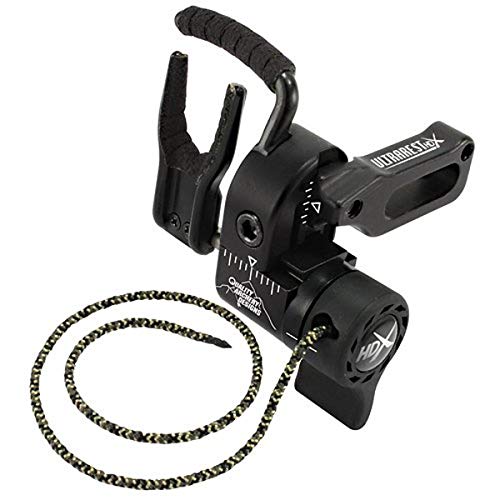
The best drop away arrow rests for most hunters in 2026 are the QAD UltraRest HDX (best all-around containment and reliability), the Ripcord Ace (best for cable-free micro-adjustment), and the Hamskea Hybrid Hunter Pro (best for target shooters who want tunable activation). Which one fits you depends less on brand loyalty and more on how your bow is built, how you hunt, and how much noise you can tolerate at the shot.
Our top picks



As an Amazon Associate we earn from qualifying purchases at no extra cost to you. Ratings are shown as listed on Amazon.
What actually separates a good drop away rest
Drop timing, noise, and containment matter more than the marketing language on the box. Here’s how to evaluate each:
- Drop timing: The rest should fall only after the arrow has traveled far enough that the fletching clears the launcher. Cable-driven rests (tied into the down cable) drop on release reliably; limb-driven rests (activated by limb movement) drop slightly later and more consistently across different draw weights. For hunting in cold weather, limb-driven designs avoid the cable stretch and stiffness issues that can delay drop timing.
- Noise level: Anything above roughly 60–65 dB at the shot is noticeable to game inside 30 yards. Rubber-dampened launcher arms, felt or moleskin-covered containment, and internal dampeners (like the Hamskea’s rebound damper) measurably reduce launch noise. Metal-on-metal contact is the enemy.
- Arrow containment: Full-cage designs (QAD’s capture-style) hold the arrow at any angle — critical for tree stand and spot-and-stalk hunting where the bow isn’t always level. Open launchers (V-style prongs) are lighter and quieter but can lose the arrow during a steep-angle draw.
- Bow compatibility: Check axle-to-axle clearance (long rests can contact short-ATA bows’ cables), cable guard position, and whether your riser accepts the rest’s mounting block without a spacer.
Spec comparison: the stands-out options
| Rest | Activation | Weight | Containment | Micro-adjust | Typical price range |
|---|---|---|---|---|---|
| QAD UltraRest HDX | Cable-driven | ~3.5 oz | Full capture cage | Yes (windage/elevation) | $120–160 |
| Ripcord Ace | Cable-driven | ~3.4 oz | Full capture cage | Yes | $130–170 |
| Hamskea Hybrid Hunter Pro | Limb or cable | ~3.7 oz | Partial cage | Yes (spring tension too) | $200–260 |
| Trophy Taker SmackDown Pro | Limb-driven | ~3.9 oz | Full capture option | Yes | $140–180 |
| Trophy Ridge Sync | Cable-driven | ~3.3 oz | Full capture cage | No (fixed adjust) | $80–110 |
Prices reflect general market ranges in 2026; sales and shop pricing vary.
Best picks by situation
Whitetail and tree stand hunting: QAD UltraRest HDX
The full capture cage holds the arrow even when the bow is tilted 45° downward — the exact situation at full draw in a stand. The internal dampener cuts launcher noise, and the timing cord attaches to the down cable in minutes. What wears first: the felt liners on the launcher (~$5 to replace, expect one season of heavy use).
Western spot-and-stalk: Trophy Taker SmackDown Pro
Limb-driven activation means no dependence on cable tension after miles of hiking and temperature swings. The rest stays up during the draw and drops cleanly; containment survives crawling over deadfall.
Target and 3D shooting: Hamskea Hybrid Hunter Pro
The adjustable spring tension and micro-tunable launcher let you dial drop timing for paper tuning without re-tying cords. It’s the heaviest option here and overkill (and overpriced) for someone who hunts twice a year.
Budget-conscious or first drop away: Trophy Ridge Sync
Full containment and cable-driven simplicity at roughly half the price of the premium options. The tradeoff is no micro-adjustment — tuning means loosening bolts and nudging by hand. Fine for hunting distances under 40 yards.
Decision matrix
| Your situation | Recommended | Why |
|---|---|---|
| Budget under $100, bowhunting only | Trophy Ridge Sync | Containment and reliability without tuning features you won’t use |
| Tree stand / steep-angle shots | QAD UltraRest HDX | 360° containment, quiet dampened launch |
| Western / backcountry, cold weather | SmackDown Pro | Limb-drive avoids cold-stiffened cable timing drift |
| Target + hunting crossover | Hamskea Hybrid Hunter Pro | Dual activation modes, full tunability |
| Mechanical broadheads, high FOC arrows | Any with containment cage | Heavy arrows stay seated through the draw cycle |
Setup steps that prevent the two most common mistakes
- Set launcher height first. Arrow centerline should sit level with or 1/8″ above the berger button hole. Too low causes fletching contact; too high makes nock pinch.
- Time the drop cord correctly. On cable-driven rests, the launcher should begin dropping in the last 1–1.5″ of draw. If it drops earlier, fletching can strike the launcher on the way through.
- Verify drop with a slow-motion phone video. Film the shot at 240fps. If the launcher is still up when fletching passes, tighten the cord by ~1/4 turn and re-test. This is the single check most buyers skip.
- Add moleskin to contact points if the rest is metal-heavy — it cuts 2–3 dB of launch noise for under $3.
Ownership realities
Expect to replace launcher felt/moleskin each season and re-serve the drop cord every 1–2 years. Limb-driven cords stretch less but can fray on sharp limb edges — route them smoothly. The most common failure isn’t the rest itself but the cord slipping in the cable serving; serve over the attachment point with a few wraps and it won’t move again.
FAQ
Drop away vs. whisker biscuit — which is more accurate?
Drop aways eliminate fletching contact entirely, so they’re more forgiving of tuning imperfections and typically tighten groups at longer distances. Biscuits win on simplicity and zero moving parts — nothing can fail to drop.
Do drop away rests work with low-poundage bows?
Cable-driven rests can drop too slowly below ~40 lbs because cable movement is reduced; limb-driven models are the safer choice for youth and low-draw-weight setups.
Can I use a drop away for indoor target archery?
Yes, but many target shooters prefer a blade-style rest (like the Hamskea Trinity line) since containment doesn’t matter on a level range and blade rests offer finer launcher tuning.