
Our Top Picks
 KitchenAid Classic Series 4.5 Quart Tilt-Head Stand Mixer4.5 Q14.1 x 8.7 x 13.9 inches22 poundsCheck on Amazon
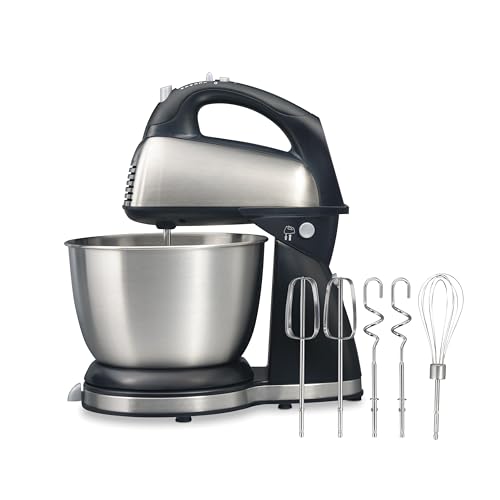 Hamilton Beach Classic Stand and Hand Mixer290 Watts Peak Power13.25 x 8.2 x 14.25 inches0 poundsCheck on Amazon
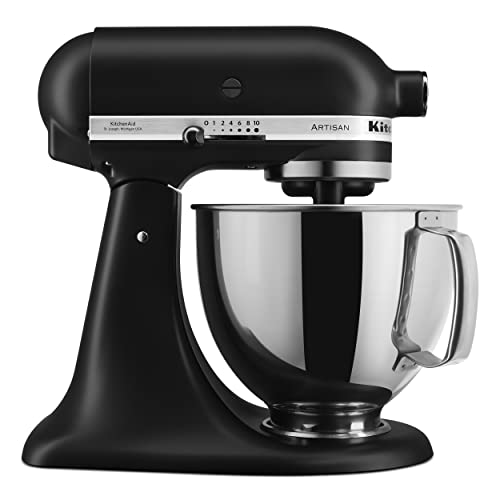

The best Black Friday stand mixer deal for most people is the KitchenAid Artisan 5-Qt Tilt-Head Stand Mixer (KSM150PS). It has the bowl size, the motor class and the powered attachment hub that cover everyday cakes, cookies and bread, and it is the model in this group most likely to still be running — and still worth reselling — a decade from now. If you bake in small batches or your counter is narrow, the KitchenAid Artisan Mini 3.5-Qt is the better fit. If you want to spend as little as possible, the Hamilton Beach Classic Stand and Hand Mixer 4 Qt handles batter, frosting and whipped cream at a budget-tier price. If you bake bread for a crowd, the 8.5-quart Kitchen in the box with its 900-watt motor is the volume pick. Below, twelve mixers — plus one hand mixer — are compared by bowl capacity, countertop footprint, attachment compatibility and how well each size actually suits regular baking, so you can match the machine to how you bake instead of to the biggest advertised discount.
Top 3 Picks
Best overall: KitchenAid Artisan 5-Qt Tilt-Head (KSM150PS)
The 5-quart Artisan is the sweet spot of the whole category: a 325-watt motor, ten speeds and a bowl that handles a double batch of cookies or a few loaves of bread without forcing you into a machine that eats half your counter. Its powered accessory hub is the real long-term value, because it turns the mixer into a pasta roller, grinder or spiralizer later. Buy it if you bake at least twice a month and want one appliance that grows with you.
Best budget: Hamilton Beach Classic Stand and Hand Mixer 4 Qt
This is the cheapest sensible entry into stand mixing, and it does something no other product here does — the head detaches and becomes a hand mixer. That means one appliance covers both a hands-free stand for batter and a handheld for small jobs. The trade-off is real: 290 watts peak, six speeds and no accessory hub, so it is a batter-and-frosting machine rather than a bread machine.
Best premium large-capacity pick: Camic 7.45 QT Tilt-Head
If your baking is batch baking — three trays of cookies at once, double sponge cakes, big bowls of dough — the Camic’s 7.45-quart bowl sits in the premium tier without the premium-tier footprint of a bowl-lift commercial style mixer. It keeps the tilt-head design, which most home bakers find easier to load and scrape. It is the pick for someone who wants capacity first and does not need an attachment ecosystem.
Quick Comparison
Every product below is compared on the same four axes: what it is best for, the specs that actually change the baking experience, and its price tier. Tiers are relative bands, not fixed prices, because holiday pricing moves daily.
| Product | Best for | Key specs | Price tier |
|---|---|---|---|
| KitchenAid Classic Series 4.5 Quart Tilt-Head (K45SS) | Small-batch baking with room to add attachments later | 4.5-qt stainless bowl; tilt-head; 10 speeds; light-duty motor class (under 300 W by the brand’s rating); powered accessory hub | Premium |
| KitchenAid Artisan 5-Qt Tilt-Head (KSM150PS) | Best all-rounder for most home bakers | 5-qt stainless bowl; 325 W; 10 speeds; tilt-head; accessory hub; approx. 8.7 in wide x 14.1 in deep x 13.9 in tall | Premium |
| Hamilton Beach Classic Stand and Hand Mixer, 4 Qt | Lowest spend and the smallest storage footprint | 4-qt bowl; 290 W peak; 6 speeds with QuickBurst; converts to a hand mixer; no accessory hub | Budget |
| Aucma 6.5-QT Tilt-Head | Most capacity per dollar in the mid-range | 6.5-qt bowl; 660 W; 6 speeds; tilt-head; dough hook and wire whip in the bundle | Mid-range |
| Kitchen in the box 8.5 QT Heavy Dough Mixer | Very large batches and stiff bread dough | 8.5-qt bowl; 900 W; heavy-dough motor class; largest frame and bowl in this roundup | Mid-range |
| Camic 7.45 QT Tilt-Head | Premium large-capacity tilt-head baking | 7.45-qt bowl; tilt-head; high-capacity class; black finish | Premium |
| VIVOHOME 6-Quart Tilt-Head | Straightforward mid-size everyday mixing | 6-qt bowl included; tilt-head; mid-size class; black finish | Mid-range |
| OLIXIS 6.3 Qt Tilt-Head | Big bowl and ten speeds at a budget price | 6.3-qt bowl; 10 speeds; tilt-head; budget motor class | Budget |
| KitchenAid Artisan Mini 3.5-Qt Tilt-Head | Small kitchens, couples and one-loaf bakers | 3.5-qt bowl; 10 speeds; tilt-head; accessory hub; about 20% smaller and 25% lighter than the full-size Artisan per the brand | Premium |
| bella STIR 5.3 Qt Tilt-Head | The widest speed range on a budget | 5.3-qt bowl; 12 speeds; tilt-head; oatmilk finish | Budget |
| KitchenAid 5 Ultra Power Speed Hand Mixer (KHM512) | Tiny kitchens and light mixing jobs | Hand mixer; 5 speeds; no bowl; stores in a drawer | Budget |
| Kourice 6.5 QT Heavy Duty Pro | Stainless-clad build quality in the mid-range | 6.5-qt stainless bowl; 10 speeds; heavy-duty class; stainless steel cladding | Mid-range |
How We Chose
This roundup is built from published specification data and category knowledge rather than any physical testing. Each mixer was assessed on four things a listing rarely puts side by side: bowl capacity measured against the batch sizes home bakers actually make, countertop footprint and the vertical clearance a tilt-head needs, motor class and speed count read honestly (peak wattage is not continuous wattage), and whether the machine has an upgrade path — a powered accessory hub, widely available replacement beaters, bowls and gaskets. Category fit mattered too: a 900-watt machine with an 8.5-quart bowl is a poor first mixer for someone who bakes a single cake a month, while a 3.5-quart model is the wrong answer for a household that bakes four loaves weekly. Finally, we weighed ownership realities that show up in year two and year five: which parts wear first, which are consumables, and how easy each is to clean. No product here was bought, borrowed, benchmarked or used by the author.
1. KitchenAid Classic Series 4.5 Quart Tilt-Head Stand Mixer (K45SS) – Best for Small-Batch Baking With Room to Grow
As an Amazon Associate we earn from qualifying purchases at no extra cost to you.
The K45SS suits the baker who makes one cake, one tray of cookies or one loaf at a time and wants the option to add attachments later without paying Artisan money. It is the entry point into KitchenAid’s tilt-head ecosystem, which means the same powered hub that runs a pasta roller on a flagship model runs one here too. If you bake for two people and your counter space is contested, this is a rational place to start.
- Bowl capacity: 4.5 quarts (stainless steel)
- Design: tilt-head, 10 speeds
- Motor class: light-duty — the brand rates it under 300 watts, the smallest motor in the classic line
- Included tools: coated flat beater, coated dough hook, wire whip
- Upgrade path: powered accessory hub for the brand’s attachment range
- Footprint: close to a full-size tilt-head in depth, slightly shorter overall
The strength here is not raw power — it is the ecosystem. Replacement bowls, beaters and gaskets are easy to find years later, the hub accepts a large attachment family, and the resale value of a working KitchenAid tilt-head is unusually strong for a small appliance. Ten speeds give you genuinely useful low settings for folding and for starting stiff doughs slowly. The tilt-head design also makes bowl access easy: you lift the head, scrape down, and drop it back without wrestling a bowl upward into a fixed head.
Pros
- Full attachment hub at the lowest price point in the KitchenAid tilt-head range
- Widely available spare parts and a strong resale market
- Compact enough for a small kitchen, with easy bowl access
- Ten speeds, including slow settings that are useful for folding and dough starts
Cons
- 4.5 quarts is the smallest capacity in the classic line — a double bread batch will strain it
- The light-duty motor means long, stiff dough sessions run hot
- No pouring shield in the standard bundle, so adding flour means stopping and scraping
- Premium-tier pricing for a machine with less capacity than several mid-range competitors
Against the nearest alternative — the Artisan 5-Qt — the K45SS gives up half a quart of bowl, a meaningfully stronger motor and the pouring shield. If you bake bread more than occasionally, the Artisan’s extra capacity and power are worth the step up. If your baking is cakes, cookies, frosting and the occasional quick bread, the K45SS does the same job with the same attachment compatibility, and it takes up less vertical space. Compared with the Artisan Mini, the K45SS has the larger bowl but the Mini has the smaller chassis — a distinction that matters more than it sounds when you are choosing between capacity and counter space.
2. KitchenAid Artisan 5-Qt Tilt-Head Stand Mixer (KSM150PS) – Best for Most Home Bakers

The Artisan is the default answer for a reason. A 5-quart bowl hits the point where a single batch of almost anything fits comfortably — a double batch of cookie dough, a three-layer cake, four loaves of bread on a long afternoon — while the frame stays small enough to live on a normal counter. It suits the household that bakes weekly, wants one machine for the next ten years, and would rather buy once than upgrade twice.
| Spec | Detail |
|---|---|
| Bowl | 5-quart stainless steel, with handle |
| Motor | 325 watts |
| Speeds | 10 |
| Design | Tilt-head with planetary mixing action |
| Included tools | Coated flat beater, coated dough hook, 6-wire whip, pouring shield |
| Approx. dimensions | 8.7 in wide x 14.1 in deep x 13.9 in tall |
| Approx. weight | Mid-20s in pounds |
| Upgrade path | Powered accessory hub |
Three things separate the Artisan from cheaper large-bowl machines. First, the planetary action: the beater travels around the bowl as well as spinning, which scrapes more of the bowl wall and reduces the stopping-and-scraping cycle. Second, the tool set — a flat beater, a dough hook and a six-wire whip cover batter, bread and aeration respectively, and the pouring shield genuinely reduces the flour cloud when you add dry ingredients at speed one. Third, the hub, which is the difference between a mixer and a kitchen machine.
Pros
- Capacity that covers single and double batches without dominating the counter
- 325-watt motor is enough for regular bread baking when you follow the low-speed rule
- Largest attachment ecosystem of anything in this roundup
- Pouring shield included; strong parts availability and resale value
Cons
- Premium tier even on sale — this is the most expensive way to buy five quarts
- Heavy enough that moving it in and out of a cupboard is a chore
- Head clearance limits very tall or very stiff doughs; a bowl-lift design handles those better
- Five quarts is still not enough for serious bulk bread baking
Against the K45SS, the Artisan buys you half a quart, a stronger motor and a pouring shield — and that combination is what makes bread baking pleasant rather than marginal. Against the Artisan Mini, it buys real capacity: the Mini is the right machine for one loaf, the Artisan is the right machine for four. Against the Aucma 6.5-QT, the Artisan gives up a quart and a half of bowl and roughly double the nominal wattage, and wins on attachment compatibility, spare parts and long-term resale. If you never plan to buy an attachment and you only bake cakes, the Aucma is better value; if you want one machine that adapts, the Artisan is the safer decade-long purchase.
3. Hamilton Beach Classic Stand and Hand Mixer, 4 Quarts – Best for the Lowest Spend and Smallest Storage
This is the pick for someone who wants a stand mixer without committing stand-mixer money or stand-mixer counter space. It suits students, small apartments, occasional bakers and anyone who makes batter, frosting or whipped cream a few times a month and nothing more ambitious. The trick is that the head detaches: you get a hands-free stand for mixing and a handheld for quick jobs, from one box.
- Bowl capacity: 4 quarts
- Power: 290 watts peak
- Speeds: 6, with a QuickBurst function for short bursts of extra speed
- Features: bowl rest for the handheld mode
- Form factor: converts between stand and hand mixer
- Upgrade path: none — no powered accessory hub
The dual-mode design is genuinely useful rather than a gimmick. A hand mixer is better for a single cake’s worth of batter, a small bowl of frosting or whipping half a cup of cream, because you can control the bowl and see what is happening. The stand mode is better when you want both hands free to add ingredients. Owning one appliance instead of two also solves the storage problem that keeps most stand mixers in a cupboard. And because it is a budget-tier machine, replacing it in three years costs less than a single repair on a premium mixer.
Pros
- Two appliances in one, with the head detaching for handheld use
- Light and easy to store — the smallest footprint here
- Budget tier, so the entry cost is low
- Six speeds plus QuickBurst covers batter, frosting and cream
Cons
- 290 watts is a peak figure, not continuous — it will labour in stiff cookie dough
- No accessory hub, so the tool set in the box is the tool set you keep
- No dough hook class capability; this is not a bread machine
- Six speeds and a light chassis mean more bowl-holding and more scraping
Against the OLIXIS 6.3 Qt, the Hamilton Beach gives up bowl capacity, speed count and stand-mixer stability, but wins on storage, on price and on the hand-mixer mode — which the OLIXIS cannot do at all. Against the KitchenAid Artisan Mini, it gives up build quality, the attachment hub and long-term parts availability, and wins decisively on cost. The honest framing: if you bake bread or run the machine weekly for years, spend more. If you make cake and frosting monthly, this does the job and stores in a cupboard.
4. Aucma 6.5-QT Tilt-Head Stand Mixer, 660W – Best for High-Volume Value Baking

The Aucma is aimed at the baker who has outgrown four quarts. At 6.5 quarts with a 660-watt motor, it covers double batches of cookie dough, big bowls of cake batter and multi-loaf bread sessions at a mid-range price. It suits the household that bakes for a crowd — holidays, birthdays, bake sales — and does not care about attachment ecosystems because it never plans to buy one.
- Bowl capacity: 6.5 quarts
- Power: 660 watts
- Speeds: 6
- Design: tilt-head, electric stand mixer
- Included tools: dough hook and wire whip named in the listing; bundles in this class typically also include a flat beater and a splash guard
- Upgrade path: none — tools are limited to what ships in the box
This is a capacity-per-dollar machine. Six and a half quarts means you can mix a batch of dough that would climb out of a 4.5-quart bowl, and 660 watts is comfortably above the light-duty class — enough that stiff dough does not stall the motor the way it does on budget machines. The tilt-head design keeps loading and scraping easy, which matters more as the bowl gets bigger. For holiday baking, where you are running batch after batch, the extra bowl volume removes the single most common bottleneck: having to split a recipe in two.
Pros
- 6.5-quart bowl handles genuinely large batches
- 660 watts is a meaningful step up in motor class for the tier
- Tilt-head access is easy to load, scrape and clean
- Mid-range pricing for capacity that competes with premium machines
Cons
- Only six speeds, so fine control between slow and medium is limited
- No accessory hub — no pasta roller, grinder or spiralizer later
- Larger frame
Affiliate disclosure. As an Amazon Associate we earn from qualifying purchases at no extra cost to you. Prices accurate as of the date shown.Best Black Friday Stand Mixer DealsCheck price on Amazon



