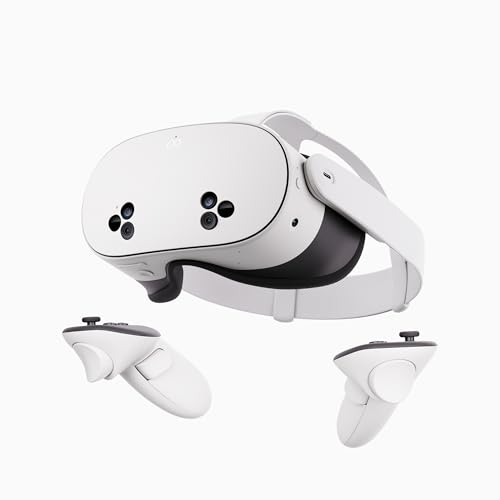
For most buyers, Meta Quest 3 is the best all-round standalone VR headset because it combines sharp lenses, colour mixed reality and the largest game library; Meta Quest 3S suits anyone who wants to enter VR at a lower tier; Pico 4 Ultra suits buyers in regions where it is sold; and Apple Vision Pro or Samsung Galaxy XR suit early adopters who want a premium spatial-computing device more than a games console. A standalone headset needs no PC or console: the processor, battery, cameras and controllers are all built in.
Our top picks



As an Amazon Associate we earn from qualifying purchases at no extra cost to you.
Standalone VR Headsets at a Glance
| Headset | Best for | Key stated specs (maker lists) | Main limit |
|---|---|---|---|
| Meta Quest 3 | Best overall: games, fitness, mixed reality | Snapdragon XR2 Gen 2, pancake lenses, colour passthrough, 128GB or 512GB at launch | Heavier front, battery of roughly two hours in heavy use |
| Meta Quest 3S | Entry tier into the same library | Snapdragon XR2 Gen 2, lower-resolution panels with Fresnel-style lenses, colour passthrough | Lenses and sharpness behind Quest 3 |
| Pico 4 Ultra | Quest alternative where sold | Snapdragon XR2 Gen 2, colour passthrough, 256GB per the maker | Smaller store; regional availability varies |
| Apple Vision Pro | Premium spatial computing, media | Micro-OLED displays, hand and eye input, visionOS | Premium tier, weight, fewer games |
| Samsung Galaxy XR | Android XR early adopters | Android XR, hand and eye tracking per the maker | Premium tier, new software ecosystem |
Specs and storage options differ by region and by release, so read the maker’s page for your market. Previous headsets such as Quest 2 and Quest Pro have been replaced and are not covered here.
What to Look For in a Standalone Headset
Processor and library
Most mainstream standalone headsets use Qualcomm’s Snapdragon XR2 family. The software library matters as much as chip choice. Meta’s store has the broadest range of games, fitness apps and social worlds. Pico’s catalogue is smaller. Apple and Samsung emphasise productivity, video and spatial apps rather than a large games shelf.
Display and lenses
Sharpness depends on per-eye resolution and lens design. Meta states that Quest 3 uses pancake lenses for a slimmer profile and wider clear area, while Quest 3S uses a lower-resolution display with a different lens design. Reviewers generally say Quest 3 looks noticeably clearer, though most casual players find the 3S perfectly fine for games.
Mixed reality and passthrough
Colour passthrough cameras show your room while you wear the headset, letting you place virtual objects around furniture. This is useful for safety, because you can see walls and people, and for apps that blend digital elements with the real room.
Comfort, weight and fit
Front-heavy headsets can strain the neck over long sessions, which is why many owners add a third-party head strap with a battery counterweight. If you wear glasses, check whether the headset has spacer options or prescription lens inserts. Adjustable inter-pupillary distance helps clarity; Meta lists a dial or step setting depending on model.
Battery and storage
Standalone headsets run roughly two to three hours on a charge for demanding games, according to reviewers and makers. Storage fills quickly because modern games can take multiple gigabytes. Buy the larger storage tier if you plan to install many titles.
Product Notes
Meta Quest 3: Best Overall
Meta pitches Quest 3 as its flagship consumer headset with an upgraded processor over previous generations, improved lenses and colour mixed reality. Reviewers praise the clear image, the easy room setup and the wide catalogue, including fitness and social apps. Limits include a heavier front, a modest battery and a store experience that pushes subscriptions. It also supports connecting to a gaming PC for desktop VR titles.
Meta Quest 3S: Entry Tier Without a Separate Console
Quest 3S uses the same Snapdragon chip and runs the same library as Quest 3. The lower resolution and lens design are the main compromises. It suits children (within Meta’s age guidance), casual players and households buying a first headset. Reviewers often say it is the sensible choice if you are unsure whether you will keep using VR.
Pico 4 Ultra: Alternative in Select Markets
Pico, owned by ByteDance, sells the Pico 4 Ultra in a number of regions. The maker lists a Snapdragon XR2 Gen 2 chip and colour passthrough. Reviewers have called it comfortable and capable but limited by a smaller app store. Availability, warranty and support vary by country, so check local sales channels first.
Apple Vision Pro: Premium Spatial Computing
Apple describes Vision Pro as a spatial computer controlled by eyes, hands and voice. Reviewers praise its display quality and media experience, while noting weight, a limited game library and a premium tier of cost. It is better thought of as a high-end screen and work companion than as a gaming console.
Samsung Galaxy XR: Android XR Early Adopter
Samsung’s Galaxy XR runs Android XR, with Google services built in. It targets the same premium tier as Vision Pro. Reviewers see promise in the platform, though the app library is young. It suits buyers already invested in Android and Google apps who accept an early-stage ecosystem.
Pick X If…
| If you… | Pick |
|---|---|
| Want the best mix of games, fitness and clarity | Meta Quest 3 |
| Want to try VR with less spending | Meta Quest 3S |
| Live where Pico is sold and want an alternative | Pico 4 Ultra |
| Want a premium media and productivity device | Apple Vision Pro |
| Prefer Android and Google apps in a headset | Samsung Galaxy XR |
Budget Tiers
| Tier | Headsets | Trade-off |
|---|---|---|
| Budget | Meta Quest 3S | Lower sharpness, same library |
| Mid-range | Meta Quest 3, Pico 4 Ultra | Heavier front; store depth differs |
| Premium | Apple Vision Pro, Samsung Galaxy XR | Cost, weight and fewer games |
Fit, Safety and Care Notes
Clear a play area and set the boundary before use, and keep pets and small children out of the space. Makers set minimum age guidance for their headsets, so check the product manual. Take regular breaks: some people feel eye strain, dizziness or motion sickness in VR. Stop if you feel unwell, and speak to a doctor if symptoms persist, or if you have epilepsy or a related condition.
Wipe lenses only with a clean microfibre cloth and never leave them in direct sunlight, which can concentrate light and damage the display. Clean the facial interface with the cleaning method the maker advises, and consider a washable cover for shared headsets.
Alternatives Worth Considering
- PC-tethered headsets: if you own a capable gaming PC, a tethered headset can offer higher fidelity, though with cables and setup.
- Console VR headsets: PlayStation VR2 connects to PS5 and has a small but polished library, but it is not standalone.
- Previous-generation standalone headsets: used Quest 2 units are still sold secondhand but no longer receive the newest features or support, so weigh the savings carefully.
Frequently Asked Questions
Do I need a PC to use a standalone VR headset?
No. A standalone headset runs apps on its own built-in processor. Some models can also connect to a PC for desktop VR games, but this is optional.
Is Quest 3S good enough, or should I buy Quest 3?
Quest 3S runs the same library and suits casual players and beginners. Quest 3 offers clearer lenses and a higher-resolution view, which matters if you plan long sessions or care about sharpness.
How long does the battery last?
Makers and reviewers commonly report around two to three hours for demanding games. Streaming video or lighter apps may last longer. A battery head strap or a USB power bank can extend sessions.
Can I wear glasses with VR headsets?
Many can fit glasses, especially with a spacer or by adjusting the strap, but fit varies by frame size. Prescription lens inserts are sold for popular headsets and avoid scratches on the lenses.
Is VR safe for children?
Makers publish minimum age guidance, and many suggest limiting session length for young users. Supervise play, set parental controls and take breaks. Ask a paediatrician if you have concerns about eyes or development.
Will a headset become obsolete quickly?
New generations appear every few years, but headsets keep working with their libraries. Check the maker’s software support commitments and whether apps continue to be updated for your model.