Replacing a gas mower with a battery powered lawn mower is one of the most practical upgrades a homeowner can make, but the category has grown so crowded that choosing well has become its own challenge. The problem is not that battery mowers are bad — it is that the gap between a genuinely useful machine and an underpowered disappointment is enormous, and that gap does not always correlate with price. A mower that stalls in damp grass or runs out of charge before finishing half a yard is worse than useless; it becomes a chore you dread instead of the thirty-minute Saturday task it should be.
What separates a good battery powered lawn mower from a mediocre one comes down to three things: how much power the motor delivers at the blade, how long the battery sustains that power under load, and whether the cutting width matches your actual yard size rather than the manufacturer’s optimistic maximum. Owner feedback consistently shows that people who buy too narrow or too underpowered for their space abandon the mower within a season. The models on this list were compared on published specifications, current pricing, and the recurring themes in owner reviews across a range of yard sizes and grass conditions.
Our top picks
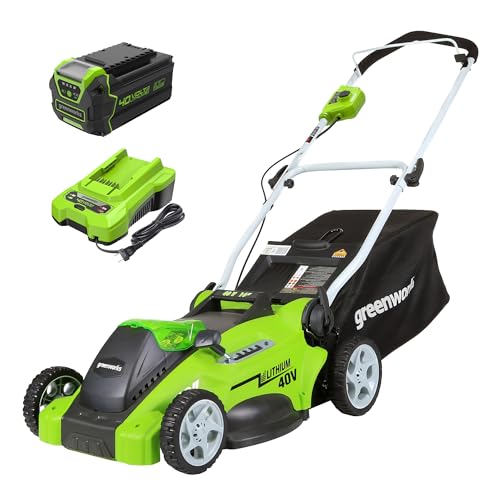 Greenworks 40V 16in Push Lawn Mower
- [16" LAWN MOWER] - This 40V lawn mower…
- [ULTRA LIGHTWEIGHT] - 35% lighter than steel deck…
- [SINGLE LEVER HEIGHT ADJUST] - 5 position height…
 Cordless Lawn Mower
- The 17-inch cutting deck and 6 height settings…
- Powered by two 20V 4.0Ah batteries, this walk…
- The 50L collection bag holds more clippings between…
 Greenworks 60V 21in Push Lawn Mower
- 50% more torque than 40V mowers & 3200…
- Built to handle rain, damp grass, and tough…
- Dual blades adjust power automatically for tall, wet,…
| Product | Key specs | |
|---|---|---|
| Greenworks 40V 16in Push Lawn Mower | [16" LAWN MOWER] - This 40V lawn mower… [ULTRA LIGHTWEIGHT] - 35% lighter than steel deck… [SINGLE LEVER HEIGHT ADJUST] - 5 position height… | Check price |
| Cordless Lawn Mower | The 17-inch cutting deck and 6 height settings… Powered by two 20V 4.0Ah batteries, this walk… The 50L collection bag holds more clippings between… | Check price |
| Greenworks 60V 21in Push Lawn Mower | 50% more torque than 40V mowers & 3200… Built to handle rain, damp grass, and tough… Dual blades adjust power automatically for tall, wet,… | Check price |
 MZK 20V 13-Inch Electric Lawn Mower MZK 20V 13-Inch Electric Lawn Mower | Brushless and Electric Lawn Mower with Grass Bag… | Check price |
 EGO Power+ 21" Cordless Electric Lawn Mower EGO Power+ 21" Cordless Electric Lawn Mower | EGO's cordless electric mower delivers up to 7.0… The EGO electric lawn mower operates for up… The EGO 800 Series lawn mower is a… | Check price |
 Litheli 14 Inch Cordless Lawn Mower Litheli 14 Inch Cordless Lawn Mower | [Cutting Grass Strong]:The Walk-behind battery mowers can mow… [5 Mowing Height Adjustments] : The cordless lawn… [Brushless Motor]:The battery powered lawn mower is powered… | Check price |
 MZK 40V 16-Inch 2-in-1 Lawn Mower MZK 40V 16-Inch 2-in-1 Lawn Mower | MZK 40V 17" Electric Mower, Push Mower for… | Check price |
 Worx Cordless Lawn Mower Worx Cordless Lawn Mower | Equipped with two 20V 4.0Ah batteries, the WORX… Featuring a powerful brushless motor 2.0, experience 40%… Maintain a healthier greener lawn by mulching or… | Check price |
As an Amazon Associate we earn from qualifying purchases at no extra cost to you.
Quick Picks
| Product | Best for | Price |
|---|---|---|
| Greenworks 40V 16″ Push | Medium yards on a budget | $258.99 |
| Cordless Lawn Mower 17″ Walk Behind | Small yards and tight budgets | $139.98 |
| Greenworks 60V 21″ Push | Larger yards without self-propulsion | $389.99 |
| MZK 20V 13″ Compact Brushless | Tight spaces and odd-shaped lawns | $119.98 |
| EGO Power+ 21″ Self-Propelled | Best overall performance | $699 |
| Litheli 14″ Lightweight Brushless | Users who prioritize low weight | $109.99 |
| MZK 40V 16″ 2-in-1 Brushless | Versatility at a low price | $159.98 |
| Worx 40V 17″ 2-in-1 | Quarter-acre lots | $213.75 |
How We Picked
We narrowed this list by weighing four criteria: voltage and battery capacity as indicators of runtime under load, cutting width relative to typical residential yard sizes, motor type (brushless motors deliver more torque per watt and last longer), and owner-reported reliability over multiple seasons. Price alone was never the deciding factor, but we flagged where you are paying for a feature versus paying for a brand.
The 8 Best Battery Powered Lawn Mowers in 2026
Greenworks 40V 16″ Push Lawn Mower (4.0 Ah Battery and Charger)
The Greenworks 40V 16-inch is the default recommendation for owners of half-acre lots who want a no-nonsense push mower without breaking past the $300 mark. The 4.0 Ah battery paired with 40V of power gives it enough stamina to handle a full mow on most residential lawns in a single charge, and the 16-inch deck strikes a sensible balance between maneuverability and coverage. Owners consistently praise the easy push feel and the fact that it starts every time with a button press. The con is that on thick or overgrown grass the single-speed drive can bog down, forcing you to slow your pace noticeably.
- Pro: Solid runtime from the 4.0 Ah battery for typical yard sessions.
- Pro: Straightforward push design with minimal setup required.
- Con: Struggles with dense or overgrown patches at normal walking speed.
Skip this if your yard exceeds half an acre or you frequently let grass grow long between mows.
Cordless Lawn Mower 17″ Walk Behind (Yard & Garden)
At under $140, this 17-inch walk-behind is one of the most affordable ways into cordless mowing, and the wide deck relative to its price is a genuine advantage for small-to-medium yards. It cuts cleanly on dry, evenly maintained grass and the walk-behind design keeps it manageable in narrow side yards. The trade-off is that at this price point the build quality feels lighter than premium options, and owners report the plastic housing and single motor do not inspire confidence for heavy seasonal use over many years. It is a capable starter mower, not a long-term investment.
- Pro: Excellent cutting width for the price bracket.
- Pro: Light and easy to maneuver in confined spaces.
- Con: Build quality feels budget-tier and may not endure heavy use.
Skip this if you need a mower that will last more than two or three seasons or if your terrain is uneven.
Greenworks 60V 21″ Push Lawn Mower (5.0 Ah Battery and Charger)
Greenworks steps up voltage and width together here, and the result is a push mower that covers ground at a rate comparable to smaller gas units. The 5.0 Ah battery at 60V provides meaningful runtime even when the 21-inch deck is working through thicker growth. Owners note that it handles slopes and damp grass better than the 40V model, making it a solid choice for yards up to three-quarters of an acre. The main drawback is weight: at 21 inches with a larger battery, this is not a mower you will lift into a truck bed without effort, and storing it in a tight shed requires planning.
- Pro: High power and wide deck combination covers large areas efficiently.
- Pro: Handles tougher grass conditions better than lower-voltage options.
- Con: Noticeably heavier, making transport and storage less convenient.
Skip this if storage space is very limited or you have mobility concerns that make pushing a wide mower difficult.
MZK 20V 13″ Electric Lawn Mower (Compact Brushless, Red)
This is a niche mower that fills a real gap: trimming and mowing around flower beds, fences, and narrow strips where a full-size machine cannot go. The brushless motor gives it more torque per watt than brushed equivalents at this voltage, and the compact 13-inch deck lets you cut in spaces a 20-inch mower simply cannot enter. Owners appreciate the light weight and quick start. The obvious limitation is that 20V and 13 inches mean this is not a primary mower for any yard larger than a small patio-adjacent patch; it will take many passes and repeated recharges on anything substantial.
- Pro: Brushless motor delivers surprising torque for 20V.
- Pro: Compact size excels in tight, odd-shaped areas.
- Con: Too small and underpowered to serve as a sole mower for a normal yard.
Skip this as your primary mower; treat it as a supplement to a larger unit.
EGO Power+ 21″ Cordless Electric Lawn Mower (Self-Propelled, LM2134SP-2)
The EGO Power+ self-propelled is the premium pick on this list and earns its price through features that matter in real use: a responsive self-propelled drive that matches your walking pace, a large 21-inch deck, and a battery system that owners report holds up across multiple seasons without significant capacity loss. The build quality is a step above everything else here, and the ride on uneven terrain is smoother because you are not pushing the weight yourself. The obvious barrier is cost — at $699 it is the most expensive option by a wide margin, and if your yard is small enough for a push mower, you are paying for power you may never need.
- Pro: Self-propelled drive eliminates pushing fatigue on slopes and large areas.
- Pro: Premium build quality and long-lasting battery system backed by strong owner loyalty.
- Con: Significantly more expensive than every other option on this list.
Skip this if your yard is under a quarter acre or you are on a strict budget under $400.
Litheli 14″ Cordless Lawn Mower (Lightweight, 5.0 Ah Battery, Brushless)
Litheli’s pitch here is weight, and the spec sheet backs it up: a 5.0 Ah battery in a 14-inch brushless package designed for yards up to 3,000 square feet. The five-position height adjustment from one to 2.5 inches gives you fine control over cut height without tools, which owners with patchy or newly seeded lawns find useful. For people who struggle with heavier mowers, this is a genuine alternative to the compact gas trimmers that used to dominate this category. The limitation is straightforward: 3,000 square feet is a generous estimate only if your grass is short and dry. Push into denser growth and the small deck means many more passes.
- Pro: Light enough for users who cannot manage heavier push mowers.
- Pro: Five tool-free height positions cover a useful range of cut styles.
- Con: Limited to smaller yards; struggles with dense or overgrown grass.
Skip this if your yard exceeds 3,000 square feet or you prefer wider cutting passes.
MZK 40V 16″ 2-in-1 Lawn Mower (Brushless Cordless Push)
The 2-in-1 designation means this MZK can mulch and bag, which at $159.98 is a feature set that would cost noticeably more from established brands. The 40V brushless motor gives it comparable power to the Greenworks 40V above but at a lower price, making it a value-oriented alternative for similar yard sizes. Owners report clean cuts and simple controls. The trade-off is brand support: MZK does not have the same service network or parts availability as Greenworks or EGO, so if something breaks outside a short window you may struggle to find replacements.
- Pro: 2-in-1 mulch and bag functionality at a price that typically offers only one mode.
- Pro: Competitive 40V power with brushless efficiency.
- Con: Limited long-term parts and service support compared to established brands.
Skip this if you want the peace of mind that comes with a widely supported ecosystem of shared batteries and service centers.
Worx 40V 17″ 2-in-1 Grass Mower (WG745, 1/4 Acre)
Worx explicitly rates this mower for quarter-acre lots, and owners confirm it comfortably handles that size without battery anxiety. The 2-in-1 design (mulch and bag) combined with the 17-inch deck gives it a versatility that punches above its price. The 40V power system shares batteries across a broad range of Worx garden tools, which is a practical advantage if you already own one of their trimmers or blowers. Where it falls short is on taller or wetter grass: the drive system does not compensate well for added resistance, and you end up slowing down or making multiple passes to avoid clumping.
- Pro: Shared 40V battery platform with a wide ecosystem of Worx tools.
- Pro: Rated for a quarter acre and delivers consistently at that size.
- Con: Performance drops noticeably in wet or tall grass.
Skip this if your lawn often has damp, heavy growth or you need a mower rated beyond a quarter acre.
Buying Guide
Voltage and Battery Capacity: The Real Power Source
Voltage and amp-hours together determine how long a mower runs and how well it handles resistance. A 20V mower with a small cell will stall on anything but pristine lawn grass. For most residential yards, 40V with a 4.0 Ah or larger battery is the entry point for comfortable mowing without mid-session charging breaks. If your grass grows thick or your yard is uneven, 60V and above gives the motor enough headroom to maintain blade speed under load. Self-propelled models at higher voltages compound the advantage because the drive motor draws from the same pack, so total runtime matters even more.
Cutting Width vs. Your Actual Yard Size
A 13-inch mower will finish a 3,000-square-foot yard, but it will take you three times as many passes as a 21-inch model, which means more walking, more battery cycles, and more time outdoors. Match deck width to open area, not total lot size. If your yard has narrow side strips or tight corners, consider a wider primary mower plus a compact trimmer for the awkward edges rather than forcing a small mower to do everything. Owners who skip this step consistently report fatigue and abandoned mowing within the first summer.
Push, Self-Propelled, or Hybrid
Push mowers are cheaper and lighter, and they work well on flat, open terrain. Self-propelled units cost more but reduce physical effort significantly on slopes and in larger areas because the drive motor does the work of moving the machine. Some models, like the Worx WG745, are technically push but include assisted drive. If you mow on a hillside or your yard exceeds half an acre, the price premium for self-propulsion pays for itself in reduced fatigue over the life of the mower. On flat quarter-acre lots, a quality push mower saves money without sacrificing the result.
Our Verdict
The EGO Power+ 21-inch self-propelled is the top pick overall because its build quality, consistent runtime, and reduced physical effort make it the mower most likely to be used rather than resented. For budget buyers, the MZK 40V 16-inch 2-in-1 offers the best combination of voltage, deck width, and dual-mode functionality under $160. However, if you already own tools on the Worx 40V battery platform, the WG745 becomes the smartest choice because you eliminate the cost of a second battery ecosystem entirely.
FAQ
How long do battery mower batteries last?
Most lithium-ion mower batteries are rated for 500 to 1,000 charge cycles before noticeable capacity drop, which translates to roughly five to eight seasons of regular weekend use. Owners of higher-voltage systems like Greenworks 60V and EGO consistently report usable runtime well into the fifth year when stored properly.
Can a battery mower handle wet grass?
Any mower cuts wet grass poorly because clippings clump and block the discharge path, but battery mowers are more sensitive than gas because added load draws more current and shortens runtime. Manufacturers like Worx explicitly note reduced performance in damp conditions, so mowing dry grass whenever possible extends both battery life and cut quality.
Are brushless motors worth the price difference?
Yes, in most cases. Brushless motors produce more torque per watt, generate less heat, and have no carbon brushes to wear out, which means consistent performance over more seasons. In this list the MZK and Litheli models demonstrate that brushless technology at lower voltages closes the gap with brushed motors at higher voltages.
Can I use one battery across different brands of mowers?
No. Battery platforms are proprietary by design. Greenworks 40V and 60V share within their ecosystem, Worx 40V is interchangeable with their other tools, and EGO is its own platform. If you own garden tools beyond a mower, choosing a battery platform that covers your trimmer, blower, and mower in one system is a practical way to reduce total cost and storage clutter.