Key takeaways
- Battery contacts: Keep the compartment dry and check for corrosion or residue when changing cells. Replace batteries as a full matched set rather than mixing old and new ones.
- Speaker protection: A grille helps, but a compact amp can still be damaged by a fall or a hard object pressing into its speaker. Use a padded bag if it travels in a crowded backpack.
- Cables and plugs: A stiff guitar cable can pull a lightweight amp off a table. Use a short, flexible cable for travel and place the amp on a stable surface.
- Outdoor use: Battery power does not mean weatherproof. Keep the amp out of rain, damp grass and direct heat, and let a cold amp acclimate before powering it on indoors.
- Accessories: Headphones, a cable, spare batteries and any required instrument adapter add to the real carry weight. Check whether an amp’s auxiliary input or phone connection suits your device before packing for a trip.
Best Battery Powered Guitar Amps for Practice & Travel
The best battery powered guitar amp for most players is the Boss Katana-Mini: it offers a useful range of tones, a proper speaker cabinet and up to seven hours of play from six AA batteries. For the lightest carry, choose the Blackstar FLY 3; for louder outdoor playing, consider the Roland CUBE Street EX, which trades pocketability for more power and a larger battery system.
Battery-life figures below are manufacturer estimates, not guaranteed playing times. Volume, tone settings, battery chemistry, age and temperature all affect runtime. The key distinction is whether you need a small amp for quiet practice or enough clean headroom to keep up outdoors: compact models are handy, but none should be expected to compete with a full drum kit.
Our top picks


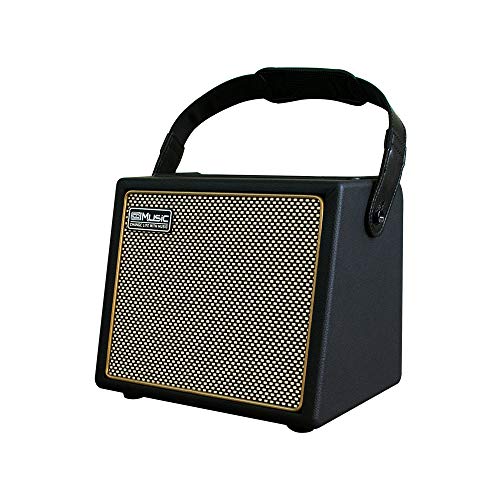

As an Amazon Associate we earn from qualifying purchases at no extra cost to you. Ratings are shown as listed on Amazon.
Quick comparison
| Model | Power and speaker | Battery option | Approx. weight | Best fit |
|---|---|---|---|---|
| Boss Katana-Mini | 7 W; 4-inch speaker | 6 AA; up to 7 hours | 1.2 kg | Versatile home or travel practice |
| Blackstar FLY 3 | 3 W; 3-inch speaker | 6 AA; up to 55 hours at low volume | 0.9 kg | Lightweight, quiet practice |
| Roland CUBE Street EX | Up to 50 W; two 8-inch speakers | 8 AA; up to 20 hours in Eco mode | 7.4 kg | Outdoor playing and small performances |
| Yamaha THR5 | 10 W total; two 3.1-inch speakers | 8 AA; up to 6 hours | 2.0 kg | Desk practice and stereo playback |
Figures are approximate and based on published manufacturer specifications. The CUBE Street EX’s power and runtime depend on operating mode; its maximum output is not the same as its battery-efficient Eco setting. Check the current manual before buying, especially if battery operation is essential.
Choose by where and how you play
| Your situation | Best starting choice | Why |
|---|---|---|
| Apartment practice; low volume matters | Blackstar FLY 3 | Small and simple, with a headphone output for genuinely quiet sessions. |
| One amp for home and travel | Boss Katana-Mini | More tone-shaping flexibility than a basic practice amp, while remaining easy to carry. |
| Practice at a desk with backing tracks | Yamaha THR5 | Stereo speakers and auxiliary input make music playback and practice convenient. |
| Playing outside with a small group | Roland CUBE Street EX | Larger speakers and higher output offer more usable projection than pocket-sized amps. |
For occasional trips, AA-powered amps are convenient because replacements are widely available. If you play outside every week, weigh the cost and hassle of disposable cells against rechargeable AA batteries or a larger amp’s battery setup. For frequent outdoor use, speaker size and clean headroom matter at least as much as the wattage printed on the box.
Which amp makes sense for your budget?
Prices vary by region and retailer, but these broad ranges help set expectations: compact 3–7 W models such as the FLY 3 and Katana-Mini typically sit around $60–$150; the Yamaha THR5 is commonly in the $150–$250 range; and the CUBE Street EX is a more substantial investment, often around $400–$600. Treat these as general market ranges, not current quotes.
If you’re a beginner or only play at home, spend first on an amp with a usable headphone output and controls you can understand. If you already own a larger home amp and want a travel companion, a small model is easier to justify. Paying more for a portable amp is worthwhile mainly when you’ll use its extra inputs, stereo playback or outdoor volume regularly.
What low-volume tone actually depends on
At bedroom volume, speaker size and voicing can matter more than headline power. Small speakers can sound thin when asked to reproduce deep bass or thick distortion, while a design with useful EQ or built-in voicings can help you find a satisfying sound without turning up. Headphones solve the noise problem, but they don’t tell you how the amp’s speaker will sound outside.
For practice, test the sound at the volume you’ll actually use. Set gain and master volume separately if the amp allows it, then listen for brittle treble, fizzy distortion and weak palm-muted notes. A convincing tone at maximum volume is not much help if it becomes harsh when turned down.
Battery runtime: plan for the session, not the box
A manufacturer’s maximum runtime is typically measured under particular conditions, often at low output. Playing loudly, using effects or letting batteries age can shorten it. Here’s a practical planning example: if an amp is rated for seven hours and you practice for 45 minutes per day, the theoretical maximum is about nine sessions. Allowing a 30% buffer for real-world variation brings that down to roughly six sessions.
For a weekend trip, carry a spare set of cells or rechargeables rather than relying on a maximum-runtime estimate. Remove disposable batteries if the amp will be stored for months; leaking cells can damage the contacts. Rechargeable AA batteries reduce waste with repeated use, but keep a charged spare set ready and confirm that the amp accepts the battery type you plan to use.
Ownership details that affect portability
- Battery contacts: Keep the compartment dry and check for corrosion or residue when changing cells. Replace batteries as a full matched set rather than mixing old and new ones.
- Speaker protection: A grille helps, but a compact amp can still be damaged by a fall or a hard object pressing into its speaker. Use a padded bag if it travels in a crowded backpack.
- Cables and plugs: A stiff guitar cable can pull a lightweight amp off a table. Use a short, flexible cable for travel and place the amp on a stable surface.
- Outdoor use: Battery power does not mean weatherproof. Keep the amp out of rain, damp grass and direct heat, and let a cold amp acclimate before powering it on indoors.
- Accessories: Headphones, a cable, spare batteries and any required instrument adapter add to the real carry weight. Check whether an amp’s auxiliary input or phone connection suits your device before packing for a trip.
Bottom line
Choose the Blackstar FLY 3 for very portable, low-volume practice; the Boss Katana-Mini for the best balance of portability and tone flexibility; the Yamaha THR5 when stereo playback and desk use are priorities; and the Roland CUBE Street EX when outdoor projection matters more than weight or price. For any battery amp, judge it at your normal practice volume, budget for less than the advertised maximum runtime, and match its speaker size to the places you’ll actually play.