Key takeaways
- Pros: Highest wattage in the 10000mAh tier; slim and travel-friendly form factor
- Con: Lower total capacity means fewer full charges compared to the 20000mAh or 50000mAh models above
What's inside
Nothing derails a day faster than a dead phone. Missing a reservation, losing directions, or being unable to call for a ride are all real scenarios that turn a minor inconvenience into a genuine problem. A power bank solves this, but the market is crowded with models that differ wildly in capacity, charging speed, and physical size. The challenge is not finding a portable charger but choosing the right one for how you actually use your phone.
What separates a good power bank from a disappointing one comes down to a few practical questions: How many full charges does it deliver to your specific phone? How fast does it refill your battery, and how quickly does it refill itself? Does it match your daily carry or your weekend trip? Across the 2026 selection reviewed here, capacity ranges from 10000mAh to 50000mAh, output spans from 22.5W to 45W, and prices vary from under fifteen dollars to over fifty. The right answer depends entirely on your lifestyle and phone usage.
As an Amazon Associate we earn from qualifying purchases at no extra cost to you. Product prices and availability are accurate as of the date shown and are subject to change.


Quick Picks
| Product | Best For | Price |
|---|---|---|
| INIU 10000mAh 45W | Fastest top-ups on the go | $22.49 |
| Miady 2-Pack 10000mAh | Couples or families sharing | $19.97 |
| OHOVIV 50000mAh PD 22.5W | Multi-day trips without outlets | $45.99 |
| Evopow 2-Pack 10000mAh | Lowest per-unit cost for two | $16.99 |
| BLASOUL Solar 49800mAh | Off-grid outdoor use | $39.99 |
| 10000mAh 22.5W Built-in Cables | Minimalist carry, zero cable anxiety | $13.49 |
| Durecopow Solar 20000mAh | Balanced solar option for camping | $20.50 |
| OHOVIV 50000mAh Built-in Cables | Maximum capacity with cable convenience | $51.98 |
How We Picked
We evaluated these models against published specifications, listed prices, and recurring themes in owner feedback. The three criteria that matter most in this category are capacity-to-weight ratio (how much usable juice you get relative to bulk), charging speed (both input and output wattage, since a power bank that takes ten hours to refill is impractical for daily rotation), and convenience features like built-in cables, multiple ports, or solar input that reduce friction in real use. Price-per-milliamp-hour served as a secondary lens to flag standout value or poor deals.
The 8 Best Power Banks For Cell Phones in 2026
INIU 10000mAh 45W Fast Charging Portable Charger
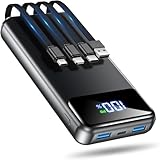
For anyone whose top priority is speed, this is the most powerful 10000mAh option in the roundup. The 45W output is well above the 22.5W ceiling shared by most competitors here, meaning it can top up a modern smartphone in noticeably less time while also refilling itself faster. Its compact travel footprint makes it easy to slip into a jacket pocket or small bag.
- Pros: Highest wattage in the 10000mAh tier; slim and travel-friendly form factor
- Con: Lower total capacity means fewer full charges compared to the 20000mAh or 50000mAh models above
Skip this if you routinely go multiple days between outlets or need to charge more than one or two devices from a single unit.
Miady 2-Pack Portable Charger, Slim 10000mAh
This bundle makes sense when two people in a household each need their own backup battery without doubling the cost. At $19.97 for two units, the per-bank price is under ten dollars, and the slim profile keeps each one pocketable. It suits parents giving a kid a dedicated charger or roommates splitting a drawer.
- Pros: Two full-sized 10000mAh banks for under twenty dollars; slim enough to carry daily without bulk
- Con: No standout charging speed advantage over single-pack competitors at a similar price point
Skip this if you travel alone or if you would rather spend a few extra dollars on a single higher-capacity or faster-charging unit.
OHOVIV Portable Charger Power Bank 50000mAh, PD 22.5W
This is a multi-day workhorse. Fifty thousand milliamp-hours translates to numerous full phone charges, making it suitable for long road trips, outdoor festivals, or emergency preparedness kits. The PD 22.5W output is respectable for its size class, and the price sits comfortably in the mid-forties.
- Pros: Enormous capacity for the price tier; supports modern fast-charging standards
- Con: Physical weight and bulk make it impractical for everyday carry or pocket storage
Skip this if you primarily need a slim backup for a single day of heavy phone use and prefer something that disappears into a small bag.
Evopow 2 Pack Portable Charger, 10000mAh
At $16.99 for two 10000mAh banks, this is the cheapest entry point for anyone who wants split coverage. The per-unit cost is among the lowest in the roundup. Owner feedback highlights solid reliability for basic phone charging, and the travel-friendly slim design keeps each unit unobtrusive.
- Pros: Lowest total price in the roundup; two independent units reduce arguments over a shared charger
- Con: No advertised fast-charging wattage advantage, so top-ups will take longer than the INIU or higher-wattage options
Skip this if you need fast charging for a flagship phone or if you want a single larger-capacity bank instead of two smaller ones.
BLASOUL Solar Power Bank 49800mAh Wireless
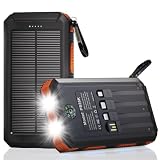
This model targets the hiker, camper, or prepper who values resilience over portability. Nearly 50000mAh capacity, wireless charging, four built-in cables, 22.5W fast output, and a solar panel combine into one rugged package. For extended trips where grid power is unavailable, the solar trickle-charge adds a genuine layer of backup.
- Pros: Near-maximum capacity in the roundup plus solar recharging and wireless output in one unit
- Con: The feature density comes with significant weight and size, and solar charging speed is inherently slow in most real conditions
Skip this if your use case is urban commuting or air travel, where the bulk and weight penalty outweighs the outdoor benefits.
Portable Charger 10000mAh 22.5W with Built-in 2 Cables
The lowest-priced option in the entire roundup, and it still delivers 22.5W output with two integrated cables, eliminating the most common annoyance of forgetting a cord. For students, commuters, or anyone wanting a simple grab-and-go backup, this is hard to beat on pure value.
- Pros: Lowest price; built-in cables remove a failure point in daily use
- Con: 10000mAh capacity limits you to roughly one or two phone charges, so it is best treated as a single-day safety net
Skip this if you need to charge multiple devices or require more than a day of backup power between outlets.
Durecopow Solar Charger Power Bank 20000mAh
Twenty thousand milliamp-hours with solar input, four cables, three ports, and a dual flashlight positions this as a practical middle ground for campers who want solar capability without the extreme bulk of the 50000mAh tier. The added flashlight is a small but meaningful feature for evening use on a trail.
- Pros: Balanced capacity for weekend trips; dual flashlight and multi-port design add versatility without a steep price jump
- Con: Solar charging is a supplementary feature, not a primary charging method, so do not rely on it for full refills on short trips
Skip this if you need the absolute fastest phone top-up available or if your trips are purely urban with frequent access to outlets.
OHOVIV Portable Charger Power Bank 50000mAh, 4 Built-in Cables
The premium tier in this roundup pairs the highest available capacity with four built-in cables, removing the need to carry separate cords for different phone types. At $51.98 it costs more than every other model here, but for someone who wants one device to handle everything from a phone to a tablet to a friend’s earbuds, the consolidation is the point.
- Pros: Maximum capacity plus integrated cable set means fewer accessories to remember; supports a wide range of devices simultaneously
- Con: The price and physical size make it a dedicated travel or emergency piece of gear rather than an everyday carry
Skip this if budget is your primary constraint or if your setup involves only one phone and you are fine carrying a single cable.
Buying Guide
Capacity: Matching mAh to Your Phone and Trip Length
Milliamp-hours (mAh) indicate the battery stored in the power bank, but usable output is lower due to conversion losses, typically around 60-70 percent. A 10000mAh bank realistically delivers one to two full charges for most modern smartphones. A 50000mAh unit stretches that to five or more. The practical question is simple: how many days will you go without an outlet? If the answer is zero, 10000mAh is sufficient and keeps weight low. If the answer is three or more, only the 40000-50000mAh tier delivers adequate headroom.
Charging Speed: Why Wattage Matters More Than You Think
Output wattage determines how fast your phone refills. The 22.5W standard shared by most models here is adequate for everyday top-ups, but the INIU’s 45W output cuts charging time meaningfully, especially on phones that support higher-wire protocols. Input wattage is equally important: a large-capacity bank with a low input rate can take the better part of a day to refill from empty, making it impractical to rotate daily. Check both numbers before purchasing, not just the one printed in bold on the label.
Convenience Features: Cables, Solar, and Multi-Device Support
Built-in cables eliminate the single most common failure point of forgetting a cord. If you carry a charger daily, at least one model with integrated cables saves frustration. Solar panels are genuinely useful for extended off-grid stays but add weight and only trickle-charge; treat them as a backup method, not a primary one. If you charge multiple device types, look for units offering three or more ports or a wireless pad, since a single USB-A output limits flexibility with modern phones and accessories.
Our Verdict
The top pick is the INIU 10000mAh 45W. It balances the most practical daily capacity with the highest charging speed in this roundup and a compact size that suits everyday carry without compromise. For the budget slot, the 10000mAh 22.5W with built-in cables at $13.49 is the clear value winner: it covers the essential use case, removes cable anxiety, and costs less than any other single unit listed. The one condition under which another product takes the crown is extended off-grid use. If you are heading out for three or more days without reliable power, the OHOVIV 50000mAh with built-in cables becomes the smartest buy despite its premium price, because capacity dominates every other factor in that scenario.
FAQ
How many times can a 10000mAh power bank charge my phone?
Most modern flagship phones have batteries in the 4000-5000mAh range. After accounting for conversion losses, a 10000mAh power bank delivers roughly one and a half to two full charges for those devices, or closer to three for smaller phones. The exact number depends on your phone’s battery size and how efficiently the power bank converts stored energy.
Is a solar power bank actually useful for everyday use?
Solar panels on power banks serve as an emergency trickle-charge method, not a primary charging solution. Under typical conditions, a small integrated panel generates very low wattage, so fully refilling even a modest-capacity bank via solar alone can take many hours of direct sunlight. They add real value for extended camping or disaster-preparedness scenarios where any charging method is better than none.
Can I bring a 50000mAh power bank on a plane?
Most airlines allow power banks under 100Wh in carry-on luggage. A 50000mAh bank at a standard 3.7V nominal voltage calculates to approximately 185Wh, which typically exceeds the no-approval-needed threshold and may require airline permission or be prohibited entirely. Check your specific carrier’s current policy before traveling, as rules vary and enforcement is strict.
Do built-in cables wear out faster than separate ones?
Built-in cables are fixed, so if one frays or breaks you lose that connection permanently and cannot replace it independently. Separate cables can be swapped for a new one at minimal cost. However, integrated cables eliminate the risk of forgetting or losing a cord, which many owners report as the more frequent real-world problem over long-term cable degradation.