Key takeaways
- Place a table microphone away from laptop fans and projector noise, and keep it out of direct line with a loudspeaker to reduce echo.
- Keep wireless receivers in line of sight of the transmitter and away from metal obstructions.
- Charge all batteries before important sessions and carry spares for events.
- Clean foam windscreens as the maker advises, and never use harsh solvents on housings.
- Follow local rules on radio frequency use; in some countries, certain wireless bands need licensing.
For a small meeting room, a USB or Bluetooth speakerphone such as the Jabra Speak2 75, Poly Sync 60 or Anker PowerConf series is the simplest wireless option; for larger rooms and hybrid meetings, a table or ceiling microphone system such as the Shure MXA series or Yamaha YVC series, or a wireless lavalier or handheld system like the Rode Wireless PRO, suits presenters and trainers. The right choice depends on room size, number of speakers and whether you need to feed a video call, a PA system or a recording. This guide explains the main categories, compares representative models using maker-stated specifications, and lists the limits of each.
Our top picks


As an Amazon Associate we earn from qualifying purchases at no extra cost to you.
Three types of wireless conference microphone
Portable speakerphones
A speakerphone combines a microphone array and a loudspeaker in one puck. It connects over USB, Bluetooth or both, and suits huddle rooms, kitchen tables and travel. Makers state pickup ranges, usually for rooms with a few people. They are the easiest to use but have limited range for large tables.
Table and boundary microphones
These sit on a table and pick up several speakers. Some are wireless in the sense that they transmit to a receiver or connect over a network, while others are wired to a hub. They are common in meeting rooms with a dedicated video-conference system.
Lavalier, headset and handheld wireless systems
Presenters, trainers and event hosts typically use a body-pack transmitter with a clip-on lavalier, a headset or a handheld microphone, paired with a receiver connected to a mixer, camera or computer. These offer the best individual voice pickup and freedom to move, but each speaker needs their own microphone.
At a glance
| Product | Type | Best for | Key stated specs | Limits |
|---|---|---|---|---|
| Jabra Speak2 75 | Portable speakerphone | Small rooms and remote workers who also travel | Maker lists USB and Bluetooth connection, multiple microphones, and a stated pickup for several people | Not designed for large tables |
| Poly Sync 60 | Smart speakerphone | Offices using common conferencing platforms | Maker lists a microphone array, USB and Bluetooth, and platform compatibility | Mid-range tier; limited coverage beyond a small room |
| Anker PowerConf S500 or similar | Portable speakerphone | Value-oriented small teams | Maker lists a six-microphone array on some models and USB connection | Sound tuning varies by model |
| Shure MXA series | Ceiling or table array | Medium to large meeting rooms and boardrooms | Maker lists beamforming coverage and network audio integration | Requires installation and often an audio processor |
| Rode Wireless PRO or Wireless GO | Clip-on wireless transmitter and receiver | Presenters, trainers and content creators | Maker lists compact transmitters with built-in microphones and a receiver for cameras or computers | One transmitter per speaker; not room coverage |
| Shure SLX-D or BLX series | Wireless handheld or body-pack system | Venues, classrooms and events with a PA | Maker lists digital wireless operation and a range of microphone options | Frequency coordination can be needed in busy venues |
What to compare
Room size and number of talkers
Count the people and measure the table or room. A speakerphone with a stated pickup radius of a few meters can handle a small group. Larger rooms need either multiple microphones or a ceiling array. If speakers are spread out, a single table puck will pick up distant voices poorly and produce an echoey sound.
Connection method
USB is the most reliable for laptops and room computers. Bluetooth is convenient but can have latency and range limits. Network audio such as Dante is used in professional installations. For wireless presenter systems, check whether the receiver outputs to a 3.5 mm jack, XLR or USB.
Echo cancellation and noise suppression
Makers of conference products usually describe acoustic echo cancellation and noise reduction. These features matter most when the microphone and the speaker are in the same device or when the room is reverberant. Reviewers often note that treated rooms with soft furnishings improve every system.
Battery life and charging
Portable and wireless units rely on rechargeable batteries. Makers state runtimes under specific conditions. For long events, look for hot-swappable batteries or the ability to run while charging.
Range and interference
Wireless microphones use 2.4 GHz, 5 GHz or UHF bands. In crowded buildings, interference from wifi and other devices can cause dropouts. Professional systems from Shure and Sennheiser include frequency scanning and coordination tools, which reviewers regard as an advantage for venues.
Platform compatibility
Some speakerphones are certified for specific conferencing platforms, which can add button integration. Check that the model you choose is listed as compatible with the software your team uses.
Budget tier guidance
Budget
Value speakerphones and compact wireless microphone kits serve small teams, teachers and individual presenters. Expect good enough speech clarity but limited range and fewer controls.
Mid-range
Jabra and Poly speakerphones and the Rode wireless systems sit here. They provide stronger echo control, better build and clearer software support, and they suit most small to medium businesses.
Premium
Ceiling arrays and digital wireless systems from Shure, Sennheiser and Yamaha target professional installations. They require setup but deliver consistent coverage and fine-grained control.
Setup and care notes
- Place a table microphone away from laptop fans and projector noise, and keep it out of direct line with a loudspeaker to reduce echo.
- Keep wireless receivers in line of sight of the transmitter and away from metal obstructions.
- Charge all batteries before important sessions and carry spares for events.
- Clean foam windscreens as the maker advises, and never use harsh solvents on housings.
- Follow local rules on radio frequency use; in some countries, certain wireless bands need licensing.
Pick X if…
| If you want… | Pick | Why |
|---|---|---|
| A simple device for a few people | Jabra Speak2 75 or Poly Sync 60 | Plug-in speakerphone with USB and Bluetooth |
| A budget speakerphone | Anker PowerConf series | Lower cost with microphone array |
| Coverage of a large boardroom | Shure MXA series | Beamforming array for installed rooms |
| A presenter who moves around | Rode Wireless PRO | Clip-on transmitter with compact receiver |
| Events with a PA system | Shure SLX-D or BLX | Wireless handheld and body-pack options |
Alternatives
- Wired boundary microphones: more reliable and cheaper than wireless ones for fixed tables.
- Conference camera bars with built-in microphones: one device for video and audio in small rooms.
- Wireless headsets: best for individuals who want the clearest voice with the least room noise.
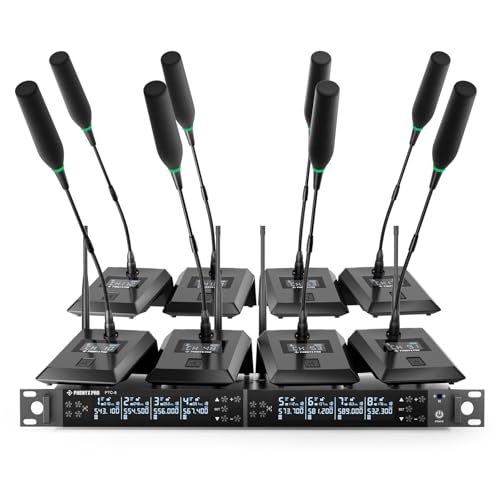
- Gooseneck table microphones: practical for moderated panels with a mixer.
Planning a meeting room audio setup
Before buying, map how the room is used. A weekly team meeting with six people around a table has very different needs from a training room where one presenter walks around. For the first case, one or two table-level devices or a ceiling array are usually enough. For the second, a body-pack or handheld system with a receiver wired to the room speakers makes more sense.
Think about the speaker side as well. Pickup is only half of a conference system; remote participants need to hear the room, and the room needs to hear them clearly. Speakers that are too loud can feed back into microphones, while speakers that are too quiet force people to lean in. Placing the loudspeaker away from microphones and positioning it so that sound reaches the audience without pointing at the pickup area reduces feedback.
Common pitfalls
Buyers frequently choose a single device for a room that is too large, leaving people at the far end of the table barely audible. Another problem is ignoring the wireless environment: a building full of wifi networks can interfere with 2.4 GHz devices. If you plan multiple wireless channels, check that the system supports enough channels at the same time without overlap. Finally, test the equipment in the real room before a high-stakes meeting, because acoustics, reflections and background noise from ventilation can change how any microphone performs.
Frequently Asked Questions
How many people can one speakerphone handle?
Makers typically state a number, often four to eight people for compact models. Real results depend on seating distance and room acoustics. If participants sit more than a few meters away, add a second device or move to a table or ceiling system.
Is Bluetooth good enough for meetings?
Bluetooth works for casual calls and travel use. For important meetings or room systems, a USB connection is generally more stable and avoids pairing issues. Bluetooth can also add a small delay.
What is the difference between a lavalier and a handheld system?
A lavalier clips to clothing and leaves hands free, which suits presenters. A handheld microphone can be passed between speakers and often rejects room noise better. Both need a receiver, and each speaker needs a transmitter.
Why do wireless microphones drop out?
Interference, obstruction or low batteries are the usual causes. Keep a clear line of sight between the transmitter and the receiver, avoid crowded wifi channels where possible and replace batteries before events.
Do I need echo cancellation?
If the microphone and loudspeaker are in the same room or device, yes. Most conference products include it, but results improve in rooms with carpet, curtains and wall treatment.
Can I use a conference microphone for streaming or recording?
Often yes, if it provides a USB or line output. Speech clarity is usually good, but conference devices are tuned for intelligibility rather than music or broadcast sound.
More from Amazon
Programs that pair well with the guide above. Offers and eligibility are set by Amazon and may change.
Free shipping on eligible items, Prime Video and more. Eligible new members can start with a free trial.
Start a Prime free trialAd-free music streaming. Eligible new subscribers can start with a free trial.
Try Music Unlimited freeA Prime membership for ages 18-24 with a trial period. Eligibility is set by Amazon.
See Prime for Young AdultsAudiobooks and podcasts to listen to on the go. Eligible new members can start with a free trial.
Try Audible freeAs an Amazon Associate we earn from qualifying purchases.