Key takeaways
- Flatness: A rigid, continuously supported panel normally looks better than a thicker sheet fixed only at its corners.
- Panel length: Long panels reveal bowing more easily. A 48-inch-wide panel can show noticeable distortion if the wall is uneven.
- Protective layers: Scratch-resistant coatings improve durability but can slightly reduce brightness or introduce haze if poorly applied.
- Viewing distance: Minor edge distortion may be irrelevant in a narrow home gym but distracting in a studio where people stand close to the wall.
- Color accuracy: Some low-cost reflective films have a gray, bronze, or bluish cast. A neutral reflection is preferable for checking alignment and clothing fit.
The best shatterproof glassless gym mirrors are large, rigid acrylic or polycarbonate panels with a thickness of at least 3 mm, a protected reflective coating, and a mounting system that keeps the panel flat; acrylic usually gives the clearest image, while polycarbonate offers better impact resistance.
Glassless does not mean unbreakable. Plastic mirrors can crack, scratch, bow, or develop a hazy reflection, but they avoid the dangerous shards associated with ordinary glass. The right choice depends on whether your priority is maximum clarity, impact safety, a lightweight installation, or covering a large wall economically.
Our top picks


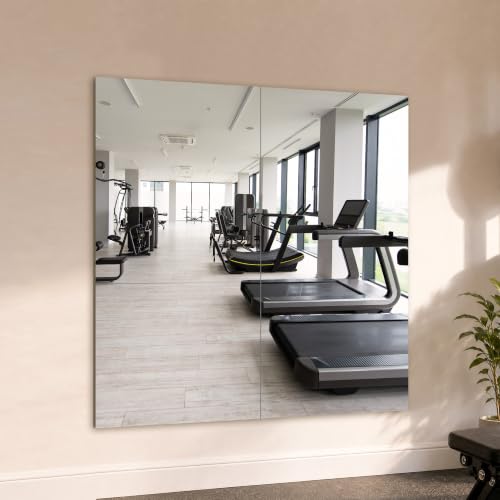

As an Amazon Associate we earn from qualifying purchases at no extra cost to you. Ratings are shown as listed on Amazon.
Quick comparison: which reflective material is best?
| Material | Typical thickness | Image clarity | Impact resistance | Typical weight at 24 x 36 in | Best use |
|---|---|---|---|---|---|
| Cast acrylic mirror | 1/8–1/4 in (3–6 mm) | Very good when mounted flat | Good; may crack under a hard blow | About 3–6 lb | Home gyms and technique viewing |
| Polycarbonate mirror | 1/8–1/4 in (3–6 mm) | Good, but more prone to visual waviness | Excellent | About 3–6 lb | Functional training areas and higher-impact spaces |
| PET mirror film or sheet | About 0.01–0.04 in (0.25–1 mm) | Fair to good, depending on tension and backing | Good, but easily creased or dented | Under 2 lb | Temporary, curved, or very lightweight installations |
| Polished stainless steel | About 0.02–0.04 in (0.5–1 mm) | Fair; often visibly less precise | Excellent | About 5–8 lb | Commercial abuse-prone environments |
These weights are approximate and exclude frames, rails, protective film, and mounting hardware. A thicker sheet is not automatically better: a badly supported 6 mm panel can still show ripples, while a properly backed 3 mm acrylic panel can look considerably cleaner.
Our picks by gym situation
Best overall for most home gyms: 3–4 mm cast acrylic
Cast acrylic is the strongest all-round choice when users need to check squat depth, lifting posture, dance alignment, or general form. It is much lighter than glass, easy to cut to custom dimensions, and commonly available in panels from approximately 12 x 24 inches to 48 x 96 inches.
Choose a cast sheet rather than an unspecified “plastic mirror” when possible. Cast acrylic generally offers a flatter, more consistent surface than inexpensive extruded sheet. Look for a rear reflective coating, a protective backing, and instructions that specify adhesive compatibility. Acrylic produces a bright reflection, but its surface scratches readily, so it should not be installed where barbells, kettlebells, or equipment regularly contact the wall.
Best for high-impact training: polycarbonate mirror
Polycarbonate is the safer choice where balls, resistance bands, equipment handles, or accidental contact are realistic risks. It is substantially tougher than acrylic and is less likely to fracture from impact. The compromise is optical quality: thin polycarbonate can show slight distortion, especially toward the edges or when the panel is not supported continuously.
For a functional training area, a 3–4 mm polycarbonate panel mounted against a rigid, flat backer is usually a better choice than a thin, unsupported sheet. If the room is used for precision movement instruction, inspect a sample at full viewing distance before buying several panels.
Best for large coverage on a restricted budget: modular acrylic panels
Several smaller panels can be easier to carry upstairs, align around outlets, and replace after damage than one full-wall mirror. Panels around 12 x 24, 12 x 36, or 24 x 36 inches are common size categories. The trade-off is a visible seam every 2–3 feet and more opportunities for misalignment.
Use a narrow, consistent gap rather than forcing edges together. Plastic expands and contracts with temperature, and tightly butted panels can bow or push against one another. A dark wall behind the seams makes the joints less distracting.
Best for temporary or rental installations: mirror film or lightweight PET sheet
Flexible mirror film is useful when drilling is not allowed or when the wall has a slight curve. It is not the best option for judging precise form because wrinkles, tension differences, and uneven walls can create a funhouse effect. Adhesive-backed products can also remove paint or leave residue.
For a temporary gym, mount the film to a removable smooth board instead of applying it directly to painted drywall. This keeps the reflective surface flatter and makes replacement easier.
Clarity and distortion: the details that matter more than the material name
- Flatness: A rigid, continuously supported panel normally looks better than a thicker sheet fixed only at its corners.
- Panel length: Long panels reveal bowing more easily. A 48-inch-wide panel can show noticeable distortion if the wall is uneven.
- Protective layers: Scratch-resistant coatings improve durability but can slightly reduce brightness or introduce haze if poorly applied.
- Viewing distance: Minor edge distortion may be irrelevant in a narrow home gym but distracting in a studio where people stand close to the wall.
- Color accuracy: Some low-cost reflective films have a gray, bronze, or bluish cast. A neutral reflection is preferable for checking alignment and clothing fit.
Before installing a full wall, place one sample panel vertically and inspect a straight object—such as a door frame or strip of painter’s tape—at the center and edges. If the line bends, repeats, or changes width, the issue may be the panel, the wall, or both.
Panel size and coverage calculation
A full-height gym mirror does not need to cover every inch of wall to be useful. For most users, the key area is the zone from roughly knee height to above the head. For example, a 12-foot-wide wall covered with 24 x 36-inch panels requires:
12 feet ÷ 2 feet per panel = 6 panels per row.
Two rows provide 72 inches of height, so the installation needs 6 × 2 = 12 panels. If each panel costs approximately $25–$55, the reflective sheets alone cost about $300–$660. Add edge trim, spacers, adhesive or rails, and a backer if needed. This modular arrangement is lighter to handle than a single 12-foot sheet, but it creates 11 vertical seams and one horizontal seam.
For a 9-foot-wide wall using 24 x 36-inch panels, four panels across cover 8 feet, leaving a 12-inch strip. Five panels across cover 10 feet and require trimming or a deliberate overlap layout. Planning the grid before ordering avoids an awkward narrow strip at one end.
Mounting options compared
| Mounting method | Flatness | Removal | Best for | Main risk |
|---|---|---|---|---|
| Mechanical clips or screws with washers | Very good when spaced correctly | Good | Permanent home or commercial installation | Overtightening can crack acrylic |
| Aluminum J-channel or framing rails | Very good | Good | Large panels and replaceable sections | Requires accurate leveling |
| Full-surface mirror adhesive | Good on a flat wall | Poor | Clean, permanent walls | Adhesive may damage plastic or drywall |
| Hook-and-loop strips | Fair | Very good | Small, lightweight panels | Panel movement and edge lift |
| Freestanding framed panel | Good if braced | Very good | Renters and changing layouts | Tip-over hazard if not secured |
For panels larger than about 24 x 36 inches, continuous support or a proper rail system is preferable to four adhesive strips. Leave room for expansion, protect drilled holes with suitable washers, and do not clamp the sheet so tightly that it cannot move slightly with temperature.
Durability and maintenance realities
The first thing that usually wears out is the surface, not the reflective backing. Dust, chalk, grit, and rough towels create fine scratches that accumulate into haze. Clean with lukewarm water and a soft microfiber cloth. If needed, use a plastic-safe cleaner specifically labeled for acrylic or polycarbonate. Avoid ammonia, abrasive powders, paper towels, rough sponges, and solvent-based cleaners unless the manufacturer explicitly approves them.
Remove grit before wiping: spray or rinse the cloth rather than rubbing dry dust across the panel. Do not use a steam cleaner. Keep barbells and storage racks at least a few inches away from the mirror face, and add a lower protective rail in areas where plates or shoes may strike the wall.
Common installation mistakes include removing protective film before all drilling is complete, mounting over a bowed wall, using ordinary glass-mirror adhesive, and placing a flexible sheet under tension. These errors can cause bubbles, permanent waves, chemical damage, or cracking around fasteners.
Decision matrix
| Your situation | Recommended choice | Why |
|---|---|---|
| Budget-conscious home gym, moderate use | 3 mm cast acrylic panels | Good clarity, manageable weight, reasonable replacement cost |
| Frequent group training or equipment near the wall | 3–4 mm polycarbonate with full backing | Better impact tolerance than acrylic |
| Precision technique, dance, or movement instruction | Flat 4–6 mm acrylic or high-quality rigid PET | Lower distortion is more important than minimum weight |
| Rental property or temporary setup | Small PET or acrylic panels on a removable board | Less wall alteration and easier removal |
| Very large wall with difficult access | Modular panels in rails or a frame | Easier transport, replacement, and alignment |
Bottom line
For most buyers, the best shatterproof glassless gym mirrors are rigid 3–4 mm cast acrylic panels installed flat with mechanical support or a proper rail. Select polycarbonate instead when impact is the dominant concern, and choose mirror film only when low weight or removability outweighs optical precision. Whichever material you choose, a flat wall, continuous backing, careful cleaning, and protected edges will have as much effect on the mirror’s useful life as the sheet material itself.