Key takeaways
- Brush rolls wear first: Hair, threads, and carpet fibers collect around end caps and bearings. Cut away wrapped hair regularly and check that the roller spins freely.
- Filters need washing or replacement: Washable filters must dry completely—often for at least 24 hours—before reinstalling. A damp filter can restrict airflow and create odors.
- Belts are consumables: Upright belts can stretch or break, especially when the brush roll is jammed. Replace them with the correct size rather than operating with a slipping belt.
- Pet hair fills capacity quickly: Empty a bagless bin when it reaches roughly two-thirds full, and inspect the inlet for clumps before assuming the motor has failed.
- Hard floors need the right head: Disable a conventional rotating brush on delicate floors unless the manufacturer specifically approves it. Grit trapped in stiff bristles can cause fine scratches.
- Battery aging is normal: Cordless batteries lose capacity over time. A model with a replaceable battery is usually easier to keep in service than one with a sealed pack.
The best home vacuums for most households are a lightweight cordless stick for quick daily cleaning, a corded upright for carpet and pet hair, or a canister vacuum for hard floors, stairs, and quieter whole-home cleaning.
Our top picks


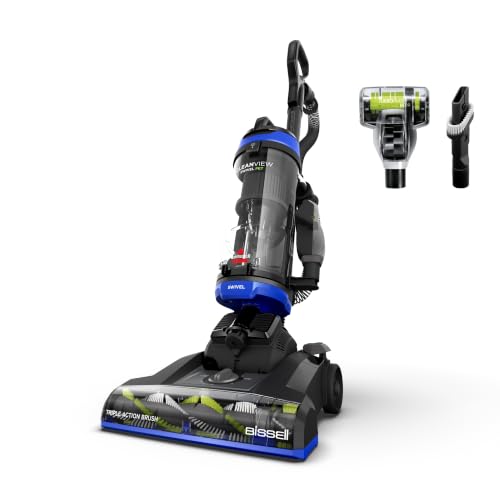
As an Amazon Associate we earn from qualifying purchases at no extra cost to you. Ratings are shown as listed on Amazon.
Best home vacuums by household
| Household and floor type | Best vacuum type | Useful target specifications | Typical market range |
|---|---|---|---|
| Small apartment, mostly hard floors | Compact cordless stick | 5–7 lb, 0.4–0.6 L bin, 30–45 minutes of usable runtime | $150–$400 |
| Apartment with rugs and one pet | Midrange cordless stick with motorized brush | 6–8 lb, 0.5–0.8 L bin, removable battery | $250–$600 |
| Large carpeted home or several pets | Full-size corded upright | 12–18 lb, 1.5–3 L capacity, sealed filtration, brush-roll control | $180–$600 |
| Large hard-floor home | Canister with bare-floor head | 8–12 L dust-bag capacity or 2–4 L bagless bin, long hose and cord | $250–$1,000+ |
| Stairs, cars, and occasional spot cleaning | Handheld or 2-in-1 cordless | 2–5 lb, crevice tool, 15–30 minutes of runtime | $60–$250 |
Quick picks for different priorities
Best all-around cordless: Dyson V15 Detect
The Dyson V15 Detect is a strong choice for homes that need one flexible machine for hardwood, tile, rugs, and moderate pet hair. Its motorized cleaner heads, adjustable suction, dust-sensing controls, and particle display provide more useful feedback than a basic stick vacuum. The dust bin is approximately 0.76 liters, and the machine weighs about 6.8 pounds in its common configuration.
Its limitation is endurance: the advertised maximum runtime is about 60 minutes, but motorized heads and higher suction reduce practical cleaning time. A larger home may require a second battery or several charging breaks. The relatively small bin also means frequent emptying when cleaning shedding pets or heavily trafficked carpet.
Best for pet hair on carpet: Shark Stratos upright
A full-size upright such as the Shark Stratos is better suited to thick carpet, multiple pets, and large rooms than most cordless sticks. Its powered brush roll, height adjustment, and odor-control features are designed around high-volume debris. Upright vacuums also maintain strong cleaning performance without battery depletion.
Expect a weight around 16–18 pounds depending on the exact configuration, so it is less convenient on stairs and awkward to carry between floors. Choose this type when deep carpet cleaning matters more than compact storage. Look for a brush-roll shutoff or bare-floor mode if your home has delicate hardwood.
Best canister approach for hard floors: Miele Classic C1
The Miele Classic C1 is a practical example of a compact bagged canister vacuum. It is particularly well matched to hardwood, tile, low-pile rugs, stairs, and homes where low operating noise and clean disposal matter. Its approximately 4.5-liter dust bag holds considerably more debris than a typical cordless stick bin, while the canister itself weighs roughly 11–12 pounds.
Bagged canisters require ongoing purchases of compatible bags and filters, but the large sealed bag is less dusty to empty than a bagless bin. The standard floor head is not intended to replace a powered carpet brush for thick or deeply embedded pet hair, so select a configuration with an electric power head if wall-to-wall carpet is the priority.
Best value for routine floors: a corded upright or compact canister
For a modest budget, a corded vacuum generally delivers more cleaning time and larger capacity per dollar than a cordless model. A basic corded upright with a brush-roll switch can handle mixed floors for roughly $100–$250, while a compact canister with a hard-floor head commonly costs about $150–$350.
Value models often compromise on hose length, wheel quality, noise insulation, filtration, and tool storage rather than raw suction. Check whether replacement belts, filters, bags, and brush rolls are readily available before buying. A cheap vacuum that cannot be maintained can cost more over several years than a slightly better-supported model.
Suction, capacity, and weight: what actually matters
Suction is not the same as cleaning performance
High suction helps lift grit and embedded debris, but the floor head determines how effectively that airflow reaches the surface. A sealed system, tight head seal, appropriately stiff bristles, and an effective brush roll can outperform a vacuum with a larger advertised motor number.
For hard floors, prioritize a soft roller or suction-only head that does not scatter crumbs. For carpet, choose a powered brush roll with height or suction adjustment. For pet hair, anti-tangle combs and an easy-to-remove brush roll matter because wrapped hair gradually reduces performance.
Bin size changes how often you stop
A 0.5-liter cordless bin may be adequate for a 600-square-foot apartment cleaned several times per week, but it can fill before one pass through a large home with pets. A 0.76-liter bin offers about 52% more nominal volume than a 0.5-liter bin, although usable capacity is lower when hair and bulky debris collect around the filter.
Bagged canisters typically offer several liters of capacity. Their advantage is not only fewer emptying cycles; the bag also acts as a large filter surface. However, replace the bag before it is completely packed, because airflow can fall as the bag becomes blocked.
Weight affects whether the vacuum gets used
Weight on the specification sheet can be misleading. A cordless stick may weigh 6–8 pounds in handheld use but feel heavier when the motor and bin sit at the handle. An upright rolls on its wheels during floor cleaning, yet its full weight matters on stairs. A canister is light in the hand but requires pulling the body behind you.
For a multi-level home, consider one light machine upstairs or choose a vacuum with a long hose and a stair tool. For a single-floor apartment, a slightly heavier model may be worthwhile if it provides a larger bin and stronger brush roll.
Decision matrix: match the vacuum to your routine
| Your situation | Recommended choice | Why | What to avoid |
|---|---|---|---|
| Clean small areas daily and dislike cords | Cordless stick, 5–7 lb | Fast setup and easy storage | Very small bins under 0.4 L |
| Clean once weekly in a large home | Corded upright or canister | Long uninterrupted runtime and higher capacity | Short-runtime cordless models |
| Several shedding pets and medium or high-pile carpet | Powered upright with sealed filtration | Strong agitation and larger debris capacity | Non-motorized floor heads |
| Mostly hardwood, tile, and stairs | Canister or soft-roller cordless | Gentler floor contact and flexible reach | Uncontrolled stiff brush rolls |
| Limited storage and no utility closet | Wall-mounted cordless or compact canister | Small footprint and accessible tools | Bulky uprights without a parking position |
Worked runtime calculation for cordless buyers
Suppose a vacuum advertises 60 minutes of runtime, but that figure applies to low power without a motorized head. If normal cleaning uses 25 minutes on standard power and 10 minutes on high power, estimate usable runtime conservatively at 35–45 minutes rather than 60.
A 1,000-square-foot home may require 20–30 minutes for an experienced user who clears clutter first. A home with furniture, stairs, and pet hair can take 35–50 minutes. This means one battery may be sufficient for the first home but marginal for the second. If the model has a removable battery, the cost of an additional battery can be more useful than paying for a higher maximum suction mode.
Ownership costs and maintenance
- Brush rolls wear first: Hair, threads, and carpet fibers collect around end caps and bearings. Cut away wrapped hair regularly and check that the roller spins freely.
- Filters need washing or replacement: Washable filters must dry completely—often for at least 24 hours—before reinstalling. A damp filter can restrict airflow and create odors.
- Belts are consumables: Upright belts can stretch or break, especially when the brush roll is jammed. Replace them with the correct size rather than operating with a slipping belt.
- Pet hair fills capacity quickly: Empty a bagless bin when it reaches roughly two-thirds full, and inspect the inlet for clumps before assuming the motor has failed.
- Hard floors need the right head: Disable a conventional rotating brush on delicate floors unless the manufacturer specifically approves it. Grit trapped in stiff bristles can cause fine scratches.
- Battery aging is normal: Cordless batteries lose capacity over time. A model with a replaceable battery is usually easier to keep in service than one with a sealed pack.
How to choose in five minutes
- Count the amount of carpet, not just the total floor area.
- Choose a powered brush roll if you have carpet or pets; choose a soft or suction-only head for predominantly hard floors.
- For a large home or infrequent cleaning, favor a corded model or at least a 0.7-liter cordless bin.
- Check the carried weight if you have stairs, and check the floor-cleaning weight if you expect to push the vacuum for long sessions.
- Before buying, price the replacement battery, filters, bags, belts, and brush roll. Those parts determine whether the vacuum remains useful after its first year.
For most apartments, a well-supported cordless stick is the most convenient answer. For large homes and heavy pet hair, a corded upright is the safer performance choice. For hard floors, stairs, and clean disposal, a canister vacuum remains difficult to beat. The best home vacuums are not the ones with the biggest headline suction figure; they are the ones whose floor head, capacity, weight, and maintenance demands fit the way your home is actually cleaned.