Key takeaways
- Best for mixed warehouse work: A standard walkie electric pallet jack rated around 4,500–6,000 lb. It balances capacity, maneuverability, and price for frequent pallet moves.
- Best for narrow shop aisles: A compact walkie model rated around 3,000–4,000 lb, with a short chassis and roughly 55–60-inch turning radius. Confirm its fork length suits the loads you handle.
- Best for repeated, longer runs: A rider or end-control jack with a higher-capacity battery. It reduces walking on long routes but needs more operating space and costs more.
- Best for occasional use: A basic electric walkie with a smaller battery and simple onboard charging. Paying extra for a large battery may not be worthwhile if it moves only a few loads per shift.
Best Electric Pallet Jacks for Warehouses & Shops
The best electric pallet jack for most busy warehouses is a 4,500–6,000 lb walkie model with a lithium-ion battery, a turning radius near 60–65 inches, and an onboard charger; choose a compact 3,000–4,000 lb model for cramped shops, or a rider jack for long travel distances. The right choice depends less on maximum capacity than on whether the jack, its forks, and its turning path fit your actual pallets and aisles.
Shortlist by working conditions
- Best for mixed warehouse work: A standard walkie electric pallet jack rated around 4,500–6,000 lb. It balances capacity, maneuverability, and price for frequent pallet moves.
- Best for narrow shop aisles: A compact walkie model rated around 3,000–4,000 lb, with a short chassis and roughly 55–60-inch turning radius. Confirm its fork length suits the loads you handle.
- Best for repeated, longer runs: A rider or end-control jack with a higher-capacity battery. It reduces walking on long routes but needs more operating space and costs more.
- Best for occasional use: A basic electric walkie with a smaller battery and simple onboard charging. Paying extra for a large battery may not be worthwhile if it moves only a few loads per shift.
These are specification targets, not claims about a single model. Brands such as Crown, Raymond, Toyota, and Big Joe offer electric pallet-handling equipment, but dimensions, batteries, and options vary by model and configuration. Verify the exact manufacturer specification before ordering.
Our top picks

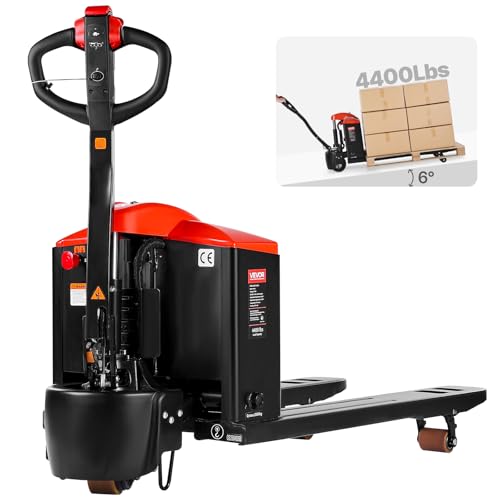


As an Amazon Associate we earn from qualifying purchases at no extra cost to you. Ratings are shown as listed on Amazon.
Compare the specifications that affect daily work
The ranges below are representative buying targets for common warehouse classes, not guaranteed specifications for every product. Manufacturers may quote turning radius differently, and battery runtime depends on load, floor condition, route length, and operator behavior.
| Jack type | Typical rated capacity | Typical turning radius | Battery and charging target | Best fit |
|---|---|---|---|---|
| Compact walkie | 3,000–4,000 lb | About 55–60 in | 24 V; roughly 2–4 hours to recharge, depending on battery and charger | Small stockrooms, shops, and lighter loads |
| Standard walkie | 4,500–6,000 lb | About 60–70 in | 24 V; roughly 2–8 hours, depending on battery size, chemistry, and charger | General warehouse and backroom use |
| Heavy-duty walkie | 6,000–8,000 lb | About 65–75 in | 24 V; plan for several hours to recharge; confirm opportunity-charging guidance | Heavy pallets and frequent movement |
| Rider or end-control | 4,500–8,000 lb | Often about 70–90 in | Battery capacity varies widely; multi-shift use may need a larger battery or battery-change plan | Long routes and high move counts |
A turning radius is not the same as the aisle width needed to turn with a pallet. Ask the dealer for the model’s right-angle stacking aisle dimension for your pallet size and load overhang. Also check overall length, fork width, fork length, lowered fork height, and the machine’s own weight: a jack that fits the aisle may still be too long for a liftgate or too heavy for a floor or ramp.
Choose by aisle, workload, and charging routine
For tight aisles and crowded stockrooms
Prioritize chassis length and turning geometry over extra capacity. Measure the narrowest aisle and the space needed to turn with the largest pallet you move. A compact jack can be easier to position, but its shorter forks may not support a long pallet correctly. If loads are often uneven or extend beyond the pallet, get advice on suitable fork dimensions rather than assuming a higher capacity solves the problem.
For heavy loads every shift
Pick a rated capacity with a sensible margin over your heaviest actual load, including packaging and any attachments. Capacity ratings apply under specified conditions; load center, elevated travel, and attachments can reduce usable capacity. Check the data plate and manual, and do not treat the advertised maximum as a routine target. For continuous movement, compare battery amp-hour capacity, battery chemistry, charger output, and whether the manufacturer permits opportunity charging during breaks.
For long travel routes
A rider model can reduce walking fatigue and improve throughput on longer, predictable trips. It generally needs more turning space and adds purchase, charging, and maintenance considerations. For short moves in a small shop, a walkie often makes more sense: it is simpler to maneuver and avoids paying for a riding platform that adds little value.
Estimate whether the battery will cover a shift
Published runtime is difficult to compare because there is no universal duty cycle. A practical screening estimate is:
Estimated active hours = usable battery energy (kWh) ÷ average draw (kW).
For example, a 24 V, 100 Ah battery stores about 2.4 kWh nominally (24 × 100 ÷ 1,000). If the work averages 0.6 kW, that suggests about four active hours before accounting for reserve, stop-start losses, temperature, battery age, and the difference between nominal and usable capacity. It is not a runtime guarantee. Ask the seller for a duty-cycle estimate based on your travel distance, load, starts per hour, and shift pattern.
Charging time also depends on charger output and battery limits. A 2.4 kWh battery charged by a 0.8 kW charger has a simple best-case estimate of three hours; real charging takes longer because of charging losses and the final charge phase. Check whether the supplied charger is onboard, what outlet it requires, and whether the battery can be topped up during breaks. Lead-acid batteries may require a dedicated charging area and more careful charging routines; lithium-ion options often support more flexible charging, but must be paired with compatible equipment.
Ownership details that prevent costly surprises
- Wheels and rollers wear first: Polyurethane load wheels and entry rollers take the impact of joints, debris, and rough floors. Inspect them regularly; damaged rollers can make pallet entry harder and increase strain on the machine.
- Keep the path clear: Stretch wrap, straps, and grit can wind around axles or damage wheels. Remove debris promptly and keep the battery and charging contacts clean and dry.
- Match the floor and ramp: Small wheels struggle over broken concrete, dock plates, and steep transitions. Check gradeability and braking limits in the manual, especially for loaded travel.
- Plan for battery service: Ask about battery warranty, replacement cost, expected service life, and local technician availability. A low purchase price can be offset by a battery or parts delay.
- Train operators: Confirm safe travel, parking, charging, and emergency-stop procedures. Avoid sharp turns with raised or unstable loads, and follow the manufacturer’s inspection and maintenance schedule.
Final buying decision
For a typical warehouse moving pallets throughout the day, start with a 4,500–6,000 lb walkie and compare its real aisle requirement, battery capacity, and charging plan. Choose a compact unit when space is the limiting factor, and a rider when long routes—not just occasional heavy lifts—drive the workload. Before purchasing, test the proposed dimensions against your narrowest turn, confirm capacity for your heaviest load, and get a written battery-and-charger specification for the exact configuration.