Key takeaways
- Mounting kit: Confirm that the exact retail package includes AM4 brackets and the required backplate or spacers. Do not discard the motherboard’s original AMD backplate unless the cooler instructions specifically require it.
- Case height: Compare the cooler’s full installed height with the case limit. A 155 mm cooler in a case rated for 155 mm leaves little room for manufacturing tolerance or a raised front fan.
- Memory clearance: Dual-tower coolers can overlap the nearest DIMM slots. Low-profile memory is safer; tall RGB modules may require the front fan to be moved upward.
- Radiator clearance: A 240 mm AIO needs both a 240 mm mounting position and enough thickness clearance for the radiator and fans. Top mounting can conflict with motherboard heatsinks or tall memory.
The best CPU cooler for AM4 is the Thermalright Peerless Assassin 120 SE for most performance-focused builds, while the Arctic Liquid Freezer III 240 is the stronger choice for sustained high heat and the DeepCool AK400 is the simplest budget option for mainstream Ryzen processors.
Our top picks


As an Amazon Associate we earn from qualifying purchases at no extra cost to you. Ratings are shown as listed on Amazon.
Best AM4 CPU Coolers at a Glance
| Cooler | Type | AM4 fit | Size or height | Rated fan speed | Best for | Typical market range |
|---|---|---|---|---|---|---|
| Thermalright Peerless Assassin 120 SE | Dual-tower air | Yes | 155 mm tall | Up to 1,550 RPM | Best overall value | $35–$50 |
| Thermalright Phantom Spirit 120 SE | Dual-tower air | Yes | 154 mm tall | Up to 1,500 RPM | High-performance air cooling | $40–$60 |
| DeepCool AK400 | Single-tower air | Yes | 155 mm tall | Up to 1,850 RPM | Budget and compact builds | $25–$40 |
| Noctua NH-D15 | Large dual-tower air | Yes | 168 mm tall | Up to 1,500 RPM | Quiet, long-term ownership | $90–$120 |
| be quiet! Dark Rock 5 | Single-tower air | Yes | 161 mm tall | Up to 2,100 RPM | Quiet premium builds | $65–$85 |
| Arctic Liquid Freezer III 240 | 240 mm liquid AIO | Yes | 240 mm radiator | Up to 2,000 RPM | High sustained workloads | $75–$110 |
Manufacturer specifications can vary slightly by revision, fan model, or regional package. Check the exact product page before buying, especially if your case has a tight CPU cooler-height limit.
Our AM4 Picks by Build Situation
Best overall: Thermalright Peerless Assassin 120 SE
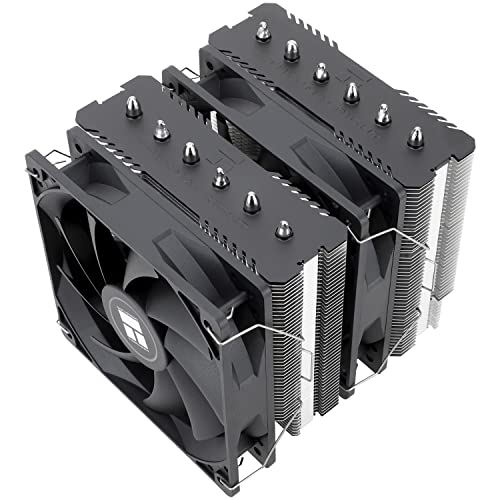
The Peerless Assassin 120 SE is the best CPU cooler for AM4 when value and cooling capacity matter more than minimum size. Its two aluminum fin towers, six copper heat pipes, and two 120 mm fans provide enough thermal headroom for Ryzen 7 processors and many Ryzen 9 systems without the cost or pump dependency of liquid cooling.
At 155 mm tall, it fits many standard ATX and micro-ATX cases, but its width can interfere with tall memory modules. The front fan can usually be raised, although doing so increases total height. Measure from the motherboard surface to the side-panel limit rather than relying only on the case’s advertised cooler clearance.
Its main weakness is consistency between units and installations: fan clips, memory clearance, and mounting pressure require more attention than a compact single-tower cooler. For a gaming PC using a Ryzen 5 5600, Ryzen 7 5700X, or Ryzen 7 5800X3D, it offers unusually strong value.
Best performance-per-dollar alternative: Thermalright Phantom Spirit 120 SE
The Phantom Spirit 120 SE uses a similar dual-tower layout but adds an extra heat pipe compared with the Peerless Assassin design. Its 154 mm height makes it a practical choice for cases that list a 155 mm limit, although tolerances are not generous.
This is a good match for a Ryzen 9 5900X or 5950X running long rendering, compiling, or encoding workloads. It can also reduce fan speed compared with a smaller cooler, which may lower noise during ordinary gaming. However, it is still a large cooler: check the first PCIe slot, memory height, and the position of motherboard heatsinks before ordering.
Best budget and easier fit: DeepCool AK400
The AK400 is a single-tower cooler with four copper heat pipes and a 120 mm fan. It is substantially easier to install around the RAM slots than a dual-tower model and is a sensible upgrade over the basic AMD stock cooler for six-core and eight-core Ryzen processors.
It is particularly suitable for a Ryzen 5 3600, 5600, 5600X, or a power-limited Ryzen 7 5700X. It can handle hotter chips, but sustained all-core workloads may produce higher temperatures and fan speeds than the larger Thermalright coolers. Choose it when case space, low cost, or straightforward installation matters more than maximum thermal headroom.
Best premium air cooler: Noctua NH-D15
The NH-D15 remains a strong premium air option for AM4 because its large fin area, dual 140 mm fans, and mature mounting system combine cooling capacity with predictable long-term maintenance. Noctua also has a well-established track record of providing mounting support for newer platforms.
The important trade-off is physical size. At 168 mm tall, it will not fit many compact cases, and its front fan may cover tall memory modules. The cooler is also heavy and expensive compared with newer value-focused designs. It makes the most sense for a quiet workstation or a system you intend to maintain for many years.
Best liquid option: Arctic Liquid Freezer III 240
The Liquid Freezer III 240 is a strong AM4 choice when the case has a suitable 240 mm radiator mount and the processor spends long periods under heavy load. Its 240 mm radiator gives it more heat-dissipation area than a typical single-tower cooler, while the integrated pump and radiator fans regulate temperatures under sustained demand.
Liquid cooling does not automatically mean quieter operation. It adds pump noise, several more cables, and a radiator that must be kept free of dust. Radiator placement also matters: front mounting may warm the graphics card with preheated air, while top mounting is often preferable when the case supports it.
AM4 Compatibility: What to Check Before Buying
Socket support is only the first compatibility test. Before purchasing, check these four measurements:
- Mounting kit: Confirm that the exact retail package includes AM4 brackets and the required backplate or spacers. Do not discard the motherboard’s original AMD backplate unless the cooler instructions specifically require it.
- Case height: Compare the cooler’s full installed height with the case limit. A 155 mm cooler in a case rated for 155 mm leaves little room for manufacturing tolerance or a raised front fan.
- Memory clearance: Dual-tower coolers can overlap the nearest DIMM slots. Low-profile memory is safer; tall RGB modules may require the front fan to be moved upward.
- Radiator clearance: A 240 mm AIO needs both a 240 mm mounting position and enough thickness clearance for the radiator and fans. Top mounting can conflict with motherboard heatsinks or tall memory.
Cooling Capacity, Noise, and Value Compared
Cooling capacity is influenced by the processor’s power limits, ambient temperature, case airflow, thermal paste, and fan curve—not just the cooler’s advertised TDP. As a practical guide, a single-tower cooler is comfortable for moderate six-core and many eight-core chips, a dual-tower cooler provides more margin for high-end AM4 processors, and a 240 mm AIO is most useful when the workload remains heavy for many minutes at a time.
For gaming, the difference between a good single-tower cooler and a large dual-tower model may be modest because games often load the CPU unevenly. For video encoding or CPU rendering, the dual-tower and 240 mm options have a clearer advantage because they can sustain higher heat output before reaching their fan-speed limit.
| Situation | Recommended class | Reason | What to avoid |
|---|---|---|---|
| Small case or limited budget | DeepCool AK400 or similar 120 mm single tower | Simple fit and adequate cooling for moderate Ryzen chips | Large dual-tower cooler without measuring |
| Gaming with Ryzen 5 or Ryzen 7 | Peerless Assassin 120 SE | High cooling margin at a moderate price | Paying for an AIO that adds no practical benefit |
| Long rendering or compiling sessions | Phantom Spirit 120 SE, NH-D15, or 240 mm AIO | Better sustained heat handling | Entry-level single-tower coolers |
| Quiet workstation | NH-D15 or a large dual-tower air cooler | No pump and low fan speeds under light use | Small cooler forced to run near maximum RPM |
| First-time builder | AK400 or a well-documented dual-tower kit | Fewer parts and easier troubleshooting | Complicated radiator routing in a cramped case |
Installation and Ownership Tips
For AM4, clean the CPU heat spreader and cooler base with isopropyl alcohol if either surface has old paste. Apply a small pea-sized amount of new thermal compound unless the manufacturer specifies a different pattern. Tighten the mounting screws alternately a few turns at a time so pressure remains even.
After installation, confirm that the CPU fan is connected to the motherboard’s CPU_FAN header. Set a sensible fan curve rather than locking the fan at maximum speed. A brief temperature spike when a Ryzen processor boosts is normal; sustained temperatures during a known workload are more useful than a single idle reading.
Air coolers generally need only dust removal every few months, depending on the room and case filters. The fans are the first parts likely to wear: bearing noise, intermittent starting, or a rattling sound can indicate replacement is due. Standard 120 mm or 140 mm replacement fans are usually inexpensive, but verify the mounting clips and thickness.
AIO coolers require more ownership awareness. The pump cannot normally be refilled by the user, and a pump failure or leak ends the cooler’s useful life. Radiator fins also collect dust, reducing performance. If maximum serviceability and minimal failure points matter, a quality air cooler is usually the better AM4 investment.
Final Recommendation
Choose the Peerless Assassin 120 SE if it fits your case and you want the strongest balance of cooling, noise, and price. Pick the Phantom Spirit 120 SE for heavier sustained workloads, the AK400 for a compact or budget system, and the NH-D15 for premium air cooling with long-term serviceability. Select the Arctic Liquid Freezer III 240 only when your case supports a radiator and your workload justifies the added pump, cabling, and maintenance considerations.