Our Top Picks


Choosing between a USB-C PD power bank and a wireless power bank is a decision about speed against convenience. A wired PD bank pushes far more watts into a phone or laptop, so it charges faster and can run a laptop, while a wireless bank snaps onto the back of a phone and starts charging with no cable to plug in. Neither type wins outright, because the right answer depends on what you charge, where you charge it, and whether you value minutes saved or hands kept free.
This guide is for phone owners torn between a cable and a magnetic pad, for iPhone users weighing Qi2 against USB-C, and for anyone who wants one bank that covers both ways of charging. The four banks below were chosen from the names and specs on their Amazon product pages, two wired PD models and two wireless models, with attention to wattage, wireless standards, capacity, and the safety protections each listing states.
Quick Picks
As an Amazon Associate we earn from qualifying purchases
| Product | Best for | Key spec from title |
|---|---|---|
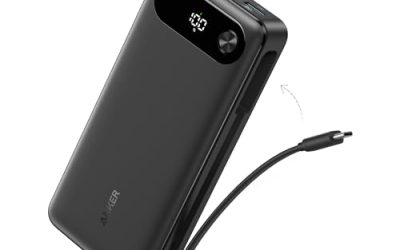
| Anker Power Bank 20K 87W | Fast wired charging for a laptop and phone | 20,000mAh, 87W total, built-in USB-C cable |
| UGREEN Nexode 25K 200W | The most powerful wired pick here | 25,000mAh, 200W PD 3.1, TFT smart display |
| Anker MagGo 10K Qi2 | Cable-free top-ups for iPhone owners | 10,000mAh, Qi2 15W wireless, smart display |
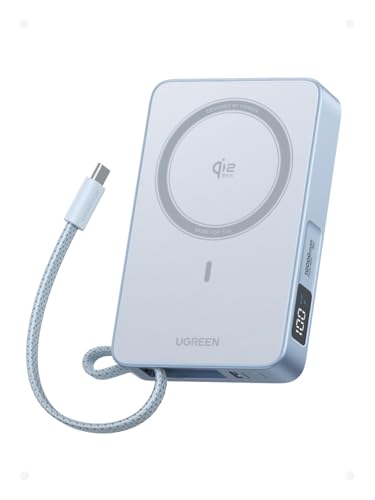
| UGREEN MagFlow 10K Qi2 25W | The fastest wireless charging here | 10,000mAh, Qi2 25W wireless, built-in cable |
How to Choose
Compare wattage honestly
Wattage is where the two types separate most clearly. A wired PD bank in this guide delivers 87W to 200W in total, with single ports reaching 65W to 140W, which is enough for laptops as well as phones. A wireless bank here delivers 15W to 25W to the phone, which suits top-ups and overnight charging but not a laptop. Read the per-port figures on wired banks and the wireless rating on magnetic banks, since both numbers decide how fast a real device charges. Read both figures. If a laptop is in the picture at all, the wired side wins on wattage alone.
Check the wireless standard on the phone
Wireless charging only reaches its headline speed when the bank and the phone share the same standard. Qi2 is rated at up to 15W, while Qi2.2 raises the ceiling to 25W, and both need a magnetic alignment ring to hold the phone in place. The Anker MagGo is Qi2 certified at 15W, while the UGREEN MagFlow is Qi2 rated at 25W. A phone that supports only the older standard will charge at the lower speed whatever the bank claims. Check your phone specifications before choosing wireless, since the fastest bank cannot lift a phone past what the phone itself supports.
Check safety protections before you buy
Both types store the same energy in a small case, so the protections a listing names are worth reading before you buy. Anker lists its ActiveShield safety system on the Prime model, which watches temperature while the bank charges, and the MagFlow listing names overcharge protection and thermal management. Wireless banks add one more heat question, since a coil that is badly aligned wastes energy as warmth. Other listings name overcurrent and short-circuit protection, or they name nothing at all. If a listing names no protection, check the listing again before buying, and stop using a bank that swells or smells hot. Check twice.
Weigh convenience against versatility
A wireless bank wins on convenience: snap it on, walk away, and the phone charges in a pocket or on a desk. A wired bank wins on versatility: it charges any device with a USB-C port, from earbuds to laptops, and it charges faster. The best compromise is a bank that does both, like the MagFlow with its built-in cable or the MagGo with its USB-C port. Think about where you charge most often: a desk and a car favor wired speed, while a pocket and a nightstand favor wireless ease. A bank that does both covers every case.
The 4 Best Options
Anker Power Bank 20K 87W

This is the strongest wired all-rounder in the comparison, and it suits anyone who wants one bank for a phone, a tablet and a thin laptop. The built-in USB-C cable means there is nothing extra to pack, and the digital display shows how much charge remains at a glance. At 20,000mAh it holds enough for several phone charges plus a useful laptop top-up, and the 87W total output covers a laptop and a phone charging together. Against the wireless banks here it wins clearly on speed and on laptop charging, and loses only on the convenience of snapping a phone on without a cable.
Specs
- 20,000mAh capacity
- 87W total output, with up to 65W from a single port
- Built-in USB-C cable
- 3 ports: built-in USB-C cable, one USB-C port, one USB-A port
- Digital display showing remaining charge
- 6.2 x 2.9 x 1.0 inches
- 15.5 oz
- 18-month warranty
- Airline-approved capacity
Best for: Fast wired charging for a laptop and phone.
Watch out for: Confirm the color and bundle on the listing before buying, since this model is sold in more than one bundle.
ASIN: B0CXDXP8VR — https://www.amazon.com/dp/B0CXDXP8VR
UGREEN Nexode 25K 200W
This is the most powerful bank in the comparison, and it suits anyone who charges a laptop and a phone at the same time. The 200W total output and the 140W USB-C port cover large laptops that smaller banks cannot keep up with, and the TFT smart display shows the output of each port. At 25,000mAh it holds the most energy here, and the 90Wh rating sits under the usual airline carry-on limit. Against the wireless banks it wins by a wide margin on wattage and on laptop support, though it is heavier and needs a cable for every device it charges.
Specs
- 25,000mAh capacity, 90Wh
- 200W total output with PD 3.1
- USB-C ports rated at 140W and 100W
- USB-A port rated at 18W
- TFT smart display
- 3 ports in total
Best for: The most powerful wired pick here.
Watch out for: Check the watt-hour limit with your airline before flying, and confirm your laptop accepts the wattage the port supplies.
ASIN: B0CXHM5RY2 — https://www.amazon.com/dp/B0CXHM5RY2
Anker MagGo 10K Qi2
This is the most convenient bank in the comparison, and it suits iPhone owners who want charging without thinking about cables. The magnetic pad snaps onto the back of the phone, the foldable stand props the phone up for video calls, and the smart display shows the remaining charge at a glance. At 10,000mAh it covers a phone for a day out, and the 15W Qi2 wireless charging is fast enough for a top-up between meetings. Against the wired banks it loses on speed and cannot charge a laptop, but for a phone-only day the snap-on convenience is hard to beat. The stand helps too.
Specs
- 10,000mAh capacity
- Qi2 certified 15W wireless charging
- 30W max USB-C port
- Smart display
- Foldable stand
- USB-C cable included
- 24-month warranty
Best for: Cable-free top-ups for iPhone owners.
Watch out for: Confirm the recipient phone supports magnetic wireless charging, since the magnets do nothing for a phone without it.
ASIN: B0CFDPQXN4 — https://www.amazon.com/dp/B0CFDPQXN4
UGREEN MagFlow 10K Qi2 25W
This is the fastest wireless bank in the comparison, and it suits anyone who wants wireless charging without giving up wired speed entirely. The 25W Qi2 wireless charging is the highest wireless figure here, and the built-in cable adds 30W wired charging for devices that cannot charge wirelessly. At 10,000mAh it covers a phone for a day out, and the magnetic attachment keeps the phone aligned on the charging coil. Against the wired banks it still loses on wattage and laptop support, but it is the closest a wireless bank comes to doing both jobs. The built-in cable also covers earbuds and tablets.
Specs
- 10,000mAh capacity
- Qi2 25W certified wireless charging
- Built-in cable with 30W USB-C output
- Magnetic portable charger for MagSafe
- 30W USB-C battery pack
- Model PB773
Best for: The fastest wireless charging here.
Watch out for: Check that your phone supports the faster wireless standard, since older phones charge at lower wattage.
ASIN: B0F37VLJQW — https://www.amazon.com/dp/B0F37VLJQW
Which One Fits Your Situation
A laptop that needs power away from a wall
Pick a wired PD bank: the Anker 20K 87W for a thin laptop, or the UGREEN Nexode 25K 200W for a large one. Wireless banks cannot charge a laptop, so the choice is made for you. The 100W or higher single-port output is the figure that matters most here. The display helps plan charging well.
A phone that needs top-ups through the day
Pick a wireless bank: the Anker MagGo 10K Qi2 for a reliable 15W snap-on charge, or the UGREEN MagFlow 10K Qi2 25W for the fastest wireless speed. Both attach magnetically and charge in a pocket, which suits a day of moving around better than a cable. The magnets also keep the phone aligned on the coil.
One bank for a phone, a tablet and a laptop
Pick the Anker Power Bank 20K 87W. Its 87W total output covers a laptop and a phone together, the built-in cable removes one more item from the bag, and the three ports cover a tablet as well. No wireless bank here can match that range of devices. The display also shows the remaining charge. The three ports also cover a tablet at the same time.
The fastest possible wireless charging
Pick the UGREEN MagFlow 10K Qi2 25W. Its 25W wireless rating beats the MagGo by a clear margin on a compatible phone, and the built-in cable still covers wired charging when speed matters more than convenience. Check your phone supports the faster standard before choosing it. The built-in cable helps too. The magnetic pad also keeps the phone aligned on the coil.
Common Mistakes
- Buying a wireless bank for a phone that cannot charge wirelessly.
- Trusting the headline wattage instead of the per-port output a laptop will receive.
- Expecting wireless charging to match wired speed, when it tops out far lower.
- Choosing a bank with no built-in cable and then forgetting the cable at home.
- Ignoring the wireless standard, so a fast bank charges a phone at the slower speed.
Frequently Asked Questions
Is wireless charging slower than wired charging?
Yes, by a wide margin. The wireless banks here deliver 15W to 25W to the phone, while the wired banks deliver 65W to 140W from a single port. Wireless suits top-ups and overnight charging, while wired suits a quick refill before leaving or charging a laptop at all.
Can a wireless power bank charge a laptop?
No. Wireless charging tops out at 25W here, while even a thin laptop needs 45W or more to charge while in use. If a laptop is part of the picture, buy a wired PD bank with at least 65W from one port, and 100W or more for a larger laptop.
What is the difference between Qi2 and Qi2.2?
Qi2 is rated at up to 15W with magnetic alignment, while Qi2.2 raises the ceiling to 25W. Both need a magnetic ring to hold the phone on the coil. A phone that supports only Qi2 will charge at 15W even on a Qi2.2 bank, so check your phone specifications first.
Should I buy a bank that does both wired and wireless?
Yes, if the budget allows. A bank like the MagFlow charges wirelessly at 25W and through its built-in cable at 30W, so it covers a phone either way and still charges earbuds and other small devices by cable. It is the most flexible single purchase in this comparison.
More from Amazon
Programs that pair well with the guide above. Offers and eligibility are set by Amazon and may change.
Free shipping on eligible items, Prime Video and more. Eligible new members can start with a free trial.
Start a Prime free trialAd-free music streaming. Eligible new subscribers can start with a free trial.
Try Music Unlimited freeA Prime membership for ages 18-24 with a trial period. Eligibility is set by Amazon.
See Prime for Young AdultsAudiobooks and podcasts to listen to on the go. Eligible new members can start with a free trial.
Try Audible freeAs an Amazon Associate we earn from qualifying purchases.