Key takeaways
- Best Overall: TALIX 20000mAh Laptop Power Bank – built-in USB-C cable, 190W total output.
- Best for Photos: SENSYNE 62-Inch Phone Tripod with Remote – extends for group shots and video calls.
- Best Car Mount: VANMASS Car Phone Holder – strong suction and a clip-style base for dash or windshield.
- Best Budget Power Bank: INIU 10000mAh 45W Power Bank – slim, flight-friendly capacity with a detachable cable.
- Best International Adapter: Anker Nano Travel Adapter – two USB-C ports for 2-pin European outlets.
- Best Wall Charger Option: TESSAN USB-C Charger with Foldable Plug – a low-cost outlet add-on.
- Best Premium Charging Dock: Anker Prime 3-in-1 Foldable Charger – phone, watch, and earbuds in one fold-flat dock.
The best phone accessories for travel are the ones that cover four jobs: power, charging at the outlet, hands-free mounting, and photos. For a one-bag kit, the TALIX 20000mAh Laptop Power Bank is our top pick because a single carry-on battery can recharge a phone and a laptop, and the SENSYNE 62-inch Phone Tripod with Remote is the runner-up for travel photos. This guide builds a pack-light kit around seven main picks and four alternatives, sorted by job, with watt-hour math for flights and checklists for road trips and international trips.
Most travel accessory lists are random gadgets. This one is organized by the problems you meet on the road: a dead phone at the gate, one outlet for four devices, a phone sliding around on a dashboard, a solo traveler who wants a photo with the landmark. Each section names what the specs mean in practice, what to confirm before buying, and what to leave at home. We only use specs published in the listings, and anything unknown is marked “not listed.”
Our top picks


As an Amazon Associate we earn from qualifying purchases at no extra cost to you.
Top Picks at a Glance
- Best Overall: TALIX 20000mAh Laptop Power Bank – built-in USB-C cable, 190W total output.
- Best for Photos: SENSYNE 62-Inch Phone Tripod with Remote – extends for group shots and video calls.
- Best Car Mount: VANMASS Car Phone Holder – strong suction and a clip-style base for dash or windshield.
- Best Budget Power Bank: INIU 10000mAh 45W Power Bank – slim, flight-friendly capacity with a detachable cable.
- Best International Adapter: Anker Nano Travel Adapter – two USB-C ports for 2-pin European outlets.
- Best Wall Charger Option: TESSAN USB-C Charger with Foldable Plug – a low-cost outlet add-on.
- Best Premium Charging Dock: Anker Prime 3-in-1 Foldable Charger – phone, watch, and earbuds in one fold-flat dock.
Travel Accessories Compared
| Product | Job | Key specs | Watch for | Price tier |
|---|---|---|---|---|
| TALIX 20000mAh Laptop Power Bank | Power on the go | 20,000mAh, 190W total, 140W single port, built-in USB-C cable | Heavy; carry on, never checked | Mid-range |
| INIU 10000mAh 45W Power Bank | Pocket backup | 10,000mAh, 45W, detachable USB-C cable | One or two phone charges only | Budget |
| SENSYNE 62″ Phone Tripod | Photos and video | Extends to 62 inches, wireless remote | Wind can tip lightweight tripods | Budget |
| VANMASS Car Phone Holder | Navigation | Suction and clip base, strong grip claim | Check local laws on windshield mounts | Budget |
| Anker Nano Travel Adapter | Overseas outlets | 2 USB-C ports, 20W, 2-pin European plug | Fits specific outlet types only | Budget |
| TESSAN USB-C Charger Block | Wall charging | 20W PD, foldable plug (outlet extender noted in title) | Confirm which version you receive | Budget |
| Anker Prime 3-in-1 Charger | Bedside or hotel charging | 25W Qi2.2, foldable, three devices | Highest cost; needs a wall adapter | Premium |
1. TALIX 20000mAh Laptop Power Bank: Best Power Bank for Travel
- 20,000mAh capacity with a built-in USB-C cable
- 190W total output; 140W on a single port
- Built to charge laptops, tablets, and phones
- Weight and port layout: not listed in the short title
Best for: travelers who bring a laptop and want one battery to recharge everything. Skip if: you only need a phone top-up; a smaller bank is lighter.
Capacity and output are two different numbers. A 20,000mAh battery contains roughly 74 watt-hours at the typical 3.7V cell rating (20 Ah multiplied by 3.7 V). Most airlines allow carry-on batteries up to 100Wh without special approval, so this capacity stays under the common limit. Always keep power banks in your carry-on, not checked luggage, and check your airline’s rules.
Output at 140W on a single port is enough for many modern USB-C laptops, which often need 65W to 100W. The built-in cable removes one more thing to forget. If your phone has a 4,500mAh battery and you assume about 70 percent real-world efficiency, a 20,000mAh bank gives roughly three full phone charges (20,000 x 0.7 / 4,500). Use that math to decide whether you want this size or a smaller one.
Pros: high capacity; high output; built-in cable; laptop-class power. Cons: heavy; carry-on only; may be overkill for phone-only travelers.

2. SENSYNE 62-Inch Phone Tripod with Remote: Best for Travel Photos
- Extends to 62 inches
- Includes a wireless remote (listed)
- Fits iPhone and Android phones
- Folded length and weight: not listed in the short title
Best for: solo travelers, group photos, and video calls. Skip if: you carry a camera and already own a compact travel tripod.
A tripod with a remote solves the problem of asking strangers to take photos. Set the phone at eye level, step into the frame, and press the remote. For landscapes, the extended height lets you shoot over a railing or a crowd. For video, it keeps the phone steady for time-lapses or vlogs. The extending legs make it useful as a selfie stick too, though in high winds the lightest models can wobble.
Check the phone clamp width against your phone and case. Most clamps open to about 3.5 inches, but the exact width is not listed in the short title. Check the grip at home before you travel by holding the phone at an angle and shaking it lightly. Pack the remote’s battery or charging cable, since a dead remote makes the tripod less useful.
Pros: long reach; remote; works for phone photos and video; budget cost. Cons: light tripods can tip in wind; plastic parts; clamp size limits.

3. VANMASS Car Phone Holder: Best Car Mount for Road Trips
- Suction base for dash or windshield, with a clip-style attachment
- Marketed as strong grip for large phones and trucks
- Adjustable arm for viewing angle
- Max phone width and weight: not listed in the short title
Best for: rental cars and road trips where you need navigation in view. Skip if: your region prohibits windshield-mounted devices.
Rental cars rarely have a phone mount, and holding a phone while driving is illegal in many areas. A suction mount lets you place the phone on a smooth dashboard surface and move it between vehicles. Clean the surface with an alcohol wipe before attaching, and press firmly. Suction cups loosen with heat, so avoid leaving the mount on a dashboard in a parked car under direct summer sun.
Whatever mount you use, position the phone low and to the side so it does not block your view. Program your route before driving and use voice guidance. Laws on windshield mounts vary by state and country, so check the rules where you are traveling.
Pros: grip claim; flexible placement; portable between cars; budget cost. Cons: suction can fail in heat; large size; legality varies.

4. INIU 10000mAh 45W Power Bank: Best Compact Backup
- 10,000mAh capacity
- 45W output
- Detachable USB-C cable
- Marketed as flight-safe and slim for travel
Best for: day trips, commutes, and a second backup in your jacket. Skip if: you need to charge a laptop several times.
At 10,000mAh, this bank holds about 37Wh (10 Ah x 3.7 V), far below the 100Wh airline limit. With 70 percent efficiency, it gives about 1.5 charges for a 4,500mAh phone. That is enough for a long sightseeing day, and it is small enough to slide into a pocket. The 45W output can charge a phone at full speed and a small tablet reasonably fast.
Because the cable detaches, you can swap in a longer one if needed, but it also means you can lose the cable. Tie it to the bank with a velcro strap. Recharge the bank overnight in the hotel, preferably before your day out.
Pros: pocket size; 45W; budget cost; flight-friendly capacity. Cons: limited capacity; cable is separate; not for laptops.
5. Anker Nano Travel Adapter: Best International Plug Adapter
- Two USB-C ports with 20W output (listed)
- 2-pin European-style AC plug
- Smart temperature control (listed)
- Compatible regions: check the maker’s list
Best for: trips to countries that use 2-pin Type C or E/F outlets. Skip if: you need UK, Australian, or other plug shapes.
A plug shape adapter alone does not convert voltage; a charger must be rated for the local voltage. Most modern phone chargers are dual-voltage (100-240V), so a simple adapter works. This Anker unit is a charger with the foreign plug built in, which means fewer pieces to carry. It supports two USB-C devices at the same time, such as a phone and earbuds.
Before you buy, check the outlet type for your destination. Europe mostly uses Type C and F, but the UK, Switzerland, and Italy have some differences. If you travel to several regions, a universal adapter may be a better fit, and we list one in the alternatives. Never plug a hair dryer or high-wattage device into a small phone charger.
Pros: compact; two USB-C ports; built-in plug; low cost. Cons: limited to specific outlets; 20W total; cannot run big appliances.
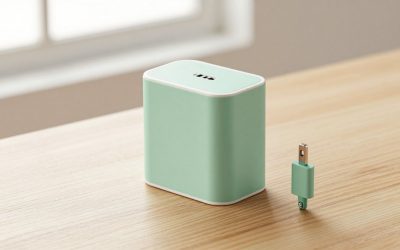
6. TESSAN USB-C Charger Block: Best Budget Wall Charger
- 20W Power Delivery USB-C output listed
- Foldable plug for packing
- The listing title also mentions a 1875W outlet extender with 4 AC and 4 USB ports; confirm the exact configuration in the product options
Best for: a spare charger for the bag or car. Skip if: you want a single, clearly specified fast charger.
A 20W PD charger can bring many phones from empty to roughly half in about 30 minutes, depending on the phone’s charging curve. A foldable plug makes it easy to pack without bending the prongs. The listing combines a charger block and an outlet extender in the title, so verify which version you receive. An extender is useful in older hotels and airports where outlets are scarce, because it lets you charge several devices from one wall socket.
Make sure the total load on any extender stays within the outlet’s limits. Do not plug in space heaters or hair dryers. Bring one cable of each type you use, such as USB-C to USB-C and USB-C to Lightning, and label them.
Pros: low cost; foldable plug; 20W; helpful for sharing outlets. Cons: title is confusing; verify configuration; modest output.

7. Anker Prime 3-in-1 Foldable Charger: Best Premium Charging Dock
- 25W Qi2.2-certified wireless charging
- Palm-sized, foldable travel design
- Charges three devices (phone, watch, earbuds) on one dock
- Needs a compatible wall adapter; confirm in the listing
Best for: iPhone, Apple Watch, and AirPods users who want hotel-room charging with one cable. Skip if: you use Android with a different watch brand.
A fold-flat dock replaces three cables with one. Qi2.2 charging uses a magnetic ring to line up the phone, which reduces misalignment that wastes power. This is a convenience product: it is not the fastest way to charge, but it is the neatest at a nightstand. Compatibility matters: confirm the watch charger is intended for your model, and note whether the dock includes the wall adapter or requires your own.
It is the most expensive pick, so it makes sense for frequent travelers or anyone who shares one outlet among several Apple devices. If you travel rarely, a simple cable and wall charger is more cost-effective.
Pros: neat; magnetic alignment; three devices; compact. Cons: premium cost; ecosystem-specific; slower than a cable.
Also Consider
LISEN Magnetic Car Mount
A magnet and vacuum-base mount for MagSafe phones. Choose it if you prefer a magnetic grip to a clamp.
eucos 62-Inch Phone Tripod with Remote
A similar extendable tripod with a remote. A second option if the SENSYNE is out of stock.
KEEPRO 3-in-1 Foldable Wireless Charger
A lower-cost foldable dock for Apple devices if the Anker Prime is above budget.
Anker Zolo 20,000mAh Power Bank
A 20,000mAh bank with built-in USB-C and 30W output. A phone-focused alternative to the laptop-class TALIX.
How We Chose
This guide is research-based. We did not personally use these products. We used manufacturer product pages, listing details, and airline battery guidance (FAA and IATA rules for lithium batteries in carry-on) as references, plus general coverage from publications such as Wirecutter and Tom’s Guide. We favored accessories that serve a clear travel job and limited each brand to two main picks. Unpublished specs are marked as not listed. Price is expressed as a tier word because retail prices change often.
Buying Guide
Power: capacity versus output
Capacity (mAh) tells you how much energy the bank holds; output (W) tells you how fast it delivers. For a phone-only trip, 10,000mAh is typically enough. For a phone plus laptop, 20,000mAh and 65W or more per port is more appropriate. Convert to watt-hours (mAh divided by 1000, times 3.7) to compare with airline limits, usually 100Wh in carry-on.
Cables and ports
Standardize on USB-C if you can. Carry two short cables rather than one long one, and keep them in a small pouch. Choose cables rated for the wattage your devices need, since cheap cables limit charging speed.
Outlets abroad
Check the plug type and voltage of your destination. Most phone and laptop chargers accept 100-240V, so a plug adapter is enough. Hair tools and travel kettles often do not, and they can be damaged.
Mounting and photos
For a car mount, choose one that attaches securely to a smooth surface and holds your phone with its case. For a tripod, check extended height, folded length, clamp width, and remote type. A tripod that folds to under 15 inches fits most carry-on bags.
Weight budget
Weigh the kit at home. A power bank may be 12 to 20 ounces, a tripod 6 to 12, and the rest a few ounces each. If your bag is already heavy, skip the doubles and pick one multi-use item.
Three Sample Travel Kits
| Trip type | Pack these | Why |
|---|---|---|
| Weekend city break, phone only | INIU power bank, Anker Nano adapter, one USB-C cable | Three items, under a pound combined, enough for a long day out and a hotel charge |
| Week-long work trip with a laptop | TALIX power bank, TESSAN charger or outlet extender, short cable pair | One battery covers the laptop in transit; the extender helps in hotel rooms with few outlets |
| Road trip with photos | VANMASS car mount, SENSYNE tripod, INIU backup battery | Navigation stays visible, the tripod handles scenic stops, and the backup covers long drives |
Packing and Airport Checklist
Place all batteries in your carry-on, with terminals protected from metal objects, and keep them where you can reach them if security asks to inspect them. Many airlines now ask you to keep power banks visible and not to use them to charge devices during take-off and landing, so check your carrier’s policy. Charge every battery the night before and bring a short cable so you can use it in a cramped seat without pulling the phone away from the tray.
For international trips, check the voltage label on each charger. Look for the text “100-240V” printed in small letters near the plug rating. If you see it, a simple plug adapter will do. If you travel with a hair dryer or shaver, check those separately, because they may have a different voltage range. Pack one spare cable in a different bag to guard against loss, and take a photo of the serial number on each battery in case you ever need to report it to an airline or airport lost-and-found.
Real-World Runtime Math
To estimate what a power bank can do for you, use a simple formula: usable energy equals capacity in mAh times 3.7 volts, divided by 1000, times about 0.7 for conversion loss. A 10,000mAh bank gives about 26 usable watt-hours. A modern phone with a 15Wh battery will then charge about 1.7 times. A 20,000mAh bank gives about 52 usable watt-hours, enough for three phone charges, or roughly one full charge of a thin laptop with a 50Wh battery. These numbers are estimates; cables, heat, and fast-charging modes change the result. If you plan to charge a phone, a watch, earbuds, and a tablet over a long travel day, the 20,000mAh class is the safer pick. If you only need an emergency boost, the smaller bank is easier to carry and often costs less.
Keeping Your Gear Safe on the Road
Travel accessories get lost more often than they break. Use a small zip pouch for cables and adapters, and make it a habit to check the hotel outlet and the airport gate seat before you leave. Avoid public USB charging stations when you can, and use your own wall charger and cable instead; this reduces the chance of connecting your phone to an unknown port. Keep a power bank that is swollen, hot, or damaged out of your bag and replace it. Finally, wipe tripod clamps and car mount pads occasionally, because dust reduces grip and a mount that slips at the wrong moment can drop a phone. A few minutes of care before each trip saves frustration later.
It also helps to label the gear. A strip of tape with your name or email on a power bank and charger makes it easier to get back if you leave it behind at a gate, and different color bands on cables help you tell a fast-charging cable from a slow one at a glance. When traveling with family, give each person their own cable and keep one shared battery in the main bag.
Common Mistakes to Avoid
- Packing power banks in checked baggage.
- Buying a plug adapter and assuming it converts voltage.
- Using the cheapest cable for fast charging and wondering why it is slow.
- Leaving suction mounts in a hot parked car.
- Skipping a trial run of the tripod and remote before leaving home.
Frequently Asked Questions
What are the best phone accessories for travel?
A power bank, a wall charger with the right plug, a car mount, and a tripod with remote cover most needs.
Is a laptop power bank allowed on planes?
Usually yes in carry-on if it is under 100Wh, but always check your airline’s current rules.
Which phone tripod with remote is best for travel?
Pick one that folds small, extends high enough for group shots, and has a clamp that fits your phone and case.
Do I need a USB-C charger for travel?
If your phone and laptop use USB-C, one multi-port USB-C charger can replace several bricks.
What is the best car phone holder for a rental car?
A suction or vent-style mount that can be removed without leaving marks. Check local laws on windshield use.
How many times can a 20,000mAh bank charge a phone?
About three to four times for a typical phone, allowing for conversion losses.
Can I use a US charger abroad?
Most modern chargers are dual-voltage and need only a plug adapter, but check the label for 100-240V.
Which One Should You Buy?
Start with the TALIX if you carry a laptop, or the INIU if you only carry a phone. Add the SENSYNE tripod for photos, the VANMASS mount if you rent cars, and the Anker Nano adapter for European trips. Treat the Anker Prime dock as a luxury for Apple users. A kit of three or four items covers most trips and keeps your bag light.
Sources
- TALIX, INIU, and Anker manufacturer product pages
- SENSYNE and VANMASS manufacturer product pages
- FAA guidance on lithium batteries in carry-on baggage
- IATA lithium battery guidance for passengers
- Wirecutter travel charging coverage
Last updated: October 2026