Key takeaways
- Low-volume or narrow: approximately 97–99 mm; best for narrower feet and slimmer heels.
- Medium-volume: approximately 100–102 mm; the most versatile starting point.
- High-volume or wide: approximately 103–104 mm or more; useful for broader forefeet and taller insteps.
The best ski boots are the ones that hold your heel securely, match your ability with an appropriate flex, and fit your foot’s shape without forcing you to sacrifice circulation for control.
Start by choosing the right category rather than the most expensive model: a forgiving, warm boot usually suits beginners and relaxed resort skiing, while a stiffer, more precise boot rewards stronger technique and higher speeds. Then narrow the choice by last width, shell volume, liner insulation, and whether you ski mostly groomers, variable snow, or touring terrain.
Our top picks
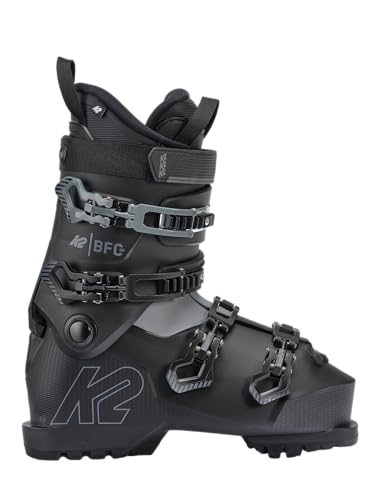


As an Amazon Associate we earn from qualifying purchases at no extra cost to you. Ratings are shown as listed on Amazon.
Quick recommendations by skier and situation
| Situation | Useful target | Boots to investigate | Why they fit the brief |
|---|---|---|---|
| First or second season, mostly groomed runs | Flex 70–90; medium last around 100–102 mm | Nordica Speedmachine 3 85; Tecnica Mach Sport MV 85 | More forgiving flex, comfortable liners, and conventional buckles that are easy to adjust |
| Intermediate resort skier seeking more control | Flex 90–110; medium last around 100–102 mm | Atomic Hawx Prime 100; Salomon S/Pro Supra BOA 100; Nordica Speedmachine 3 100 | A useful balance of support, warmth, and all-day comfort |
| Strong skier who drives the boot hard | Flex 110–130; low- or medium-volume fit | Lange RX 120 LV; Tecnica Mach1 MV 120; Atomic Hawx Ultra 120 S | More progressive support and closer foot-to-shell connection for precise edging |
| Wide forefoot or higher-volume foot | Last around 102–104 mm; heat-moldable shell preferred | Salomon S/Pro Supra BOA MV; Tecnica Mach Sport HV; Nordica Sportmachine 3 | Extra room at the forefoot and instep, with fit adjustment available through molding |
| Resort and occasional uphill access | Walk mode, tech inserts if needed, roughly 1,500–2,000 g per boot | Hybrid alpine-touring boot such as the Atomic Hawx Ultra XTD or Tecnica Cochise | More efficient walking than an alpine boot while retaining downhill-focused construction |
Flex ratings are not standardized between manufacturers. A 100 from one brand can feel noticeably softer or stiffer than a 100 from another, so use the number as a starting point, not a universal measurement.
How much flex do you need?
Flex 70–90 is generally suitable for lighter skiers, beginners, and people who prioritize easy turn initiation. The cuff bends more readily when you move forward, which can make learning less intimidating. The compromise is less support when skiing aggressively or in heavy, uneven snow.
Flex 90–110 is the practical sweet spot for many intermediate and advanced resort skiers. It provides enough resistance to transfer pressure into the ski without demanding perfect technique. If you ski several days each season and want one boot for groomers, bumps, and occasional powder, this range is often the safest starting point.
Flex 110–130 is aimed at stronger, heavier, or more aggressive skiers. A stiff boot can improve response, but only if you can flex it. An overly stiff boot may leave a lighter skier standing upright, tiring the legs and making turn initiation harder. Women’s and lower-volume versions may use different flex scales, so compare within a brand rather than by number alone.
Fit matters more than the logo
Ski boots should feel snug and secure when new. Your toes may lightly touch the front while standing upright, then pull slightly away as you bend your knees into skiing position. Your heel should not lift substantially when you flex forward, and there should be no sharp pressure over the ankle bones, navicular, or little-toe joint.
Choose the correct last width
- Low-volume or narrow: approximately 97–99 mm; best for narrower feet and slimmer heels.
- Medium-volume: approximately 100–102 mm; the most versatile starting point.
- High-volume or wide: approximately 103–104 mm or more; useful for broader forefeet and taller insteps.
Last width is normally measured in a reference shell size, so the number does not describe every size identically. A wider boot is not automatically more comfortable: excess space can allow the foot to slide, forcing you to overtighten buckles and reducing control.
Shell molding, boot fitting, and custom footbeds can solve many localized problems, but they cannot reliably turn an entirely wrong size into a good fit. Measure both feet, choose based on the larger foot, and have the shell assessed by a professional boot fitter if you experience persistent numbness, severe pressure, or heel movement.
Warmth, liners, and typical conditions
Warmth comes from the liner, shell volume, circulation, and how tightly the boot is closed—not simply from choosing a larger size. Thicker, softer liners are comfortable for casual resort use but can pack out more quickly. Performance liners are often thinner and more supportive, but they depend on an accurate shell fit.
For cold-weather resort skiing, look for insulated liners, heat-moldable materials, and enough room to wear one thin technical ski sock. Two pairs of socks usually create pressure points and restrict circulation. Keep buckles closed loosely while riding the lift if your boots permit it, then secure them for skiing.
BOA closures can provide even pressure across the lower shell and make fine adjustments convenient. Traditional buckles are easier to repair in many ski areas and allow very familiar zone-by-zone tightening. Neither system compensates for a poor shell shape.
Alpine boots versus hybrid touring boots
A standard alpine boot is usually the better choice for lift-served skiing. It transfers power efficiently, has a solid cuff, and avoids the extra mechanisms and weight of a walk mode. A hybrid boot makes sense if you regularly hike or skin uphill and want one pair for both jobs.
Do not choose a hybrid boot merely because walking sounds convenient. Tour-capable designs can feel less laterally solid than dedicated alpine boots, and tech inserts only work with compatible bindings. Confirm that the boot, binding, and release system are approved as a combination before skiing.
What you really get at different budgets
| Approximate market range per pair | Usually included | Where compromises appear |
|---|---|---|
| $200–$350 | Basic alpine construction, comfort liner, conventional buckles | Less shell adjustment, simpler liners, and fewer narrow or wide fit options |
| $350–$600 | Heat-moldable liner, better shell shaping, multiple volume choices, stronger materials | Still may need professional fitting for unusual feet |
| $600–$900+ | Premium liners, BOA or advanced buckle systems, lighter materials, high-performance shells | Stiffer models can be less forgiving, and replacement parts may cost more |
Prices vary by season, retailer, and previous-year stock. A well-fitting prior-season boot is usually a better purchase than a current model in the wrong width.
Boot setup: four steps that prevent common mistakes
- Try boots late in the day. Feet commonly swell after walking and standing, producing a more realistic fit check.
- Use your actual ski socks. Thick casual socks can disguise a shell that is already too small.
- Flex in skiing position. With knees bent, check that the heel stays down and the toes are not crushed.
- Heat-mold only after the shell size is right. Molding can improve contact and relieve moderate pressure, but it cannot add unlimited length or replace the correct last.
On the first ski day, tighten the lower shell only enough to prevent foot movement and use the upper buckle and power strap to support the shin. Over-tightening the lower buckles is a common cause of cold or painful feet.
Ownership: what wears out first?
Liners usually pack out before the plastic shell fails. As the liner compresses, heel lift increases and you may find yourself tightening the buckles more. Replacement liners can extend the life of an otherwise sound boot, but their thickness must match the shell’s internal volume.
Inspect soles, toe and heel lugs, buckles, power straps, and walk-mode levers at the end of each trip. Worn soles can affect binding engagement, particularly on boots with replaceable alpine or touring soles. Replace damaged parts with manufacturer-compatible components and have binding function checked when changing sole standards.
Dry boots fully after every outing: remove the liners when practical, open the shells, and use a boot dryer that does not overheat the plastic. Do not leave wet boots in a hot car or place them directly against a heater. Store them buckled lightly in a cool, dry place. With correct drying and occasional liner replacement, a quality pair can remain useful for many seasons.
Bottom line
For most resort skiers, begin with a medium-volume boot in the 90–110 flex range and then choose the last that matches your heel, forefoot, and instep. Choose a softer boot for learning and relaxed skiing, a stiffer one only when your technique and strength can use it, and a hybrid model only when uphill travel is a regular part of the plan. The best ski boots are not the warmest, stiffest, or most expensive pair on paper—they are the pair that holds your foot precisely without creating pressure that you cannot solve through normal fitting adjustments.