Key takeaways
- Best all-around cordless choice: a 18V or 20V SDS-Plus rotary hammer with about 2 to 3 ft-lb of impact energy, such as the Bosch GBH18V-28C, DeWalt DCH273, or Milwaukee M18 FUEL 1-inch SDS Plus Rotary Hammer.
- Best for frequent drilling near an outlet: a corded 1-inch SDS-Plus model such as the Bosch GBH2-28L or Makita HR2475. Continuous power and lower operating cost are the main advantages.
- Best for larger holes and heavier chiseling: an SDS-Max rotary hammer in the approximately 8 to 13 ft-lb class. These are better suited to concrete penetrations, thick masonry, and demolition than ordinary SDS-Plus tools.
- Best for occasional homeowners: a compact SDS-Plus hammer with variable speed, a clutch, and hammer-only mode. Spending more on maximum impact energy rarely helps if the tool is used only a few times per year.
The best rotary hammers depend on whether you are drilling occasional anchor holes, installing pipe through thick concrete, or chiseling masonry for hours: choose a compact cordless SDS-Plus model for mobility, a corded 1-inch-class tool for sustained drilling, or an SDS-Max hammer when large holes and demolition matter more than portability.
Our top picks
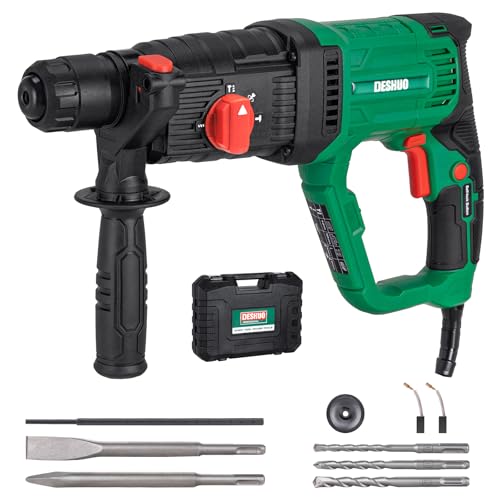


As an Amazon Associate we earn from qualifying purchases at no extra cost to you. Ratings are shown as listed on Amazon.
Quick picks by concrete and masonry job
- Best all-around cordless choice: a 18V or 20V SDS-Plus rotary hammer with about 2 to 3 ft-lb of impact energy, such as the Bosch GBH18V-28C, DeWalt DCH273, or Milwaukee M18 FUEL 1-inch SDS Plus Rotary Hammer.
- Best for frequent drilling near an outlet: a corded 1-inch SDS-Plus model such as the Bosch GBH2-28L or Makita HR2475. Continuous power and lower operating cost are the main advantages.
- Best for larger holes and heavier chiseling: an SDS-Max rotary hammer in the approximately 8 to 13 ft-lb class. These are better suited to concrete penetrations, thick masonry, and demolition than ordinary SDS-Plus tools.
- Best for occasional homeowners: a compact SDS-Plus hammer with variable speed, a clutch, and hammer-only mode. Spending more on maximum impact energy rarely helps if the tool is used only a few times per year.
What the important specifications actually tell you
Impact energy, measured in foot-pounds or joules, is the best indicator of how aggressively a hammer breaks concrete. Around 1.5 to 2.5 ft-lb is suitable for common anchor holes and light chiseling. Around 2.5 to 4 ft-lb is a useful general-purpose range for repeated work. Larger SDS-Max machines commonly start near 8 ft-lb and are intended for larger bits, deeper penetrations, and demolition.
Drilling capacity should be read together with the material. A tool advertised for a 1-inch concrete hole may drill that size effectively with the correct bit, but large holes take considerably longer in reinforced or dense concrete. SDS-Plus models are generally most comfortable with 5/16- to 3/4-inch holes; SDS-Max machines make more sense when large core bits, long penetrations, or chiseling are routine.
Weight affects both transport and accuracy. A 6- to 8-pound bare tool is easier to hold overhead and is usually the better choice for anchors, electrical work, and small masonry repairs. Tools around 10 pounds or more can remove material faster but become tiring on ladders, walls, and overhead work.
Vibration control is more than a comfort feature. Reduced vibration helps you maintain pressure and bit alignment, and it makes longer sessions less punishing. Look for a suspended rear handle, an isolated motor housing, or an electronic anti-vibration system. These features do not make a powerful hammer weightless, so handling technique and breaks still matter.
Head-to-head comparison of useful rotary-hammer classes
| Tool class or example | Power source | Impact energy | Typical concrete capacity | Approximate weight | Best use |
|---|---|---|---|---|---|
| Compact SDS-Plus cordless | 18V/20V battery | 1.5–2.0 ft-lb | Up to about 3/4 inch | 6–8 lb bare | Anchors, block, tile removal, service work |
| Full-size SDS-Plus cordless | 18V/20V battery | 2.0–3.5 ft-lb | Up to about 1 inch | 8–11 lb bare | Repeated concrete drilling and moderate chiseling |
| Bosch GBH2-28L | Corded, 8.5 amp | About 2.4 ft-lb | Up to about 1-1/8 inches | About 7.7 lb | Frequent general drilling with access to power |
| Makita HR2475 | Corded, 7 amp | About 1.9 ft-lb | Up to about 15/16 inch | About 6.6 lb | Budget-friendly anchors and masonry work |
| SDS-Max rotary hammer | Corded or high-voltage cordless | 8–13+ ft-lb | About 1-1/2 inches or more | 15–25+ lb | Large penetrations and demolition |
Published capacity varies by model and bit type, and the numbers above are practical ranges rather than a promise of drilling speed. A quality bit, correct pressure, and dust removal can matter as much as a small difference in impact energy.
Corded versus cordless: which trade-off wins?
Choose cordless when mobility controls the job
Cordless rotary hammers are preferable on scaffolding, roofs, unfinished buildings, remote masonry, and occupied spaces where a cable becomes a trip hazard. Modern brushless SDS-Plus models can handle a large number of anchor holes, especially with a high-capacity battery. Electronic clutches, kickback control, and selectable speed modes are particularly valuable when drilling near embedded metal.
The costs are batteries, chargers, and downtime. A high-capacity battery adds noticeable weight at the base of the tool, while a second battery may be necessary for a full day. Runtime also changes sharply with hole diameter: dozens of small holes may be practical, while continuous large-hole drilling can exhaust a pack quickly.
Choose corded when drilling is continuous
A corded hammer supplies uninterrupted power and usually costs less to operate over years if you already have a suitable extension cord. It is a strong choice for workshop use, basement remodeling, repeated anchor installation, and chipping jobs near a reliable outlet. The disadvantages are cable management, dependence on mains power, and less convenient work from ladders or lifts.
A useful break-even example illustrates the decision. Suppose a cordless kit costs roughly $350 to $550 and a second battery adds $100 to $200, while a capable corded SDS-Plus tool costs roughly $150 to $300. If the cordless tool saves 15 minutes per job and you complete 20 jobs per year, it saves about five hours annually. That convenience may justify the premium for a mobile contractor, but not for a homeowner drilling six holes once a year.
Decision matrix: match the hammer to the user
| Situation | Recommended specification | Why |
|---|---|---|
| Six or fewer small holes per year | Compact SDS-Plus, 1.5–2.0 ft-lb | Lower purchase cost and easier storage |
| Several dozen anchors each month | Brushless cordless or corded SDS-Plus, 2–3.5 ft-lb | Better speed, clutch protection, and durability |
| Overhead or ladder work | Tool under about 8 lb with vibration control | Less fatigue and better control |
| Large conduit or plumbing penetrations | SDS-Max, roughly 8 ft-lb or more | Accepts larger bits and removes material faster |
| Tile removal and light surface preparation | SDS-Plus with hammer-only mode | Allows chisels without rotating the bit |
| Jobsite without dependable power | 18V/20V cordless with two high-capacity batteries | Eliminates cords and reduces interruption |
Features worth paying for
- SDS-Plus or SDS-Max chuck: SDS-Plus is the versatile choice for smaller holes and common chisels. SDS-Max is larger, heavier, and built for high-impact work.
- Hammer-only mode: Essential for tile, mortar, brick, and light concrete chipping.
- Rotation-only mode: Useful for ordinary drilling with the right chuck or adapter, although a regular drill is often better for wood and metal.
- Mechanical clutch and electronic kickback control: These reduce sudden twisting when a bit binds, particularly in reinforced concrete.
- Variable speed and reverse: They help start holes cleanly and remove a stuck bit.
- Depth stop and side handle: Small accessories, but important for repeatable anchor depth and two-handed control.
- Dust extraction compatibility: A shroud or vacuum attachment improves visibility and reduces airborne concrete dust.
Setup and maintenance that extend tool life
Before drilling, locate hidden wiring and plumbing, select a bit designed for the material, and mark the required depth. Start at low speed with the hammer function engaged only when the bit is seated. Apply firm, steady pressure rather than forcing the tool; excessive pressure can reduce impact efficiency and accelerate bit wear. Withdraw the bit periodically on deep holes to clear dust, or use a compatible dust-extraction system.
After use, remove dust from the vents and wipe the SDS shank before applying the manufacturer-approved grease. Inspect the bit for rounded carbide, cracks, or a shank that no longer locks securely. Replace worn bits rather than compensating with extra pressure. Keep batteries out of extreme heat, avoid storing them fully depleted, and let a hot pack cool before charging.
The parts most likely to wear first are masonry bits, chuck seals, carbon brushes on older corded tools, battery packs, and vibration-isolation components. A rotary hammer that suddenly loses power may have a worn bit, clogged vents, an exhausted battery, or a damaged clutch—not necessarily a failed motor. Repeatedly using a rotary hammer as a general drill, chiseling with a damaged point, or drilling without dust clearance are common ways to shorten its life.
Final buying advice
For most concrete and masonry repairs, the best rotary hammers are mid-size SDS-Plus models with roughly 2 to 3 ft-lb of impact energy, a clutch, hammer-only mode, and vibration control. Pick cordless if access and movement save meaningful time; pick corded if the work is stationary and continuous. Move to SDS-Max only when large holes or demolition justify the additional weight, cost, bits, and storage space. Match the tool to the hole sizes you actually make, because a smaller hammer used comfortably and with sharp bits often outperforms an oversized model that is tiring to control.