Key takeaways
- Best Fishing Waders for Comfort and Dryness The best fishing waders for most anglers are breathable stockingfoot waders with reinforced knees, taped seams, and a well-measured fit; choose neoprene instead when cold-water insulation matters more than lightweight comfort, or bootfoot…
Best Fishing Waders for Comfort and Dryness
The best fishing waders for most anglers are breathable stockingfoot waders with reinforced knees, taped seams, and a well-measured fit; choose neoprene instead when cold-water insulation matters more than lightweight comfort, or bootfoot waders when simplicity and muddy access are priorities.
Quick comparison: breathable versus neoprene waders
Material determines how comfortable you will be after several hours, but it does not work alone. Seam construction, layering, fit, and boot design can matter just as much as the fabric itself.
Our top picks


As an Amazon Associate we earn from qualifying purchases at no extra cost to you. Ratings are shown as listed on Amazon.
| Feature | Breathable fabric | Neoprene |
|---|---|---|
| Typical thickness | 3-layer or 4-layer laminate | 3.5 mm to 5 mm neoprene |
| Approximate garment weight | 2.5 to 4.5 lb, excluding some boots | 4 to 7 lb, depending on thickness and boots |
| Best temperature range | About 45°F to 75°F with suitable layers | About 35°F to 55°F, depending on activity and layering |
| Moisture management | Moves perspiration vapor outward; not a guarantee against overheating | Very water-resistant but retains more body heat and sweat |
| Mobility | Usually better for hiking and frequent casting | Flexible, but bulkier and heavier |
| Typical market price | About $150 to $800 | About $100 to $450 |
These are useful buying ranges rather than universal specifications. A premium breathable wader may use stronger fabric, better patterning, and more durable waterproof zippers than an entry-level model. Likewise, a 5 mm neoprene wader is warmer but noticeably less comfortable for long walks than a 3.5 mm version.
Choose by fishing situation
| Your situation | Recommended choice | Why |
|---|---|---|
| Frequent spring-to-fall use | 3-layer breathable stockingfoot | Works across changing temperatures with adjustable layers |
| Cold water, low activity, or winter steelhead | 4 mm to 5 mm neoprene | Built-in insulation reduces dependence on thick underlayers |
| Long approaches and steep banks | Lightweight breathable stockingfoot | Lower weight and less heat buildup during walking |
| Occasional use on a tight budget | Basic breathable or 3.5 mm neoprene | Lower initial cost; accept fewer pockets and less reinforcement |
| Mostly muddy ponds or marshes | Bootfoot waders with lugged soles | Faster to put on and less vulnerable to sand entering separate boots |
| Multiple anglers sharing equipment | Adjustable stockingfoot design | More adaptable, though hygiene and fit still require attention |
Breathable waders: the versatile choice
Breathable waders use a waterproof laminate that allows some water vapor to escape. They are not air-conditioned clothing: in humid weather, during strenuous hiking, or under a rain jacket, condensation can still accumulate inside. Their advantage is adaptability. Wear lightweight synthetic or wool layers in mild conditions and add insulated layers as temperatures fall.
Look for a true 3-layer or 4-layer construction, rather than choosing solely by the word “breathable.” Reinforced lower legs and knees are valuable where brush, rocks, and repeated kneeling cause abrasion. A front zipper can make bathroom breaks easier, but it adds cost and another component that must be kept clean and lubricated according to the manufacturer’s instructions.
Brands such as Simms, Patagonia, Orvis, Redington, and Frogg Toggs sell breathable waders in different price tiers. The important comparison is not the logo: check the fabric layers, seam-tape coverage, warranty terms, repair service, and whether the suspenders and gravel guards can be adjusted without restricting movement.
Neoprene waders: warmth first
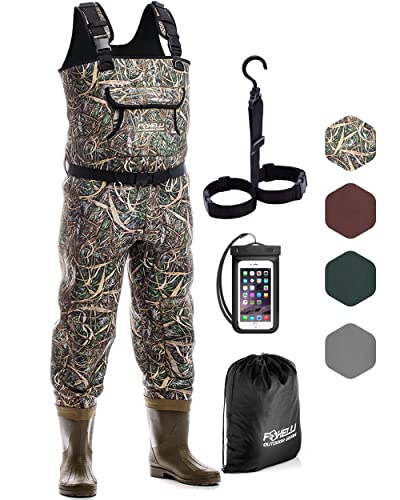
Neoprene is a closed-cell foam that provides insulation even when the garment is in cold water. It is a sensible choice for waterfowl hunting, winter fishing, and slow-paced wading where warmth matters more than ventilation. A 5 mm suit offers more insulation than a 3.5 mm suit, but it also adds weight and can become uncomfortable during a long walk.
Neoprene does not eliminate the need for proper layers. A moisture-managing base layer and roomy fleece or synthetic insulation are preferable to cotton, which holds moisture and dries slowly. Avoid wearing so many layers that the wader becomes tight around the crotch, knees, or seat; compressed neoprene loses some insulating loft and restricted movement increases stress on seams.
Stockingfoot versus bootfoot
Stockingfoot
Stockingfoot waders end in attached neoprene socks. You add separate wading boots, allowing you to select felt-free rubber, lugged rubber, or other permitted sole designs for your local regulations. This setup usually gives better ankle support and makes it easier to replace boots without replacing the waders. It is often the better option for anglers who hike, fish frequently, or use different soles in different locations.
Bootfoot
Bootfoot waders combine the wader and boot in one piece. They are quick to put on, often cost less than buying separate boots, and keep gravel from entering through the boot opening. Their drawbacks are less precise boot fit, more bulk in storage, and a larger replacement expense if either the boot or wader portion fails. Make sure the boot has enough room for the socks you will actually wear; sizing up can create heel lift and blisters.
Fit and sizing: measure before ordering
Do not select waders by waist size alone. Record height, chest or bust, waist, hip, inseam, shoe size, and—if provided by the manufacturer—larg