Key takeaways
- Dimensions and capacity: A dish’s outside measurements determine whether it fits your oven, while its inside base area affects how quickly food cooks. A broad, shallow dish suits gratin potatoes and roasted vegetables; a deeper one is more versatile for casseroles but may brown toppings less evenly.
- Oven limit: Follow the manufacturer’s limit for the exact dish, not a generic claim about ceramic or glass. Check whether the stated limit applies with or without a lid, and whether the dish is safe under a broiler.
- Material: Ceramic and stoneware hold heat well, keeping food warm at the table. Glass lets you see the sides and bottom, but can be vulnerable to thermal shock. Neither material should be moved directly from a freezer to a hot oven unless the maker explicitly permits it.
- Nesting: Nested dishes save shelf space, but handles and rims may prevent a tight fit. Check the stacked height and use a thin cloth or pan protector between pieces if they rub.
- Serving versatility: Rounded handles are useful with mitts, and attractive finishes can go from oven to table. Confirm whether the set is also suitable for microwave, freezer, and dishwasher use; these are separate specifications.
Best Gratin Dish Sets for Oven Cooking: Picks by Kitchen and Cooking Style
The best gratin dish set for oven cooking is a nested set of oven-safe ceramic dishes in several useful sizes, with a clearly stated temperature limit and handles you can grip with oven mitts. Choose stoneware or porcelain for heat retention and serving at the table; choose borosilicate glass if seeing browning and checking food is a priority. Before buying, check the largest dish’s exterior dimensions against your oven and the set’s storage footprint.
What to compare before choosing
- Dimensions and capacity: A dish’s outside measurements determine whether it fits your oven, while its inside base area affects how quickly food cooks. A broad, shallow dish suits gratin potatoes and roasted vegetables; a deeper one is more versatile for casseroles but may brown toppings less evenly.
- Oven limit: Follow the manufacturer’s limit for the exact dish, not a generic claim about ceramic or glass. Check whether the stated limit applies with or without a lid, and whether the dish is safe under a broiler.
- Material: Ceramic and stoneware hold heat well, keeping food warm at the table. Glass lets you see the sides and bottom, but can be vulnerable to thermal shock. Neither material should be moved directly from a freezer to a hot oven unless the maker explicitly permits it.
- Nesting: Nested dishes save shelf space, but handles and rims may prevent a tight fit. Check the stacked height and use a thin cloth or pan protector between pieces if they rub.
- Serving versatility: Rounded handles are useful with mitts, and attractive finishes can go from oven to table. Confirm whether the set is also suitable for microwave, freezer, and dishwasher use; these are separate specifications.
Size guide: match the dish to the job
Capacities below are practical planning ranges, not standardized product specifications. Actual capacity varies with shape, depth, and how full you fill the dish. Dimensions are approximate exterior ranges commonly useful when comparing sets; measure the individual product before buying.
Our top picks


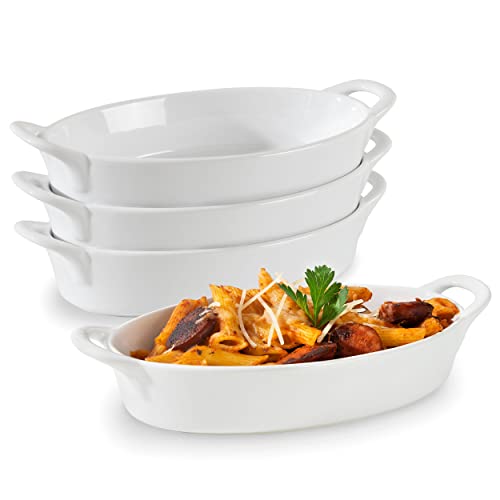
As an Amazon Associate we earn from qualifying purchases at no extra cost to you. Ratings are shown as listed on Amazon.
| Dish size | Approx. outside dimensions | Useful capacity range | Best suited to | Typical oven fit consideration |
|---|---|---|---|---|
| Small | 18–22 cm long | 0.5–1.0 L | Side dishes, baked eggs, or a small portion | Usually fits easily, but check handle-to-handle width |
| Medium | 25–30 cm long | 1.5–2.5 L | A family side dish or compact casserole | Check clearance from oven walls and other cookware |
| Large | 32–38 cm long | 2.5–4.0 L | A larger gratin, roast vegetables, or a shared main | Measure the usable rack width, including handles |
For a practical fit check, measure the oven rack’s usable width and depth, then compare them with the dish’s maximum outside dimensions. Leave room around the dish for airflow and for lifting it out safely. A dish that technically fits wall-to-wall may be awkward to rotate or remove with mitts.
Best set type by situation
| Your situation | Best choice | Why it fits | Trade-off to accept |
|---|---|---|---|
| Limited cupboard space | Three-piece nested ceramic or stoneware set | Several sizes occupy one stacked footprint | Check stack height and whether rims touch or wobble |
| Frequent oven-to-table cooking | Stoneware or porcelain with broad handles | Retains warmth and looks suitable for serving | Often heavier than glass; confirm a comfortable lift when full |
| Budget-conscious occasional use | Simple glass baking dishes in two or three sizes | Practical, easy to inspect, and often available at a modest general-market price | May not retain heat as well at the table; verify broiler limits |
| Cooking under a broiler | A dish explicitly marked broiler-safe | Removes guesswork about intense direct heat | Many oven-safe dishes are not broiler-safe; check the exact model |
| One set for sides and baked mains | A shallow small dish plus medium and deeper large dishes | Covers crisp toppings, vegetables, and layered bakes | More pieces may mean more weight and shelf space |
Material trade-offs that matter in daily use
Ceramic, stoneware, and porcelain
These materials are strong choices for dishes that go directly to the table. Their heat retention helps keep a gratin warm after it leaves the oven, and an opaque body conceals cooking marks. The downside is weight: a large dish filled with potatoes or vegetables can be cumbersome. Glazes can also chip if dishes knock against each other or a hard sink. Check for chips before use, and avoid using a damaged dish if the manufacturer advises against it.
Glass
Glass makes it easier to judge browning on the sides and bottom, and smooth surfaces are generally easy to clean. Its performance depends on the type of glass and the manufacturer’s instructions, so do not assume every glass dish is broiler-safe or suitable for direct stovetop heat. Sudden temperature changes are a common cause of breakage: use a dry cloth or trivet, and avoid placing a hot dish on a cold, wet, or stone surface.
Broiler safety and temperature limits
“Oven-safe” does not automatically mean “broiler-safe.” A broiler exposes cookware to concentrated radiant heat, which can exceed the conditions assumed by a general oven rating. Look for broiler safety in the maker’s instructions for the specific set, and observe any distance or time limits. Do not use a dish with a plastic lid, decorative trim, or other component under the broiler unless that component is specifically approved.
Also check whether the dish can go from refrigerator to oven. Many makers advise letting cold cookware warm toward room temperature first, or placing it in a preheated oven only under specified conditions. Thermal shock can crack both glass and ceramic, even when the dish’s maximum oven temperature has not been exceeded.
Ownership details: what wears first and how to avoid damage
- Chipped rims and handles: Most likely when heavy dishes are stacked without protection or tapped against a sink. Nest carefully and separate pieces with a cloth or cookware protector.
- Stuck-on cheese and starch: Soak the cooled dish in warm water before scrubbing. Avoid sudden cold-water rinses while it is still hot.
- Scratches or dulling: Metal utensils and abrasive pads can mark some glazed surfaces. Use nonmetal utensils when practical and follow the care label.
- Heat damage from misuse: Do not set a hot dish directly on a cold counter, use it on a burner, or exceed its stated temperature limit unless the manufacturer specifically allows it.
- Storage wear: Nested sets can rub at contact points. If pieces do not nest securely, store them separately rather than forcing a tight stack.
How to choose the right set
Start with the largest meal you expect to cook, then make sure the biggest dish fits your oven rack with room to handle it. Next, pick a material based on use: stoneware or porcelain for warm table service, glass for visibility and easy monitoring. Finally, confirm the temperature limit, broiler status, care instructions, and stacked storage height. A set with three genuinely useful sizes is usually more practical than one with extra pieces that rarely leave the cupboard.