Key takeaways
- Change engine oil and the oil filter on the manufacturer’s schedule, commonly after the initial break-in service and then at an annual or hour-based interval.
- Inspect or replace the gearcase lubricant and check for water contamination.
- Inspect the propeller for bent blades, fishing line, and damaged hardware.
- Check spark plugs, fuel lines, clamps, battery terminals, and steering components.
- Replace or service the water-pump impeller at the interval specified for the model and usage.
- Use fresh fuel and follow the manual’s instructions for fuel stabilizer and storage.
Best Gas Outboard Motors
The best gas outboard motor for most owners is a four-stroke model sized to the boat’s maximum rated horsepower: a 5–10-hp engine suits small tenders and utility boats, 15–25 hp covers many compact fishing boats, and 40–60 hp is a practical range for larger aluminum and fiberglass boats carrying several people.
There is no single best gas outboard motor for every boat. The right choice depends on horsepower, transom height, total load, carrying weight, starting system, access to service points, and whether the engine will run in freshwater, saltwater, or both.
Our top picks

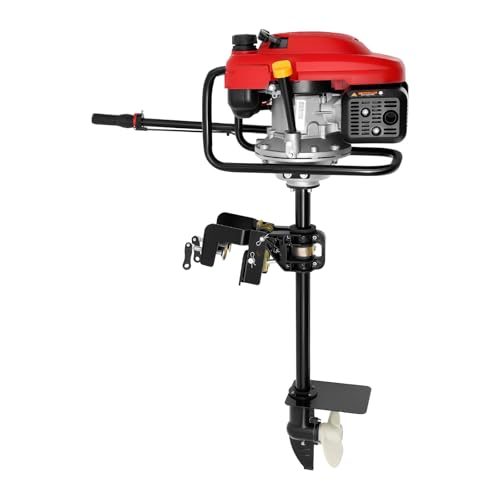
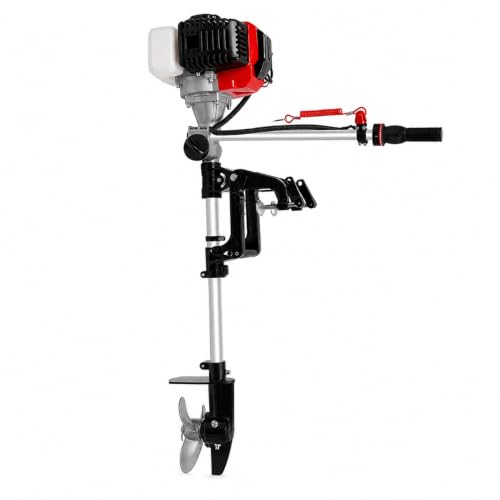
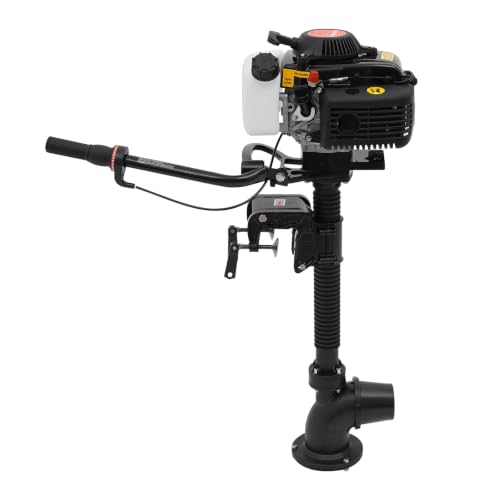
As an Amazon Associate we earn from qualifying purchases at no extra cost to you. Ratings are shown as listed on Amazon.
Best gas outboard motors by situation
| Boating situation | Recommended class | Good examples | Why it fits |
|---|---|---|---|
| Light tender, canoe-style boat, or small inflatable | 2.5–6 hp, portable | Tohatsu MFS5, Mercury 5hp FourStroke, Yamaha F4 | Low weight and simple handling; usually easy to store |
| Fishing boat for one or two people | 9.9–20 hp | Mercury 9.9 FourStroke, Honda BF15/BF20, Suzuki DF20A | Useful thrust without the weight and cost of a mid-size engine |
| 14–16-foot utility or aluminum boat | 20–30 hp | Yamaha F25, Suzuki DF25A, Tohatsu MFS25 | Strong all-around acceleration and practical fuel consumption |
| Family or fishing boat carrying several people | 40–60 hp | Honda BF50, Yamaha F50, Suzuki DF60A | Better planing performance and reserve power under load |
| Frequent offshore or rough-water use | 60 hp and up, often with remote controls | Choose a manufacturer-supported model matched to the hull | Greater range of propeller choices, controls, and service support |
Top choices compared by horsepower and weight
Horsepower determines how effectively the boat accelerates and stays on plane, but weight matters just as much on a small transom. An engine that is technically powerful enough can still make a lightweight boat sit low at the stern or become difficult to lift.
| Model | Horsepower | Approximate dry weight | Starting system | Best match |
|---|---|---|---|---|
| Tohatsu MFS5 | 5 hp | About 55 lb | Manual recoil | Small inflatables and portable tenders |
| Mercury 9.9 FourStroke | 9.9 hp | About 84 lb, configuration dependent | Manual or electric, depending on version | Small fishing and utility boats |
| Suzuki DF20A | 20 hp | About 97 lb, short-shaft manual version | Manual or electric, depending on version | Light boats needing strong low-speed thrust |
| Yamaha F25 | 25 hp | About 126 lb for a portable configuration | Manual or electric, depending on version | 14–16-foot aluminum and utility boats |
| Honda BF50 | 50 hp | About 214 lb, configuration dependent | Electric start | Boats designed for remote controls and heavier loads |
Weights vary with shaft length, tiller or remote control, electric-start hardware, alternator equipment, and trim system. Confirm the exact configuration before buying. A manufacturer’s listed dry weight also excludes fuel, engine oil, battery, rigging, and sometimes the propeller.
Fuel economy: what the numbers mean on the water
Modern four-stroke outboards generally use less fuel and produce fewer fumes than older two-stroke designs, especially at moderate cruising speed. Actual consumption depends on hull shape, propeller pitch, throttle position, current, wind, passenger load, and whether the boat is planing.
A small outboard may use roughly 0.3–0.6 gallons per hour at a moderate cruise, while a 20–25-hp engine may use approximately 1–2 gallons per hour under a useful load. A 50–60-hp engine can consume about 3–5 gallons per hour at cruising speed. These are planning ranges, not guaranteed specifications.
For example, if a 20-hp motor burns 1.4 gallons per hour and you expect a four-hour outing, the fuel requirement is:
1.4 gallons × 4 hours = 5.6 gallons
Add a reserve of at least 20 percent for wind, detours, idling, and changing conditions. That makes a portable fuel capacity of about 6.7 gallons a more sensible target than carrying exactly 5.6 gallons. Never rely on the tank’s nominal capacity alone; leave room for expansion and follow the fuel-system instructions.
Starting systems and everyday convenience
Manual recoil start
Pull-start engines are usually lighter, less expensive, and mechanically simpler. They are a good fit for small motors that can be operated from the stern. The trade-off is that starting may be awkward when the engine is mounted low, the boat is crowded, or the operator has limited pulling strength.
Electric start
Electric start is valuable on 20-hp-and-larger engines, on boats with remote controls, and for frequent use. It requires a properly sized marine battery, clean terminals, suitable cables, and a charging system or charging plan. An electric starter does not remove the need for emergency preparation: carry a manual-start option when the engine supports one, or maintain a charged backup battery.
Tiller versus remote control
A tiller handle keeps the installation compact and is convenient for small boats. Remote steering and throttle controls are safer and more comfortable on larger boats, particularly when the operator needs to sit forward or when the stern is crowded. Do not choose an engine solely by horsepower without checking whether the hull is designed for tiller or remote installation.
Saltwater use, freshwater use, and corrosion protection
Most current four-stroke outboards can operate in freshwater or saltwater, but saltwater requires more cleaning and inspection. Look for sacrificial anodes, corrosion-resistant fasteners, paint systems designed for marine use, and a flushing connection that is easy to reach. A freshwater-rinsing port is useful, but it does not replace flushing according to the owner’s manual.
After saltwater use, rinse the exterior with fresh water, flush the cooling passages as directed, and inspect the propeller, propeller shaft, anodes, steering hardware, and mounting bolts. Do not aim a high-pressure washer at seals, electrical connectors, or the powerhead. Salt crystals hidden under brackets and trim components can cause damage even when the visible surfaces look clean.
Maintenance access and ownership costs
The most convenient outboard is often the one with an easy-to-remove engine cover, visible oil filter, accessible drain plug, reachable fuel filter, and clear lubrication points. Service access matters because neglected maintenance usually costs more than the original price difference between two similar engines.
- Change engine oil and the oil filter on the manufacturer’s schedule, commonly after the initial break-in service and then at an annual or hour-based interval.
- Inspect or replace the gearcase lubricant and check for water contamination.
- Inspect the propeller for bent blades, fishing line, and damaged hardware.
- Check spark plugs, fuel lines, clamps, battery terminals, and steering components.
- Replace or service the water-pump impeller at the interval specified for the model and usage.
- Use fresh fuel and follow the manual’s instructions for fuel stabilizer and storage.
The water-pump impeller, anodes, propeller, fuel filter, spark plugs, and starter battery are normal wear items. Fishing line wrapped around the propeller shaft is a common cause of seal failure. Another frequent mistake is running the engine without a proper water supply; even a short dry run can damage the impeller.
How to size an outboard correctly
- Read the boat’s capacity plate. Treat its maximum horsepower, maximum engine weight, passenger capacity, and load rating as limits, not suggestions.
- Calculate the real operating load. Include people, fuel, battery, safety equipment, cooler, fishing gear, and the engine itself.
- Match the shaft length. Measure from the transom mounting surface to the boat’s underside near the centerline. A short shaft is commonly around 15 inches and a long shaft around 20 inches, but the boat manufacturer’s specification takes priority.
- Choose the control layout. Decide between tiller and remote steering before comparing engines, because the available weight and equipment can change significantly.
- Plan for storage and lifting. Confirm that the transom, trailer, lifting points, and storage rack can support the engine’s actual weight.
For infrequent use on a small boat, a lighter 9.9- or 15-hp engine may be more practical than a heavier 20-hp model. For regular use with several passengers, selecting the upper portion of the boat’s approved horsepower range usually improves acceleration and reduces the need to operate at full throttle.
Final recommendation
Choose a portable 5–10-hp four-stroke when low weight and simple storage matter most. Choose a 15–25-hp model such as the Honda BF20, Suzuki DF20A, or Yamaha F25 when you want a versatile small-boat engine with useful carrying capacity. For a family-sized boat, move to a 40–60-hp electric-start outboard that supports remote controls and has a strong local service network. In every category, correct shaft length, an approved horsepower rating, accessible maintenance points, and disciplined saltwater rinsing matter more than a small difference in advertised peak speed.