Key takeaways
- Place ventilation low on the cool side and higher on the warm side when the enclosure design allows it. This supports air movement across the habitat.
- Avoid sealing every vent to chase a humidity number. Stale, damp air and persistently wet substrate can create hygiene problems.
- Use a digital hygrometer near the middle of the enclosure, not directly above the water bowl or against a misted wall.
- Use a larger water bowl and moisture-retaining substrate rather than constant spraying. The substrate should be slightly damp below the surface, not muddy.
Best Ball Python Tanks: Setup, Size and Heating Guide
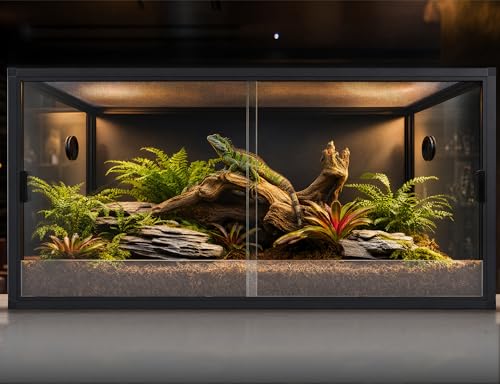
The best ball python tanks for most adult snakes are front-opening PVC enclosures measuring about 48 × 24 × 24 inches, with controlled ventilation, a guarded heat source connected to a thermostat, and enough floor space for the snake to stretch out fully.
Glass aquariums can work for young ball pythons, but they usually lose heat and humidity faster than enclosed PVC or melamine habitats. The right choice depends on your snake’s size, room temperature, available space, and how much control you want over humidity.
Our top picks


As an Amazon Associate we earn from qualifying purchases at no extra cost to you. Ratings are shown as listed on Amazon.
Quick recommendations by situation
| Situation | Best enclosure type | Suggested size | Why it fits |
|---|---|---|---|
| Young snake or limited budget | 20-gallon-long glass tank with secure screen lid | 30 × 12 × 12 inches minimum | Affordable and easy to observe, but needs more humidity and heat management |
| Growing juvenile | Medium PVC enclosure | 36 × 18 × 18 inches | Improved heat retention and room for multiple hides |
| Typical adult | Front-opening PVC enclosure | 48 × 24 × 24 inches | Provides full-body stretching space while holding temperature and humidity steadily |
| Large adult or highly active snake | Large PVC or sealed wood enclosure | 60 × 24 × 24 inches or larger | Extra floor area supports enrichment and a larger temperature gradient |
| Rack-style space-saving setup | Purpose-built reptile tub system | At least the snake’s full length and adequate turning width | Efficient, but less visually accessible and dependent on reliable ventilation |
How much space does a ball python tank need?
Use the snake’s adult body length rather than its current size when planning a long-term enclosure. A useful minimum is an enclosure whose longest dimension is at least the snake’s length, with enough width and height for the animal to turn, climb over low furnishings, and use separate warm and cool hides.
For many adult ball pythons, 48 × 24 × 24 inches is a practical baseline rather than an excessive size. A 4-foot enclosure offers substantially more usable floor area than a 36-inch tank: 48 × 24 inches provides 1,152 square inches of floor space, compared with 648 square inches in a 36 × 18-inch enclosure. That is about 78% more floor area.
Very large enclosures are not automatically stressful. An open enclosure becomes a problem when it lacks cover, hides, or a usable heat gradient. Fill the habitat with cork, artificial foliage, branches, and two snug hides so the snake can move through the space while remaining concealed.
Tank materials compared: PVC, glass and melamine
PVC enclosures
PVC is usually the strongest all-round choice for a ball python because solid panels reduce heat loss and help retain humidity. Front-opening PVC habitats are available from specialist manufacturers such as Animal Plastics and Zen Habitats, although dimensions, door styles, ventilation and shipping options vary by model.
Expect roughly $200–$600 or more for a large enclosure before adding a stand and equipment, depending on construction and accessories. PVC does not absorb water like unfinished wood, but seams and drilled openings still need inspection. Sliding-door tracks may collect substrate and should be vacuumed or wiped regularly.
Glass aquariums
Glass tanks are widely available and provide excellent visibility. A 20-gallon-long aquarium can suit a small juvenile, while a 40-gallon breeder can house a larger juvenile or smaller adult if its dimensions and furnishings are appropriate.
The main disadvantage is heat and humidity loss through the large screen top. Covering part of the screen with a safe solid panel can reduce evaporation, but never block ventilation completely. Glass also makes it harder to maintain a warm side without raising the room or basking area temperature too far.
Melamine or sealed wood
Melamine habitats can retain heat well and may cost less per square inch than premium PVC. The vulnerable areas are exposed edges, screw holes and floor seams. Water bowls, damp substrate and repeated cleaning can cause swelling if the interior is not properly sealed. Choose a design with waterproof laminate surfaces or seal all wood edges with a reptile-safe, fully cured coating.
Ventilation versus humidity: finding the useful middle ground
Ball pythons need fresh-air exchange, but excessive open ventilation can make the enclosure dry and difficult to heat. A solid-sided PVC enclosure with adjustable vents often provides better control than a tank with a fully screened lid.
- Place ventilation low on the cool side and higher on the warm side when the enclosure design allows it. This supports air movement across the habitat.
- Avoid sealing every vent to chase a humidity number. Stale, damp air and persistently wet substrate can create hygiene problems.
- Use a digital hygrometer near the middle of the enclosure, not directly above the water bowl or against a misted wall.
- Use a larger water bowl and moisture-retaining substrate rather than constant spraying. The substrate should be slightly damp below the surface, not muddy.
A commonly used target is approximately 50–60% relative humidity, with a temporary rise toward 60–70% often useful around shedding. Husbandry needs vary by room and enclosure, so monitor the snake’s condition and consult an experienced reptile veterinarian if you see persistent skin or respiratory concerns.
Heating setup for a stable temperature gradient
The enclosure should have a warm side and a cooler retreat, not one uniform temperature. A practical starting range is about 88–92°F (31–33°C) at the warm hide and roughly 75–80°F (24–27°C) on the cool side. Measure the actual surfaces and air zones rather than relying on the thermostat setting alone.
- Select the heat source. A ceramic heat emitter, deep-heat projector or radiant heat panel can be used depending on the enclosure and room. Overhead heat should be protected by a guard so the snake cannot contact the hot element.
- Install a thermostat. The thermostat probe should be secured at the heated surface or in the manufacturer’s recommended position. A thermostat is essential; a plug-in timer only controls schedule and does not prevent overheating.
- Create two hides. Put one snug hide on the warm side and one on the cool side. A snake that must choose between security and its preferred temperature is less likely to use the gradient properly.
- Measure at several points. Use two digital thermometers and a separate hygrometer. Check the warm hide, cool side and ambient room temperature after the enclosure has run for at least 24 hours.
- Protect every heat source. Use a rigid heat guard for internal emitters. Do not use unregulated heat rocks, which can create dangerous hot spots.
For example, a 100-watt heater does not necessarily produce a 100-watt “temperature.” The result depends on room temperature, enclosure material, ventilation, distance and thermostat control. This is why wattage should be treated as a starting specification, not a guarantee.
Best enclosure choices by ownership priorities
| Priority | Recommended choice | Trade-off |
|---|---|---|
| Lowest initial cost | Glass aquarium with partial screen cover | More frequent adjustments to humidity and heating |
| Stable humidity | Solid-sided PVC enclosure | Higher purchase price and possible shipping cost |
| Easy cleaning | Water-resistant PVC with removable doors or panels | Some lightweight panels can flex under heavy furnishings |
| Maximum visibility | Glass front or glass aquarium | More heat loss and reflections can make temperature control harder |
| Several snakes in limited space | Purpose-built tub or stacked enclosure system | Less display value and closer attention required for ventilation |
Setup details that affect long-term ownership
Choose a substrate that is easy to spot-clean and replace. Aspen, coconut-based products and other reptile substrates are commonly used, but avoid fragranced materials, dusty products and anything that remains saturated. Replace soiled areas promptly and perform a deeper clean according to the enclosure’s condition rather than following an arbitrary calendar.
Provide a heavy, stable water bowl that cannot be tipped easily. Replace the water when contaminated and wash the bowl regularly. Keep electrical connections outside the enclosure where possible, use drip loops, and inspect cords for chewing or moisture damage.
The parts most likely to wear first are door seals, sliding tracks, screen panels, thermostat probes and thin plastic clips. Check the probe position after moving decorations, since a displaced probe can cause a thermostat to read the wrong temperature. Hinges and door latches should close firmly enough to prevent escape without crushing or pinching.
Common buying mistakes
- Choosing a tank based only on gallons instead of length, width and usable floor area.
- Buying a large enclosure with no plan for hides and cover.
- Assuming a thermostat replaces thermometers and routine monitoring.
- Using a full screen lid in a dry room without considering humidity loss.
- Installing heat inside the enclosure without a secure guard.
- Placing the water bowl directly under the heater, causing excessive evaporation.
- Using an unsealed wooden habitat with damp substrate.
Final recommendation
For most keepers, a 48 × 24 × 24-inch front-opening PVC enclosure is the best ball python tank because it balances adult floor space, heat retention, humidity control and ease of access. Choose a 36 × 18 × 18-inch habitat for a growing juvenile when a full adult enclosure is impractical, and choose glass when budget or visibility matters more than effortless climate stability. Whichever material you select, the thermostat, protected heat source, two-hide layout and measured temperature gradient matter more than the brand name on the enclosure.