Key takeaways
- Flat display, drop-prone habits (construction, cycling, kids): tempered glass, standard adhesive.
- Curved display, want full edge coverage: TPU film, or UV-cured curved glass if budget allows.
- Heavy stylus or note-taking use: TPU film for better pen feel.
- Phone kept bare in pockets with keys/coins: tempered glass for scratch resistance.
- Resale value matters, want zero screen marks: tempered glass, replaced every 6 months.
- Budget-tight, replacing often: film, since multi-packs lower cost per replacement.
Tempered glass protects better against drops and deep scratches, while film protects better against shattering into sharp pieces and keeps the thinnest possible feel on curved screens. The right pick depends on whether your phone has a flat or curved display, how often you drop it, and how much you care about touch feel versus impact absorption.
As an Amazon Associate we earn from qualifying purchases at no extra cost to you.


The core material difference
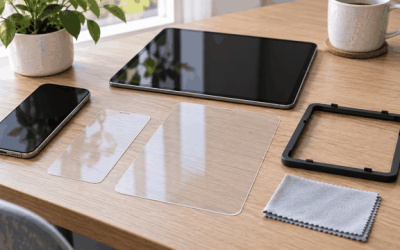
Tempered glass screen protectors are made from chemically strengthened glass, usually 0.2mm to 0.4mm thick, bonded to the display with a silicone adhesive layer. Film protectors are thin sheets of TPU (thermoplastic polyurethane) or PET plastic, typically 0.1mm to 0.2mm thick, applied as a flexible skin rather than a rigid layer.
That structural difference drives almost every practical difference below: how they handle impact, how they feel under your finger, and how they fail when they eventually fail.
Scratch resistance
Tempered glass wins here, clearly. Most tempered glass protectors rate 9H on the pencil hardness scale, close to the hardness of a sapphire crystal and well above average keys, coins, or sand grit. Film protectors, even TPU ones marketed as “self-healing,” rate closer to 3H-5H. They resist light surface marks and some scuffing, and TPU film can shrug off fine scratches over a few days as the material relaxes, but they will show visible scoring from grit, zippers, or rough countertops much sooner than glass.
If your phone lives in a bag with keys or coins, glass will look better after six months. If it lives in a case pocket by itself, the gap narrows.
Shatter behavior on drop
This is where film has a real advantage that often gets overlooked. Tempered glass is designed to crack and absorb impact energy, which protects the screen underneath, but on a hard enough drop the glass itself can shatter into sharp shards or spiderweb across the whole panel, sometimes impairing visibility. Film doesn’t shatter. It can dent, deform, or puncture under a sharp impact, but it stays in one flexible piece and rarely creates sharp edges.
For raw drop protection measured in successful screen saves, glass generally performs better because its rigidity spreads impact force across a wider area before it cracks. For failure safety, meaning what happens to your hands and face when it does fail, film is more forgiving.
| Factor | Tempered Glass (0.33mm) | TPU/PET Film (0.15mm) |
|---|---|---|
| Hardness rating | 9H | 3H-5H |
| Typical thickness | 0.2mm-0.4mm | 0.1mm-0.2mm |
| Drop protection (flat screens) | High, cracks to absorb impact | Moderate, dents/deforms |
| Shatter risk | Can crack into sharp pieces | Does not shatter |
| Touch sensitivity | Near-native, minor lag on some styluses | Slightly softer feel, excellent stylus response |
| Curved-edge fit | Often leaves 1-2mm gap on curved displays | Full edge-to-edge coverage |
| Install difficulty | Easy with alignment tray, bubble-prone without one | Harder, requires patience and a squeegee |
| Average lifespan | 6-12 months before cracking or peeling | 2-4 months before scratching through |
| Typical price per unit | $8-$20 | $5-$12 (often sold in 2-3 packs) |
Touch sensitivity and screen feel
At 0.33mm, quality tempered glass sits close enough to the display that touch response, 3D Touch equivalents, and fingerprint sensors under the glass generally work without noticeable lag, provided the protector is rated for in-display sensors. The glass surface also has a harder, slightly more “clicky” feel that some users prefer for gaming.
Film at 0.15mm sits even closer to the panel and flexes with your finger, which many users describe as feeling more like the bare screen. Stylus users, including those using phones with pressure-sensitive pens, often prefer film because the softer surface reduces the scratchy sound and slight drag that glass can introduce.
Curved-edge adhesion: the real deciding factor
If your phone has a flat display, this section barely matters. If it has a curved-edge display, it matters more than scratch resistance or drop rating.
Tempered glass is rigid, so it cannot fully conform to a curved edge. Manufacturers solve this two ways: making the glass smaller so it only covers the flat center (leaving the curved edges exposed and vulnerable), or using a UV-cured liquid adhesive that glues a slightly flexible glass to the full curve. The second method works well but is fussier to install and costs more.
Film is flexible by nature, so it wraps the full curve with consistent adhesion and no edge lifting. This is the main reason film still outsells glass on phones with heavily curved displays, despite being less scratch-resistant overall.
Quick decision guide
- Flat display, drop-prone habits (construction, cycling, kids): tempered glass, standard adhesive.
- Curved display, want full edge coverage: TPU film, or UV-cured curved glass if budget allows.
- Heavy stylus or note-taking use: TPU film for better pen feel.
- Phone kept bare in pockets with keys/coins: tempered glass for scratch resistance.
- Resale value matters, want zero screen marks: tempered glass, replaced every 6 months.
- Budget-tight, replacing often: film, since multi-packs lower cost per replacement.
Install risk: bubbles and dust
Glass installs are more forgiving if you use an alignment tray, which most mid-range and premium kits now include. Without one, trapped air bubbles are common and dust under the glass is the top complaint, since any particle under a rigid sheet creates a visible, permanent bump.
Film is harder to install cleanly. It requires a wet or dry squeegee technique, more patience, and a dust-free surface, because the flexible material shows wrinkles and air pockets more readily during application and takes longer to settle flat. Many first attempts at film application end up with at least one small bubble near the edge that works itself out over 24-48 hours as the adhesive cures, or doesn’t.
Practical tip for either type: install in a steam-filled bathroom right after a shower, or use a lint roller on the screen first. Floating dust is the single biggest cause of bad installs for both materials.
Cost per year of use: a worked comparison
Sticker price is misleading because the two materials wear out at different rates. Here’s a simple annual cost comparison based on typical lifespans from the table above.
- Tempered glass: $14 average price, replaced roughly every 9 months, so about 1.3 replacements per year = $18-$20 per year.
- Film: $8 average price for a single unit (or roughly $3 per unit in a 3-pack at $9), replaced roughly every 3 months, so about 4 replacements per year = $32-$36 per year if bought single, $12-$14 per year if bought in multi-packs.
The practical takeaway: glass is usually cheaper per year if you buy single units, but film becomes the cheaper option when bought in bulk multi-packs, which is how it’s most commonly sold. Factor in your own drop frequency too, since one cracked glass replacement can erase a full year of savings.
What wears out first, and common mistakes
On glass, the oleophobic coating degrades first, usually within 4-6 months, making the surface feel grippier and show more fingerprint smudging well before the glass itself cracks. On film, the top layer scratches through first, often within 2-3 months of daily pocket use, which is why “self-healing” marketing claims only apply to light surface marks, not deep scratches.
The most common mistake with either type is applying it over a case lip that doesn’t match the protector’s edge profile, which causes dust to collect in the gap over time. The second most common mistake is skipping the dust-removal sticker step included in most kits, which is there specifically to lift fine particles the lint roller misses.
Bottom line
Choose tempered glass for flat screens, heavy drop risk, and the lowest annual cost if you don’t crack it too often. Choose film for curved-edge phones, stylus use, and situations where a cheap multi-pack beats paying for glass twice a year. Neither material replaces a good case, but pairing either one with a raised-lip case meaningfully extends its working life.