Key takeaways
- Find the best battery backup for android phone owners: USB-C power banks compared by capacity, wattage, built-in cable, wireless charging and pocket size.
An Android phone runs out of charge at the worst moments: on a long commute, at the end of a travel day, or halfway through a navigation route in an unfamiliar city. A battery backup solves that problem, but only when it matches the phone it charges. Android phones use USB-C charging with fast-charge standards that vary by brand, so a power bank that works well for one phone can charge another slowly. The right backup delivers the wattage the phone accepts, carries enough capacity for the day, and fits in a pocket without a tangle of cables.
This guide is for Android phone owners who travel, commute, or spend long days away from a wall outlet and want a pocket power bank that keeps up. Every power bank below was chosen from the names and specifications on its Amazon page, with capacity, wattage, ports, and cable design checked against the listing, and the wattage claims were matched to Android fast-charge standards, before it earned a place here.
Quick Picks
As an Amazon Associate we earn from qualifying purchases
| Product | Best for | Key spec from title |
|---|---|---|
| Anker Nano Power Bank 10K 30W | Everyday carry with a built-in cable | 10,000mAh with 30W USB-C |
| INIU Portable Charger 10000mAh 45W | Fastest pocket charging | 10,000mAh with 45W USB-C PD |
| Samsung 25W Battery Pack 10000mAh | Wireless plus wired charging | 10,000mAh with 25W and Qi wireless |
How to Choose
Capacity and how many charges it really gives
Capacity in milliamp-hours looks simple, but the number on the box is not the number that reaches the phone. Energy is lost as heat and voltage conversion, so a 10,000mAh bank typically delivers around two-thirds of its rated capacity to a phone battery. That still covers one full charge for most Android phones with room for a top-up, which is enough for a long day away from an outlet. Check the rated capacity on the listing, then think about the phone battery size and how many charges the day actually needs, rather than chasing the biggest number on the shelf. Two full charges suit a weekend away, though capacity adds weight.
Wattage and Android fast charging
Wattage decides how fast the phone charges, and Android phones vary widely in what they accept. Many Samsung and Pixel phones charge fastest at 25W over USB-C with Power Delivery and PPS, while other Android models accept 30W or more. A bank that outputs only 15W will charge a modern Android phone slowly, even when the capacity is generous. Check the wattage of the USB-C port on the listing, confirm the phone supports that standard, and remember that the bank and the phone negotiate the fastest speed both sides support, so a higher-wattage bank never harms a phone that accepts less. Check the cable rating too, since a thin cable caps the wattage.
Built-in cable, ports, and everyday carry
A built-in cable changes how a power bank feels in daily use. It removes the need to carry a separate lead, doubles as a carry loop on some models, and means the bank is ready the moment the phone runs low. Check how many ports the bank offers alongside the cable: a second USB-C port and a USB-A port let the bank charge earbuds or a second phone at the same time. Also check the size and weight, since a bank that is too heavy stays at home, and a bank that is too bulky will not fit a jacket pocket next to the phone. A display that shows remaining charge helps planning.
Wireless charging and extra features
Wireless charging suits Android phones that support Qi, and it removes the cable entirely for a quick top-up on a desk or a nightstand. A bank with a wireless pad plus wired ports covers both patterns: wireless for convenience at rest, wired for speed on the move. Check the wireless wattage on the listing, since a low-wattage pad charges slowly, and confirm the phone case is thin enough for the pad to connect. Other features worth checking include a digital display or LED indicator for remaining charge, pass-through charging, and a low-current mode for earbuds and watches. Pass-through charging lets the bank charge a phone while it refills.
The 3 Best Options
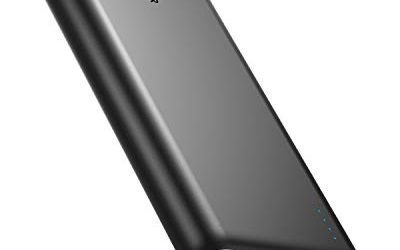
Anker Nano Power Bank 10K 30W
The Anker Nano is the everyday carry pick in this group, and its built-in USB-C cable is the reason. The cable folds into the shell and doubles as a carry loop, so the bank is ready without a separate lead, and it delivers up to 30W in both directions through the cable or the USB-C port. A 10,000mAh capacity covers a full charge for most Android phones with room to spare, and the bank itself refills to half charge in about 45 minutes at 30W input. At 215 g and just over 4 inches long, it slips into a jacket pocket without dragging it down.
- Specs:
- Battery capacity: 10,000mAh
- Output: 30W max on USB-C cable and USB-C port
- USB-A output: 22.5W max
- Total shared output: 24W max
- Built-in cable: USB-C, doubles as carry loop
- Ports: built-in USB-C cable, USB-C, USB-A
- Weight: 215 g
- Dimensions: 4.09 x 2.06 x 1.02 inches
- Model: A1259
- Best for: daily carry where a built-in cable and 30W charging cover most Android phones.
- Watch out for: the 24W shared total means charging two devices at once is slower than charging one.
INIU Portable Charger 10000mAh 45W
The INIU P41 is the fastest pocket pick in this group, and its 45W USB-C PD output sets it apart from the usual 10,000mAh banks. That wattage charges compatible Android phones noticeably faster than a 30W bank, and the built-in USB-C cable works as a lanyard so the bank is always ready without a separate lead. The 10,000mAh capacity holds a full charge for most Android phones, and the pocket-size body keeps it easy to carry on a commute or a trip. It is the pick for a rider who wants the most speed from the smallest bank in the group.
- Specs:
- Battery capacity: 10,000mAh
- Output: 45W USB-C PD
- Built-in cable: USB-C, doubles as lanyard
- Ports: USB-C, USB-A
- Size: pocket-size
- Best for: Android phones that accept high-wattage USB-C charging and need the fastest top-up.
- Watch out for: the phone must support 45W USB-C PD to use the full speed, or it charges at the phone’s own limit.
Samsung 25W Battery Pack 10000mAh Wireless

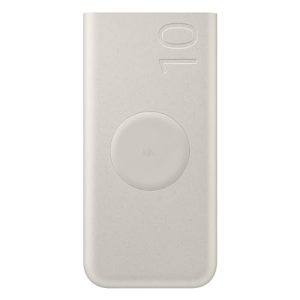
The Samsung battery pack is the versatile pick, because it charges three devices at once: two wired over USB-C and one wireless over Qi. Its 25W wired output matches Samsung Super Fast Charging, so Galaxy phones charge at full speed, and the 7.5W wireless pad tops up earbuds or a phone without a cable. The 10,000mAh capacity covers a full phone charge, the 222 g body fits a jacket pocket, and the pack uses recycled material in its construction. A USB-C to USB-C cable is included in the box, so it works straight out of the package.
- Specs:
- Battery capacity: 10,000mAh
- Wired output: 25W max over 2 USB-C ports
- Wireless output: 7.5W Qi
- Devices at once: up to 3
- Fast-charge standard: USB PD 3.0 PPS
- Weight: 222 g
- Dimensions: 148 x 72 x 16.4 mm
- Included: USB-C to USB-C cable
- Model: EB-U2510
- Best for: Galaxy owners who want wireless charging plus 25W wired charging in one pack.
- Watch out for: the wireless pad charges slowly, so use the wired ports when speed matters.
Which One Fits Your Situation
Daily commuting with a Galaxy phone
A commuter needs a bank that charges fast, fits a pocket, and works without a hunt for cables. The Samsung battery pack suits Galaxy owners: its 25W wired output matches Super Fast Charging, the built-in wireless pad tops up earbuds on the train, and the 222 g body rides easily in a jacket pocket. Keep the included cable in the bag, and recharge the pack overnight so it starts each day full.
Travel days with heavy phone use
Travel days mean navigation, photos, and messaging from morning to night, so the bank must deliver a full charge and refill quickly at a stop. The Anker Nano covers that pattern: its 10,000mAh capacity gives a full charge with room to spare, the built-in cable means no spare lead to forget, and the 30W input refills the bank to half charge in about 45 minutes. Charge the bank whenever a wall outlet appears.
Fast top-ups between meetings
Some days need speed more than capacity, and the INIU P41 is built for that pattern. Its 45W USB-C PD output charges a compatible Android phone far faster than a standard bank, so a short break between meetings adds real charge instead of a trickle. The built-in cable doubles as a lanyard, so the bank hangs ready on a bag strap.
Charging a phone, earbuds, and a watch together
A traveller who carries a phone, earbuds, and a watch needs a bank that handles several devices at once. The Samsung battery pack is the only pick here that charges three devices simultaneously: two wired over USB-C and one wireless over Qi. Put the phone on a wired port for speed, set the earbuds on the wireless pad, and use the second USB-C port for the watch cable.
Common Mistakes
- Buying a bank by capacity alone and ignoring the wattage the phone actually accepts.
- Choosing a bank with only USB-A ports for a phone that charges fastest over USB-C.
- Forgetting a cable when the bank has no built-in lead, then finding the phone dead anyway.
- Expecting the rated capacity to reach the phone, when conversion losses take a real share.
- Leaving the bank empty between trips, so it has nothing to give when the phone runs low.
Frequently Asked Questions
How much capacity do I need in a battery backup for Android?
A 10,000mAh bank covers a full charge for most Android phones with room for a top-up, because conversion losses mean roughly two-thirds of the rated capacity reaches the phone. That is enough for a long day of navigation, photos, and messaging. Choose a larger bank only when the trip lasts several days without a wall outlet.
Why does my Android phone charge slowly from a power bank?
Slow charging means the bank output is lower than the phone accepts, or the cable cannot carry the wattage. Check the USB-C wattage on the bank listing and confirm the phone supports that fast-charge standard, then use a cable rated for the same wattage. A bank that outputs 15W charges a phone that accepts 25W at the lower speed.
Is wireless charging from a power bank worth it?
Wireless charging is worth it for convenience, not speed. A 7.5W wireless pad tops up a phone or earbuds without a cable, which suits a desk, a nightstand, or a train seat. For a fast charge on the move, a wired USB-C connection is far quicker. Choose a bank with both options when the phone supports Qi.
Can a power bank charge a phone and earbuds at the same time?
Most modern banks can charge two or three devices at once, but the total output is shared, so each device charges more slowly than it would alone. The Samsung pack in this guide charges three devices at once, while the Anker and INIU banks handle two. Put the phone on the fastest port when speed matters.
More from Amazon
Programs that pair well with the guide above. Offers and eligibility are set by Amazon and may change.
Free shipping on eligible items, Prime Video and more. Eligible new members can start with a free trial.
Start a Prime free trialAd-free music streaming. Eligible new subscribers can start with a free trial.
Try Music Unlimited freeA Prime membership for ages 18-24 with a trial period. Eligibility is set by Amazon.
See Prime for Young AdultsAudiobooks and podcasts to listen to on the go. Eligible new members can start with a free trial.
Try Audible freeAs an Amazon Associate we earn from qualifying purchases.