Key takeaways
- Canon's EF mount has been around since 1987, which means the used and renewed market is crowded with glass that still fits every EOS DSLR made in the.
Canon’s EF mount has been around since 1987, which means the used and renewed market is crowded with glass that still fits every EOS DSLR made in the last two decades. That is both the appeal and the problem. A shopper typing “best EF lenses” is rarely looking for one perfect answer; they are trying to decide which gap in their bag to fill first: a cheap bright prime, a wide zoom for landscapes, a standard zoom that can carry a whole wedding, or a long zoom for a kid’s soccer game.
This guide is built for DSLR owners who already have an EF-compatible body and want a short, sorted list instead of a hundred near-identical listings. We collapsed duplicate listings of the same lens, kept both genuine Canon glass and two third-party portrait primes, and judged everything strictly from what each listing states. In 2026, with mirrorless bodies dominating new releases, EF lenses are mostly a value play, so the focus here is on which focal range earns its place.
Quick Picks
Our top picks
 Canon EF 50mm f/1.8 STM Lens
- 50 millimeter focal length and maximum aperture of…
- Great for portraits, action, and nighttime photography
- Minimum focusing distance of 1.15 feet (0.35 meter)…
 Canon 17-40mm f/4L EF Ultra Wide Angle
- Focus Adjustment - Inner focusing system with USM
- Closest Focusing Distance - 0.28m / 0.9 foot
- Zoom System - Rotating Type
 Canon EF 16-35mm f/2.8L ll USM Zoom
- 16-35mm ultra-wide-angle zoom lens with f/2.8 maximum aperture
- 3 high-precision aspherical lens elements produce superior image…
- Circular aperture produces natural background blur at wider…
| Product | Key specs | |
|---|---|---|
| Canon EF 50mm f/1.8 STM Lens | 50 millimeter focal length and maximum aperture of… Great for portraits, action, and nighttime photography Minimum focusing distance of 1.15 feet (0.35 meter)… | Check price |
| Canon 17-40mm f/4L EF Ultra Wide Angle | Focus Adjustment - Inner focusing system with USM Closest Focusing Distance - 0.28m / 0.9 foot Zoom System - Rotating Type | Check price |
| Canon EF 16-35mm f/2.8L ll USM Zoom | 16-35mm ultra-wide-angle zoom lens with f/2.8 maximum aperture 3 high-precision aspherical lens elements produce superior image… Circular aperture produces natural background blur at wider… | Check price |
 Canon EF 75-300mm f/4-5.6 III Telephoto Zoom | EF Mount 4.9-foot closest focusing distance Measures 2.8 inches in diameter and 4.8 inches… | Check price |
 Canon 344B006 EF 24-105mm f/4.0 L is | Image stabilised ultrasonic motor (USM) makes for silent… Switch between autofocus and manual operation Comes with 1 year manufacturer's warranty | Check price |
 Canon EF 24-70mm f/2.8L II USM Standard | 24-70mm focal length, 38.4-112mm equivalent focal length on… F2.8 constant maximum aperture 82mm filters, Closest Focusing Distance: 0.38m/1.25 ft. | Check price |
 Canon EF 24-105mm f/4L IS USM Zoom | 24-105mm standard zoom lens with f/4 maximum aperture… 1 Super UD glass element and 3 spherical… Ring-type USM system delivers silent but quick autofocus… | Check price |
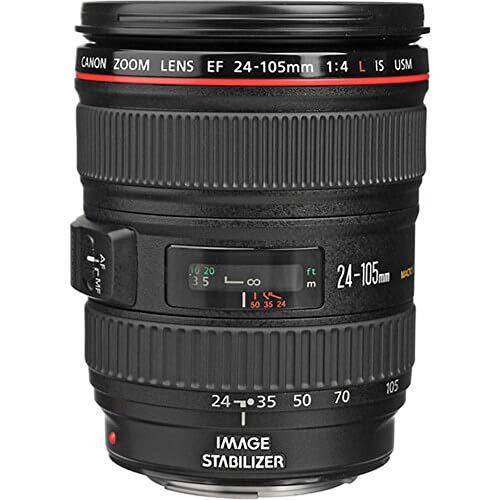 Canon EF 24-105mm f/4 L is USM | 24-105mm standard zoom lens with f/4 maximum aperture… 1 Super UD glass element and 3 aspherical… Ring-type USM system delivers silent but quick autofocus… | Check price |
As an Amazon Associate we earn from qualifying purchases at no extra cost to you.
| Product | Best for | Key spec from the title |
|---|---|---|
| Canon EF 50mm f/1.8 STM | First prime, low light, portraits | f/1.8 aperture, STM motor |
| Canon EF 17-40mm f/4L | Landscapes and architecture | 17-40mm ultra wide zoom, f/4 L |
| Canon EF 16-35mm f/2.8L II USM (Renewed) | Wide-angle work in dim light | f/2.8 constant, USM, renewed |
| Canon EF 75-300mm f/4-5.6 III (Renewed) | Budget telephoto reach | 75-300mm, f/4-5.6, renewed |
| Canon EF 24-105mm f/4L IS USM | One-lens travel and events | 24-105mm, f/4 L, IS USM |
| Canon EF 24-70mm f/2.8L II USM | Professional standard zoom | f/2.8 constant, two aspherical types |
| EF 85mm f1.8 portrait lens (manual focus) | Cheap portrait experiments | 85mm f1.8, MF |
| AF+MF 85mm f1.8 EF-STM portrait lens | Portraits with autofocus | 85mm f1.8, AF+MF, STM motor |
How to Choose
Start with focal length, not brand
Decide what you shoot most. Under 24mm is wide-angle territory for interiors and landscapes, 24-70mm covers everyday and event work, 85mm is the classic portrait length, and 70-300mm is for distant subjects. Remember the crop factor: on a Canon APS-C body, multiply by roughly 1.6, so a 50mm behaves like an 80mm and a 17mm like a 27mm. Buyers on crop bodies who want true wide shots should lean toward 16-35mm or 17-40mm rather than a standard zoom.
Aperture: constant f/2.8 versus f/4
A constant f/2.8 zoom lets in twice the light of an f/4 zoom, which matters indoors or at dusk. An f/1.8 prime gains another stop or more. If you mostly shoot outdoors in daylight, f/4 is perfectly workable and the lenses are usually lighter and cheaper. Variable-aperture telephotos such as f/4-5.6 darken as you zoom, so expect slower shutter speeds at the long end.
Motor and stabilization
Look for USM or STM in the listing. USM generally means fast, quiet focusing, while STM is geared toward smooth, near-silent focus that suits video. IS in the name means optical stabilization, a real help for handheld shots at 100mm and beyond. Manual-focus-only lenses can work for slow, deliberate portraits, but they are a poor fit for moving children or pets.
Condition and packaging
Renewed and bulk-packaged lenses are common in this mount. They can be good value, but confirm the return window, inspect for haze, fungus, and focus accuracy as soon as the box arrives, and do not expect the retail box, hood, or case. Ignore claims of compatibility with long lists of camera models; every EF lens mounts on every EF body. Budget third-party primes usually cut corners on build quality and focus consistency rather than on the optical idea.
The 8 Best Options
Canon EF 50mm f/1.8 STM
This is the lens most DSLR owners add first, and the title explains why: a wide f/1.8 aperture paired with an STM focusing motor, in a Canon-branded lens made for EOS DSLRs. It suits portraits, food, and indoor shots where a kit zoom runs out of light.
- Strength: f/1.8 opens the door to blurred backgrounds and indoor shooting without a flash.
- Strength: STM focusing is designed for smooth operation in stills and video.
- Trade-off: a fixed focal length means walking closer or farther instead of zooming.
Skip it if you need to cover a wide range of framing without moving, or if you primarily shoot landscapes where 50mm is too tight.
Canon EF 17-40mm f/4L
The listing calls this an ultra wide angle lens, and the L designation places it in Canon’s professional line. It spans 17mm to 40mm at a constant f/4, which makes it a straightforward tool for landscapes, real estate, and architecture on full-frame bodies.
- Strength: the 17mm end gives dramatic wide perspectives on full-frame cameras.
- Strength: constant f/4 keeps exposure consistent while zooming.
- Trade-off: f/4 is a stop slower than the f/2.8 wide zoom, limiting low-light use.
Skip it if you shoot astrophotography or dim interiors and need maximum light, or if you want image stabilization, which the title does not list.
Canon EF 16-35mm f/2.8L II USM Zoom (Renewed)
This is the brighter sibling of the 17-40mm: a constant f/2.8 aperture, USM focusing, and a 16-35mm range, sold renewed. For event photographers and landscape shooters who work near sunrise or inside churches and venues, that extra stop is the whole reason to pay more.
- Strength: f/2.8 throughout the range helps with handheld wide shots in low light.
- Strength: USM focusing and L-series positioning aim at professional use.
- Trade-off: renewed condition means the buyer must verify the unit and return terms.
Skip it if you only shoot in daylight, where the cheaper f/4 wide zoom does nearly the same job, or if you want a factory-sealed box.
Canon EF 75-300mm f/4-5.6 III Telephoto Zoom (Renewed)
A long, inexpensive zoom for Canon SLRs, listed as renewed. At 300mm it reaches distant subjects like sports fields, school stages, and backyard wildlife that a kit lens cannot, and it is the entry point into telephoto for many hobbyists.
- Strength: 75-300mm range covers a huge span of distant subjects.
- Strength: a budget way to try telephoto photography on an EOS body.
- Trade-off: the variable f/4-5.6 aperture is slow at the long end, and the title lists no stabilization.
Skip it if you shoot indoor sports or fast action in dim gyms, or if you want a lens built for professional-level sharpness.
Canon EF 24-105mm f/4L IS USM
The most versatile lens on this list. The 24-105mm range handles wide scenes and tight portraits, f/4 stays constant, and the IS USM label means stabilization plus fast focusing. Several listings of this same lens exist, including bulk-packaged versions, so shop condition and packaging carefully.
- Strength: one lens covers landscapes, travel, family events, and portraits.
- Strength: image stabilization helps handheld shots at slower shutter speeds.
- Trade-off: f/4 will not blur backgrounds as strongly as an f/2.8 or f/1.8 lens.
Skip it if you need very bright apertures for dim venues or if you prefer to carry several smaller primes.
Canon EF 24-70mm f/2.8L II USM Standard Zoom
This is the working professional’s standard zoom. The title notes it combines two types of aspherical lenses to reduce spherical aberration, and it keeps a constant f/2.8 with USM focusing. Wedding, event, and portrait shooters tend to keep it on the camera all day.
- Strength: constant f/2.8 across 24-70mm works well in dim halls and for subject separation.
- Strength: aspherical elements are aimed at controlling optical flaws.
- Trade-off: it sits in the premium tier and lacks the longer reach of a 24-105mm.
Skip it if you want stabilization or a longer zoom range, or if your shooting is casual and a lighter lens would be used more often.
EF 85mm f1.8 Portrait Lens (Manual Focus)
A third-party 85mm f1.8 aimed at Canon EOS bodies from the Rebel line up to the 5D Mark IV and 1D X III, as the long compatibility list shows. The title says MF, so you focus by hand. It is a low-cost way to see whether the 85mm portrait look suits you.
- Strength: 85mm at f1.8 is the classic setup for flattering headshots and blurred backgrounds.
- Strength: it fits a wide set of EOS DSLRs.
- Trade-off: manual focus only, so shots of moving subjects will be hit and miss.
Skip it if you want autofocus for kids, pets, or events, or if you depend on camera electronics to confirm focus.
AF+MF 85mm f1.8 Portrait Lens EF-STM
This version of the 85mm f1.8 adds autofocus with an STM motor alongside manual focus, again for a long list of Canon EOS Rebel and full-frame bodies. It is the more practical of the two budget 85mm choices for anyone who does not want to focus by hand.
- Strength: AF+MF operation gives flexibility for both quick shots and careful portraits.
- Strength: STM motor is listed, which suits quiet focusing.
- Trade-off: as a budget third-party lens, focus consistency and build quality may not match Canon’s own L glass.
Skip it if you want a guarantee of reliable autofocus tracking, or if you already own a Canon 85mm.
Which One Fits Your Situation
You are on a tight budget and want better indoor photos
Start with the Canon EF 50mm f/1.8 STM. It is the simplest upgrade over a kit zoom and works for portraits, pets, and dim rooms.
You shoot landscapes or interiors
Choose between the Canon EF 17-40mm f/4L for daylight work and the renewed Canon EF 16-35mm f/2.8L II when you need a brighter aperture near sunrise, sunset, or inside buildings.
You want one lens for travel and family events
The Canon EF 24-105mm f/4L IS USM covers the widest range of everyday framing with stabilization. If you work professionally in low light, the Canon EF 24-70mm f/2.8L II USM is the stronger choice.
You photograph distant action or wildlife on a small budget
The renewed Canon EF 75-300mm f/4-5.6 III gives you reach for the least outlay, with the understanding that low-light and long-end performance are modest.
Common Mistakes
- Ignoring the crop factor and expecting a 17mm lens to be ultra wide on an APS-C body.
- Buying a manual-focus lens for moving subjects and then blaming the camera for missed shots.
- Paying for f/2.8 when most shooting happens in bright daylight where f/4 would do.
- Skipping a condition check on renewed or bulk-packaged lenses before the return window closes.
- Assuming a long compatibility list means better quality; every EF lens fits every EF body.
Related guides
- 3 In 1 Wireless Charging Stations For Iphone Apple Watch Airpods
- How To Tell If A Charger Is Damaging Your Phone Battery
- Rugged Phone Cases For Samsung Galaxy S25 Ultra
Frequently Asked Questions
Do EF lenses work on Canon mirrorless cameras?
They do through Canon’s EF-to-RF adapter, which keeps autofocus and stabilization functions intact. Check the adapter listing for the specific RF body you own before buying.
Is a renewed lens a bad idea?
Not necessarily. Renewed lenses can save a meaningful amount, but you should inspect the glass for haze or scratches and test focus accuracy right away. Make sure a return option exists.
Which EF lens is best for beginners?
The 50mm f/1.8 STM is the usual starting point because it is simple, bright, and affordable. Once you know your favorite framing, move to a wide or standard zoom.
Are the third-party 85mm lenses worth buying?
They are a low-risk way to try portrait photography. Expect compromises in build and focus consistency compared with Canon’s own glass, and pick the AF+MF version if you photograph anything that moves.